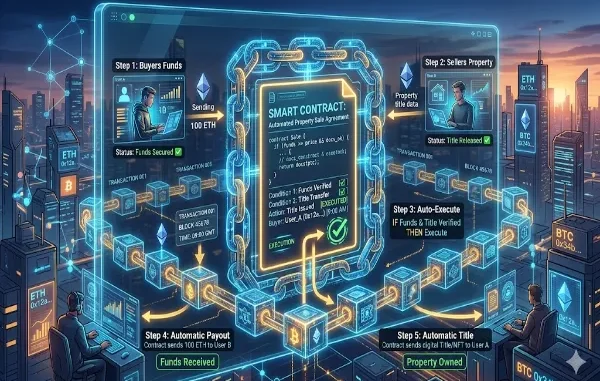
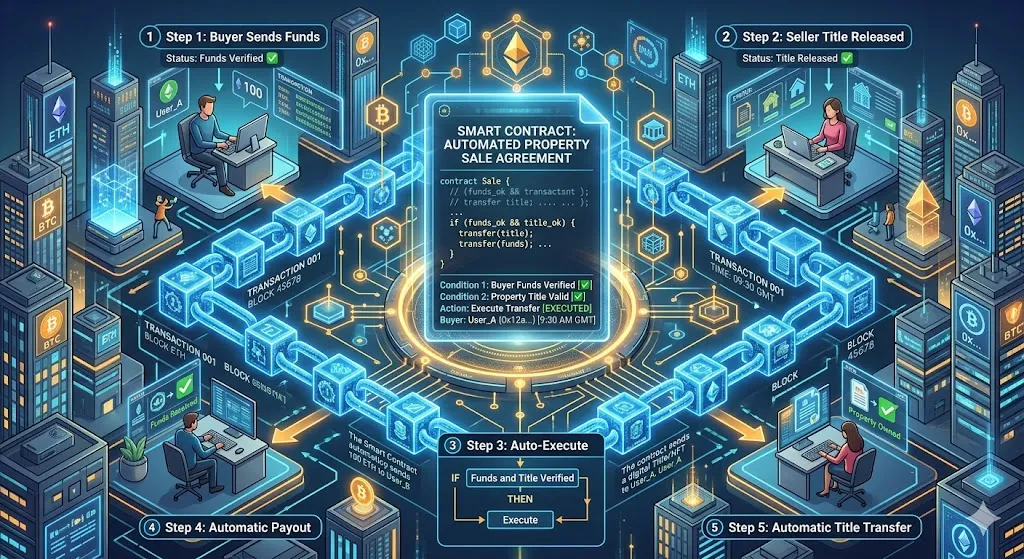
A smart contract is a self-executing program stored on a blockchain that automatically performs an action when specific conditions are met. Smart contracts eliminate the need for intermediaries by using code to enforce agreements and execute transactions.
Smart contracts are one of the most important innovations in blockchain technology. They power decentralized finance (DeFi), NFT marketplaces, blockchain games, token swaps, and countless Web3 applications. Without smart contracts, modern blockchain ecosystems such as Ethereum, Base, Polygon, and BNB Chain would not be possible.
This beginner-friendly guide explains what smart contracts are, how they work, why they matter, and how they are transforming industries far beyond cryptocurrency.
What Is a Smart Contract?
A smart contract is a digital agreement written in computer code and stored on a blockchain network. Instead of relying on a bank, lawyer, broker, or other middleman to enforce an agreement, the smart contract automatically carries out its instructions when predetermined conditions are satisfied.
Think of a smart contract as a vending machine.
With a traditional transaction, a person accepts your money and manually provides the product. With a vending machine, you insert the correct amount, select an item, and the machine automatically delivers it.
Smart contracts work in a similar way:
- Conditions are programmed into the contract.
- Users interact with the contract.
- The blockchain verifies the conditions.
- The contract executes automatically.
No central authority is required. Ethereum popularized smart contracts and remains the largest smart contract ecosystem today.
Why Were Smart Contracts Created?
Traditional agreements often require trusted third parties to verify transactions, enforce contracts, and maintain records.
Examples include:
- Banks processing payments
- Lawyers managing contracts
- Real estate agents handling property transfers
- Brokers facilitating trades
These intermediaries add costs, delays, and potential points of failure.
Smart contracts were created to automate trust through code. Instead of trusting a company or individual, users trust transparent rules stored on the blockchain.
This allows transactions to become:
- Faster
- More transparent
- More efficient
- Less dependent on centralized organizations
How Do Smart Contracts Work?
Smart contracts operate through a simple process.
Step 1: The Rules Are Written
Developers create the smart contract using programming languages designed for blockchain networks.
The contract includes specific conditions and actions.
For example:
“If User A sends 1 ETH, then send 1,000 tokens to User A.”
The instructions cannot be changed without following the contract’s predefined rules.
Step 2: The Contract Is Deployed
Once completed, the smart contract is uploaded to a blockchain network.
After deployment, it receives its own blockchain address and becomes publicly accessible.
Anyone can interact with it according to its programmed rules.
Step 3: Users Interact With the Contract
Users connect their crypto wallets and submit transactions.
Examples include:
- Swapping tokens
- Lending assets
- Purchasing NFTs
- Participating in staking programs
The contract receives the request and evaluates whether all conditions have been met.
Step 4: Automatic Execution
If the conditions are satisfied, the contract automatically executes the action.
No manual approval is required.
The blockchain records the transaction permanently, creating a transparent and immutable record.
Smart Contract Definition Card: Blockchain Immutability
Blockchain immutability refers to the inability to alter or delete transaction records after they have been confirmed and added to the blockchain. This ensures that smart contract activity remains transparent, permanent, and verifiable by anyone.
What Makes Smart Contracts Different From Traditional Contracts?

Traditional contracts rely on legal systems and intermediaries for enforcement.
Smart contracts rely on blockchain code.
Traditional Contract
- Requires human oversight
- Can involve legal disputes
- Often requires intermediaries
- May take days or weeks to execute
Smart Contract
- Executes automatically
- Operates according to code
- Requires no intermediary
- Can settle transactions within minutes
The key difference is automation.
Once deployed, the contract follows its programmed instructions without human intervention.
Real-World Examples of Smart Contracts
Many people use smart contracts without realizing it.
Decentralized Exchanges (DEXs)
Platforms such as Uniswap use smart contracts to allow users to swap cryptocurrencies directly from their wallets.
The smart contract manages:
- Liquidity pools
- Token swaps
- Pricing calculations
- Transaction settlement
No central exchange controls the process.
Lending Platforms
DeFi lending protocols use smart contracts to automate borrowing and lending.
The contract can:
- Accept collateral
- Issue loans
- Calculate interest
- Liquidate risky positions
All without requiring a bank.
NFT Marketplaces
NFT platforms use smart contracts to:
- Verify ownership
- Transfer NFTs
- Process payments
- Distribute creator royalties
The entire transaction occurs automatically on-chain.
Blockchain Gaming
Many blockchain games use smart contracts to manage:
- In-game assets
- Digital ownership
- Rewards
- Marketplace transactions
Players can truly own and trade their digital items.
Smart Contract Definition Card: Gas Fees
Gas fees are transaction costs paid to a blockchain network to execute smart contract operations. They compensate validators for processing transactions and securing the network. More complex smart contract interactions typically require higher gas fees.
Which Blockchains Use Smart Contracts?
Many modern blockchains support smart contracts.
Popular examples include:
- Ethereum
- Base
- Polygon
- Arbitrum
- Avalanche
- BNB Chain
- Solana
Ethereum introduced the concept to a global audience and remains the largest smart contract ecosystem, but many newer networks focus on lower fees and faster transaction speeds.
Benefits of Smart Contracts
Automation
Transactions execute automatically when conditions are met.
Transparency
Contract code and transactions can often be viewed publicly on the blockchain.
Security
Blockchain networks use cryptography to protect data and transactions.
Reduced Costs
Removing intermediaries can lower transaction fees and administrative costs.
Global Accessibility
Anyone with an internet connection and a crypto wallet can interact with smart contracts.
Risks and Limitations of Smart Contracts
Despite their advantages, smart contracts are not perfect.

Coding Errors
A bug in the contract code can create vulnerabilities or unintended outcomes.
Security Exploits
Hackers may discover weaknesses and exploit poorly designed contracts.
Irreversible Transactions
Blockchain transactions generally cannot be reversed once confirmed.
Regulatory Uncertainty
Many governments are still developing regulations around blockchain applications and decentralized finance.
User Mistakes
Sending funds to the wrong address or interacting with malicious contracts can result in permanent loss of assets.
| Feature | Traditional Contract | Smart Contract |
|---|---|---|
| Execution | Requires human oversight | Executes automatically |
| Speed | May take days or weeks | Settles within minutes |
| Intermediaries | Banks, lawyers, or brokers | None (governed by code) |
| Disputes | Handled via legal systems | Prevented via immutable code |
Smart Contract Security Best Practices
Before interacting with any smart contract:
- Verify the website URL.
- Research the project thoroughly.
- Avoid clicking suspicious links.
- Review wallet permissions carefully.
- Revoke unnecessary contract approvals.
- Use a hardware wallet for significant holdings.
- Never share your seed phrase.
Remember that blockchain transactions are often irreversible.
How Ethereum Smart Contracts Changed Blockchain
Before Ethereum, most blockchain networks were primarily designed to record and transfer digital currency. While Bitcoin introduced decentralized peer-to-peer payments, its scripting capabilities were intentionally limited. Ethereum changed the blockchain industry by introducing programmable smart contracts that allowed developers to build decentralized applications directly on the blockchain. This innovation transformed blockchain from a simple payment network into a platform capable of supporting decentralized finance (DeFi), NFT marketplaces, blockchain games, decentralized autonomous organizations (DAOs), and countless Web3 applications. Today, Ethereum’s smart contract model has influenced many other blockchain networks, making programmable blockchain technology a foundation of the modern digital economy.
Famous Smart Contract Hacks
Although smart contracts can automate transactions and reduce reliance on intermediaries, security vulnerabilities have occasionally led to major losses. Some of the most well-known blockchain incidents demonstrate the importance of secure coding practices and thorough audits.
The DAO Hack
The DAO Hack in 2016 remains one of the most significant events in blockchain history. The Decentralized Autonomous Organization (DAO) was an early Ethereum-based investment fund that raised millions of dollars worth of ETH. A vulnerability in its smart contract code allowed an attacker to exploit the system and drain a large portion of the funds. The incident ultimately led to a controversial Ethereum hard fork, which resulted in the creation of Ethereum and Ethereum Classic as separate blockchains.
Ronin Bridge Hack
The Ronin Bridge Hack in 2022 became one of the largest cryptocurrency thefts ever recorded. Attackers compromised validator nodes that secured the bridge connecting the Ronin Network and Ethereum. By gaining control of the network’s validation process, the attackers were able to authorize fraudulent transactions and steal hundreds of millions of dollars in digital assets. The hack highlighted the security risks associated with blockchain bridges and the importance of decentralized network security.
Real Smart Contract Examples
Smart contracts are already used by millions of people every day across various blockchain applications. These automated programs execute transactions without requiring a central authority and help power many of the most popular Web3 services.
Token Swaps
Decentralized exchanges use smart contracts to enable token swaps directly between users. Instead of relying on a traditional exchange to match buyers and sellers, the smart contract automatically processes the trade, calculates exchange rates, and transfers assets between wallets once the transaction conditions are met.
NFT Purchases
When users buy or sell NFTs, smart contracts handle ownership verification, payment processing, and asset transfers. The contract automatically updates blockchain records to show the new owner while ensuring that creators can receive royalties when applicable.

Staking
Many blockchain networks allow users to stake cryptocurrency through smart contracts. These contracts lock digital assets for a specified period, distribute rewards, and manage the staking process automatically. Staking helps secure blockchain networks while providing participants with potential rewards.
DAO Voting
Decentralized Autonomous Organizations (DAOs) rely on smart contracts to facilitate community governance. Members can submit proposals, vote on decisions, and automatically execute approved actions through blockchain-based voting systems. This enables transparent and decentralized decision-making without requiring a central authority.
Smart contracts have become the foundation of decentralized applications and continue to drive innovation across blockchain ecosystems. From token swaps and NFTs to lending and governance, smart contracts enable trustless automation at a global scale.
Frequently Asked Questions (FAQ)
In some jurisdictions, smart contracts may have legal recognition, but laws vary significantly between countries. Smart contracts primarily enforce rules through code rather than traditional legal systems.
Most smart contracts cannot be modified after deployment unless developers specifically build upgrade mechanisms into the contract.
A properly decentralized smart contract operates according to its code and is not controlled by a single person after deployment.
Smart contracts can be very secure, but poorly written code or security vulnerabilities can create risks. Audited contracts are generally considered safer than unaudited ones.
Yes. Most blockchain networks require users to pay transaction fees using the network’s native cryptocurrency when interacting with smart contracts.
Key Takeaways
- Smart contracts are self-executing programs that run on blockchains.
- They automatically perform actions when predefined conditions are met.
- Smart contracts eliminate many traditional intermediaries.
- They power DeFi, NFT marketplaces, blockchain gaming, and Web3 applications.
- Ethereum popularized smart contracts, but many blockchain networks now support them.
- Gas fees are required to execute smart contract transactions.
- Smart contracts offer transparency, automation, and efficiency.
- Users should always verify projects and understand risks before interacting with smart contracts.
Final Thoughts
Smart contracts are the technology that transformed blockchain from a simple payment system into a programmable financial and digital infrastructure. They enable decentralized applications, automate complex transactions, and allow people around the world to interact without relying on traditional intermediaries.
As Web3 continues to grow, understanding how smart contracts work will become increasingly important for anyone exploring cryptocurrency, decentralized finance, NFTs, blockchain gaming, or the broader digital economy.
Disclaimer
This article is for educational and informational purposes only and should not be considered financial, investment, legal, or tax advice. Smart contracts, cryptocurrencies, and blockchain applications involve risk, including potential loss of funds due to coding errors, security vulnerabilities, market volatility, or user mistakes. Always conduct your own research before interacting with any blockchain application or smart contract.
About the Author:
Ana Milojevic is a crypto writer and the creator of basedmoondog.com. She writes in-depth guides on Web3, DeFi liquidity, and AI trading technologies, including insights on MoonDog AI. When she isn’t breaking down complex crypto mechanics, she is tracking market trends across decentralized ecosystems.
Leave a Reply