
Blockchain is the foundational technology behind cryptocurrencies like Bitcoin and Ethereum, but its use goes far beyond digital money. At its core, a blockchain is a shared digital record system that allows multiple participants to store, verify, and update information without relying on a central authority. Instead of a single company or institution controlling the data, the blockchain is maintained by a distributed network of computers around the world.
To understand why this matters, imagine a database that no one can secretly alter, delete, or manipulate. Every update is recorded permanently, and everyone in the network can verify it independently. This is what makes blockchain so powerful: it replaces trust in institutions with trust in mathematics and decentralized consensus.
Why Blockchain Was Created
Before blockchain technology existed, digital systems relied heavily on intermediaries. Banks, payment processors, and centralized servers were responsible for keeping records accurate. While this system worked, it had several limitations:
- Users had to trust a central authority
- Data could be altered or censored
- Systems were vulnerable to hacking or failure
- Cross-border transactions were slow and expensive
Blockchain was designed to solve these problems by removing the need for a single controlling entity. Instead, it distributes responsibility across many independent participants, making the system more transparent and harder to manipulate.
How a Blockchain Works (Simple Explanation)
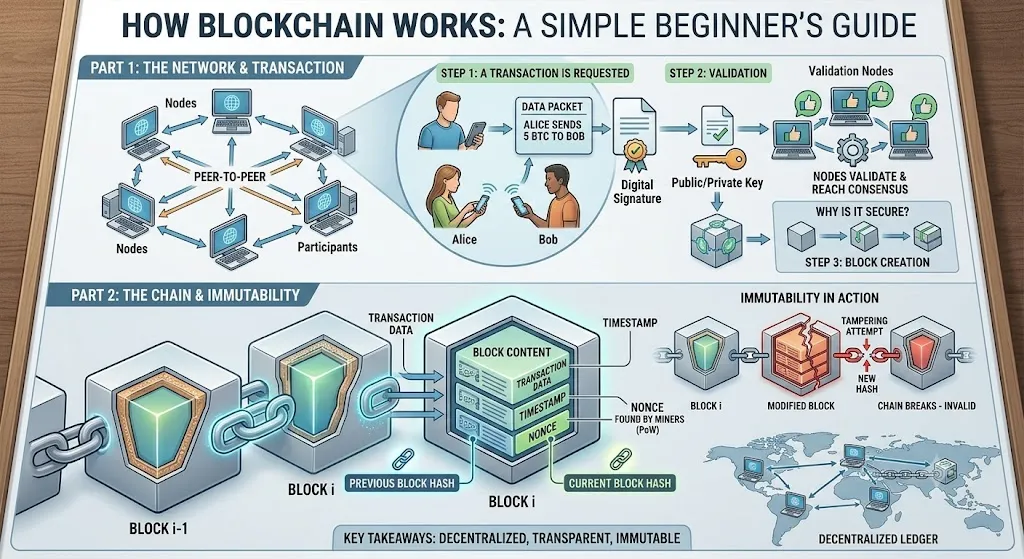
A blockchain is essentially a chain of digital “blocks.” Each block contains a group of verified transactions or data entries. Once a block is filled, it is added to the chain in chronological order.
Think of it like a digital notebook:
- Each page = a block
- Each line = a transaction
- The notebook = the blockchain
Once a page is written and added, it cannot be edited. Instead, new pages are continuously added to the end.
This creates a permanent and transparent history of all activity on the network.
Step 1: A Transaction Is Created
Everything begins when a user initiates a transaction. This could be:
- Sending cryptocurrency to another wallet
- Swapping tokens on a decentralized exchange
- Interacting with a smart contract
- Recording data on the blockchain
For example, if Alice sends Bitcoin to Bob, that transaction is broadcast to the network.
Step 2: The Transaction Is Broadcast to the Network
Instead of going to a bank for approval, the transaction is sent to a decentralized network of computers known as nodes.
These nodes are independent participants that maintain copies of the blockchain and help verify new data.
At this stage, the transaction is not yet confirmed—it is waiting to be validated.
Step 3: Nodes Verify the Transaction
Nodes check whether the transaction is valid. They confirm things like:
- Does Alice actually have enough funds?
- Is the digital signature correct?
- Has this coin already been spent?
This process ensures that only legitimate transactions are added to the system.
Step 4: Transactions Are Grouped Into a Block
Once verified, multiple transactions are grouped together into a “block.”
This block contains:
- A list of transactions
- A timestamp
- A reference to the previous block
- A unique cryptographic identifier (hash)
The reference to the previous block is what forms the “chain.”
Step 5: Consensus Confirms the Block
Before a block is permanently added, the network must agree that it is valid. This process is called consensus.
Different blockchains use different methods, but the most common are:
Proof of Work (PoW)
Used by Bitcoin, this system requires miners to solve complex computational puzzles to validate blocks. This is explained in detail in our guide on cryptocurrency mining, where computing power is used to secure the network.
Proof of Stake (PoS)
Used by newer networks, this system selects validators based on how much cryptocurrency they lock up as collateral.
Both systems aim to achieve the same goal: ensuring the network agrees on a single version of truth.
Step 6: The Block Is Added to the Blockchain
Once consensus is reached, the new block is permanently added to the chain. At this point:
- The transaction becomes confirmed
- The record is publicly visible
- It cannot be changed or deleted
This is what makes blockchain technology “immutable.”
What Makes Blockchain Secure?

Blockchain security comes from a combination of cryptography and decentralization.
1. Cryptographic Hashing
Each block contains a unique digital fingerprint called a hash. If any data inside the block is changed, the hash changes completely, immediately revealing tampering.
2. Decentralization
Because thousands of computers maintain the network, there is no single point of failure. To alter the blockchain, an attacker would need to control the majority of the network, which is extremely expensive and difficult.
3. Chain Structure
Each block is linked to the previous one. Changing a single block would require rewriting every subsequent block, making fraud practically impossible on large networks.
What Blockchain Is Used For
Although blockchain is best known for cryptocurrency, its applications are expanding rapidly.
1. Cryptocurrency Transactions
Bitcoin, Ethereum, and other digital assets rely on blockchain to record ownership and transfers.
2. DeFi (Decentralized Finance)
Blockchain enables financial systems without banks. Users can lend, borrow, and trade directly through smart contracts. This is the foundation of DeFi ecosystems.
3. Web3 Trading
In Web3 environments, users interact directly with blockchain-based markets. Trading happens through decentralized exchanges where smart contracts handle execution instead of intermediaries.
4. NFT Ownership
Blockchain verifies ownership of digital assets like art, collectibles, and in-game items.
5. Supply Chain Tracking
Companies use blockchain to track goods from production to delivery, improving transparency and reducing fraud.
Blockchain vs Traditional Databases
To understand blockchain better, it helps to compare it with traditional systems:
| Feature | Traditional Database | Blockchain |
|---|---|---|
| Control | Central authority | Decentralized network |
| Data changes | Can be edited | Immutable |
| Transparency | Limited | Fully transparent |
| Trust model | Institution-based | Mathematics-based |
The key difference is control. Blockchain removes the need to trust a single organization.
Limitations of Blockchain
Despite its advantages, blockchain is not perfect:
- Transactions can be slower than centralized systems
- Some networks consume high energy (especially Proof of Work systems)
- Data storage is limited and expensive
- User experience can be complex for beginners
These challenges are actively being solved through new innovations like Layer 2 networks (for example, Base) and improved consensus mechanisms.
Why Blockchain Matters for the Future
Blockchain is more than a cryptocurrency technology—it is a new way of organizing digital trust.
It allows systems to operate without centralized control while maintaining transparency, security, and global accessibility. As more industries adopt blockchain, its role in finance, data systems, and digital ownership will continue to grow.
This is why understanding blockchain is essential before exploring advanced topics like:
- Cryptocurrency mining
- DeFi platforms
- Web3 trading systems
- AI-powered trading tools like MoonDog AI rely on real-time ledger data
Each of these systems is built on the same foundation: blockchain infrastructure.
Internal Connection to Advanced Topics
If you want to go deeper into how blockchain is used in real systems, explore:
- Cryptocurrency Mining: How networks stay secure and transactions are validated
- What Is DeFi: How financial systems run without banks
- Web3 Trading Guide: How blockchain enables decentralized markets
- Base Network Guide: How Layer 2 scaling improves blockchain performance
Final Thoughts
Blockchain is the backbone of the modern decentralized internet. It replaces centralized control with distributed verification, creating systems that are transparent, secure, and resistant to manipulation.
While the technology can seem complex at first, its core idea is simple: a shared digital record that everyone can trust without needing to trust each other.
As blockchain continues to evolve, it will remain the foundation for cryptocurrencies, decentralized finance, Web3 applications, and the next generation of digital systems.
Frequently Asked Questions
A: A blockchain is a shared, digital notebook that records information across a global network of computers rather than a single central server. Once information is added to this notebook, it becomes permanent and cannot be deleted or altered, making it highly secure and transparent.
A: Traditional databases are controlled by a single central authority, making them vulnerable to hacking, censorship, or failure. Blockchain achieves security through decentralization (thousands of computers must agree on updates) and cryptographic hashing, which immediately exposes any attempt to tamper with the data.
A: Both are consensus mechanisms used to validate data on a blockchain. Proof of Work requires network participants (miners) to solve complex computational puzzles using hardware power. Proof of Stake selects validators based on the amount of cryptocurrency they lock up as collateral, making it a much more energy-efficient alternative.
A: No. While blockchain is the foundational infrastructure for cryptocurrencies like Bitcoin, its applications extend to Decentralized Finance (DeFi), tracking global supply chains, verifying digital ownership through NFTs, and secure decentralized trading ecosystems.
A: Currently, major blockchains face challenges with slower transaction speeds compared to centralized networks, high energy consumption (for older Proof of Work systems), high data storage costs, and a complex user experience for beginners. Modern innovations like Layer 2 networks are actively working to solve these scaling issues.
About the Author:
Ana Milojevic is a crypto writer and the creator of basedmoondog.com. She writes in-depth guides on Web3, DeFi liquidity, and AI trading technologies, including insights on MoonDog AI. When she isn’t breaking down complex crypto mechanics, she is tracking market trends across decentralized ecosystems.
Leave a Reply