
MoonDog AI differs from most AI meme coins by offering a utility-focused AI trading platform, multi-function tokenomics, and a Base Network ecosystem rather than relying solely on hype and speculation.
The AI meme coin market has exploded into one of the most crowded corners of cryptocurrency. At last count, CoinMarketCap lists hundreds of AI-themed tokens, and more are being created weekly. For every serious project attempting to fuse artificial intelligence with real blockchain utility, there are dozens of near-identical tokens dressed up with a robot mascot and a one-page website. In a market this saturated with imitation, the question of genuine differentiation matters enormously.
So where does MoonDog AI (MDOGAI) fit in? Is it just another entry in a long list of AI-flavored meme coins riding a dual narrative? Or does it offer something meaningfully different from the Fartcoins, GOATs, Turbos, and AIXBT clones that have defined this category since late 2024?
This article answers that question directly. It examines how MoonDog AI differs from the rest of the AI meme coin space across six key dimensions: the nature of its AI integration, the platform it is built to serve, its tokenomics design, its blockchain choice, its community model, and the honesty of its positioning. It also acknowledges where MoonDog AI shares risks with its peers, because a fair comparison requires both sides of the ledger.
This is not investment advice. It is an analytical comparison designed to help you think clearly about a crowded and high-risk category.
Understanding AI Meme Coins
Before examining what makes MoonDog AI different, it is worth understanding what most AI meme coins actually are.
The category emerged with force in late 2024, when Goatseus Maximus (GOAT) surged from a niche joke to a billion-dollar market cap, driven by its association with an autonomous AI agent called Truth Terminal. The success of GOAT created a template that dozens of projects scrambled to copy: find a connection — however loose — to artificial intelligence, package it in meme-friendly branding, launch on a high-speed chain, and hope the dual narrative of AI plus meme culture ignites a speculative frenzy.
What followed was predictable. Projects like Fartcoin built billion-dollar valuations on absurdist AI-adjacent humour, proving that attention and entertainment value alone could move markets in a speculative environment. Turbo launched as the first token reportedly created by an AI directly. MIND of Pepe marketed itself as a social media-scanning AI trading assistant. KIBSHI claimed the historical distinction of being the first AI-generated meme coin, created in December 2022 days after ChatGPT launched publicly.
Most of these projects share a common thread: the AI is more narrative than infrastructure. The AI component inspired the token’s name, origin story, or marketing, but it does not deliver a tangible product to the token holder. As multiple industry analysts have noted, many AI meme coins have “limited real-world utility, even if they were AI-developed,” existing primarily as speculative assets that reflect internet culture rather than platforms with measurable output.
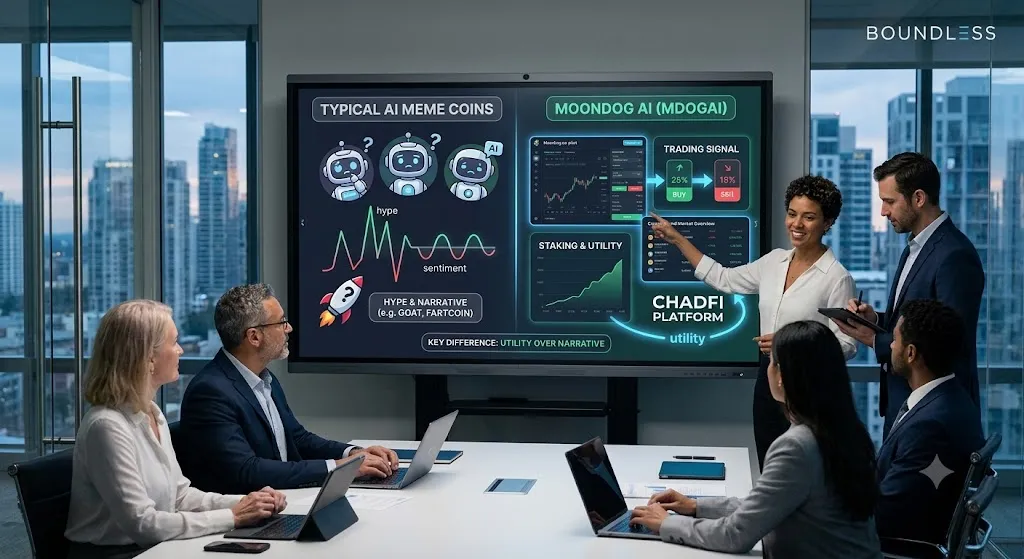
This is where MoonDog AI steps. The question is whether it steps in differently.
Difference One: The AI Is a Product, Not Just a Story
The most fundamental difference between MoonDog AI and the majority of AI meme coins is the nature of the artificial intelligence at the project’s centre.
In most AI meme coins, the AI is a founding story. Truth Terminal influenced the birth of GOAT and Fartcoin, but Truth Terminal is not a tool that GOAT or Fartcoin holders use. It is an origin myth. The AI gave the project its narrative and, through that narrative, its community and price action. Once launched, the token’s value is driven by social momentum, meme velocity, and speculative sentiment — not by any AI product the holder can interact with.
MoonDog AI is structured differently. The token’s core purpose is to gate access to an actual AI product: the MoonDog co-pilot, a trading assistant built into the ChadFi platform. This AI co-pilot is designed to deliver real-time market analysis, identify high-probability trading setups, and provide personalised trading recommendations to individual users.
This distinction is significant. It means the AI is not a story that created the token — it is the reason the token has demand. Holders of MDOGAI are not holding a narrative. They are holding access rights to a software product that is designed to improve their trading results. The token and the AI are functionally inseparable. Remove the token and you lose access to the platform. Remove the platform and the token loses its utility case entirely.
Whether the AI product itself is excellent, mediocre, or still maturing is a separate question. The structural difference is what matters here. MoonDog AI positions its token as a subscription mechanism to a working tool, not a cultural artefact from a viral AI experiment.
Difference Two: The Platform Has a Defined Problem to Solve
A recurring weakness in the AI meme coin category is the absence of a clear problem being solved. Fartcoin solves no problem. It is entertainment. GOAT exists as a cultural phenomenon. Turbo was created as an experiment. These are legitimate reasons for tokens to exist in a speculative market, but they are not platforms — they do not have users, churn metrics, product roadmaps, or value propositions beyond community and narrative.
ChadFi, the platform that MDOGAI is built to power, starts from a different premise entirely. It identifies three concrete pain points that active cryptocurrency traders experience and builds its product architecture around solving them.
The first pain point is information overload. Crypto traders following multiple markets, chains, social channels, and technical indicators simultaneously face an overwhelming amount of data. Signal is buried in noise, and the faster the market moves, the harder it becomes to extract meaningful analysis from the torrent of information. MoonDog’s AI co-pilot is designed to address this by consolidating analysis into a single, actionable interface.
The second pain point is security. Managing assets across multiple wallets, protocols, and platforms exposes traders to a range of security vulnerabilities. ChadFi positions itself as a more secure, integrated environment for managing trading activity.
The third pain point is time. Active trading is extraordinarily time-consuming. Even skilled traders often cannot monitor the markets with the consistency required to catch every high-probability setup. An AI assistant that works continuously and surfaces opportunities at any hour is a genuine value proposition for the working trader who cannot be at a screen around the clock.
This problem-solution framing separates MoonDog AI from most of its AI meme coin peers at a conceptual level. The project is designed as a product business, not a cultural experiment. Whether it succeeds as a product business depends on execution — but the intent and architecture are meaningfully different from a token born from an AI chatbot’s Twitter output.
Difference Three: Tokenomics Designed for Utility, Not Just Speculation
Compare the tokenomics model of MoonDog AI against the typical AI meme coin and another structural difference emerges.
Most viral AI meme coins launched via platforms like Pump.fun on Solana have extremely simple tokenomics: a fixed supply, immediate full circulation, and no utility mechanism beyond speculative trading. The token exists to be bought and sold. There are no staking contracts, no access tiers, no governance functions, no fee discount systems. The token’s only economic role is as a vehicle for speculative returns.
MDOGAI carries a more developed utility layer within its tokenomics. Holding the token unlocks access to the MoonDog AI co-pilot features on ChadFi, creating organic buy-side demand from platform users rather than purely from speculators. Staking mechanisms reward long-term holders with passive returns, reducing liquid supply and encouraging conviction over short-term trading. Governance rights give token holders input into platform decisions. Fee discount mechanics create economic incentives to hold MDOGAI rather than convert it to other assets between trades.
This multi-function tokenomics design attempts to create demand vectors that are independent of market sentiment. In theory, even in a flat or declining market, platform users who need access to the AI tools have reason to hold MDOGAI. This is categorically different from a pure meme token, where the only demand is speculative.
In practice, the strength of this model depends on how many people are actively using the ChadFi platform. Utility demand only materialises when there are users who value the utility enough to acquire and hold tokens to access it. At its current stage of development, MoonDog AI is still building toward the scale required to demonstrate that utility demand is a meaningful component of its price support.
What matters for the comparison is the design intent: MDOGAI was built with a utility-demand model in mind. Most AI meme coins were not.
Difference Four: Built on Base, Not the Meme Coin Default Chains
Where a token launches is not a trivial detail. Blockchain choice shapes the community a project attracts, the trading infrastructure available to it, the security model it operates under, and the long-term ecosystem it is aligned with.
The majority of AI meme coins launched during the 2024 and 2025 cycles were built on Solana. This was a natural choice: Solana offers fast finality, low transaction costs, and a vibrant meme coin ecosystem anchored by launchpad platforms like Pump.fun. GOAT, Fartcoin, Turbo, and dozens of their imitators are all Solana-native.
MoonDog AI was built on Base Network, Coinbase’s Ethereum Layer 2 network. This is a deliberate differentiation. Base inherits Ethereum’s security model and its established developer ecosystem, while offering significantly lower transaction costs than Ethereum mainnet. Crucially, Base is associated with a more institutionally credible infrastructure compared to Solana’s meme-heavy culture.
The choice of Base also reflects where the broader DeFi and trading infrastructure is maturing. Serious trading platforms — the kind that attract active, sophisticated traders rather than pure speculators — tend to gravitate toward Ethereum-aligned ecosystems. For a project positioning itself as a professional trading platform with AI capabilities, building on Base signals a different audience than building on a Pump.fun-dominated chain.
It also places MDOGAI alongside AIXBT, one of the few AI tokens with a genuine utility reputation, which also operates on Base. The Base network is becoming associated with AI trading tools in a way that Solana’s ecosystem is associated with meme-first speculation.
None of this makes Base Network inherently superior to Solana for every use case. But for a project like ChadFi that is trying to attract serious traders, the alignment is meaningful.
Difference Five: The MoonPack — Community With a Purpose
Every meme coin lives or dies on community energy. Community is the mechanism through which meme coins achieve virality, sustain price action during downturns, and attract new holders. This much MoonDog AI shares with every other token in the AI meme category.
What differs is the framing of the community itself. Most AI meme coin communities are united by a shared narrative — they are believers in the GOAT lore, participants in the Fartcoin phenomenon, holders of the first AI-created token. The community identity is built around the cultural story of the token.
MoonDog AI’s community, referred to as the MoonPack, is framed around a shared goal: trading better. The identity is not “we hold a funny AI dog coin.” It is “we are traders who use AI to make better decisions and who hold MDOGAI to access those tools.” This is a subtly but meaningfully different community proposition. It attracts a different kind of participant — someone motivated by trading outcomes, not just by speculative excitement.
This community framing has important implications for retention. Meme coin communities tend to be volatile in their loyalty. When price momentum reverses, the narrative that held the community together dissolves, and holders exit. A community built around a shared goal — improving trading performance — has a more durable reason to remain engaged even when price action is unfavourable, because the utility of the platform exists independent of the token price.
Whether the MoonPack has successfully built this kind of durable, purpose-driven community at scale is an open question. What is clear is that the attempt to build a community around platform utility rather than pure narrative entertainment is another genuine differentiator.
Difference Six: Honest Positioning in an Exaggerated Category
One of the most exhausting features of the AI meme coin space is the tendency toward exaggerated claims. Projects routinely promise to revolutionise finance, eliminate trading losses, deploy superintelligent algorithms, and deliver guaranteed returns — all while offering no verifiable evidence of any AI capability at all. The category is rife with projects that use the word “AI” as pure marketing decoration.
MoonDog AI’s positioning, while clearly promotional, is grounded in a more realistic framing. The project does not claim that the MoonDog co-pilot will make traders infallible or guarantee profits. It positions the AI as an assistant — a co-pilot — that helps traders manage information overload, identify setups, and make more informed decisions. The language is functional rather than messianic.
This matters because positioning shapes community expectations, and community expectations shape how a project weathers setbacks. Projects that have overpromised and underdelivered tend to experience catastrophic community collapse when reality does not match the hype. Projects that have set realistic expectations tend to retain more holder confidence even when the development journey is slower or bumpier than anticipated.
For a micro-cap project navigating an early stage of development, honest positioning is not just an ethical choice — it is a strategic one.
Where MoonDog AI Is the Same as Every Other AI Meme Coin
Intellectual honesty requires acknowledging the ways in which MoonDog AI is not different from its peers, and the risks that make it similar to any other speculative micro-cap token.
MoonDog AI is still deeply speculative. At its current market cap — which has ranged widely from thousands of dollars to low millions depending on market conditions and the source consulted — it is a micro-cap token with thin liquidity and extreme price volatility. It has already retraced more than 90% from its all-time high. Anyone who bought near the peak in early 2025 has experienced devastating losses.
It still relies partly on meme energy. The dog mascot, the tongue-in-cheek name, the community culture — these elements are not incidental. They are part of how MoonDog AI attracts attention in a market where attention is the first requirement for any kind of traction. The AI meme coin category rewards virality, and MoonDog AI competes for that virality like every other project in the space.
It still has unproven platform scale. The distinction between MoonDog AI’s utility model and pure-meme coins only becomes meaningful at scale. Right now, the ChadFi platform is early stage. There is no publicly verified data on active user counts, platform revenue, or trade volumes processed through the AI co-pilot. The utility thesis is structurally sound, but it remains a thesis until demonstrated by user adoption.
The smart contract and technical risks are the same. Operating on Base with Uniswap liquidity means the same categories of smart contract vulnerability, liquidity manipulation, and rug-pull risk that apply to any DeFi token apply here.
The regulatory environment is the same. AI and crypto face evolving regulatory scrutiny globally, and no small project is immune to the impact of jurisdictional changes in how these assets are classified.
The Central Question: Does Differentiation Translate to Durability?
The category comparison above establishes that MoonDog AI is structurally different from most AI meme coins in meaningful ways: it has a working product premise, a defined problem to solve, a multi-function tokenomics model, a thoughtfully chosen blockchain, a purpose-driven community, and realistic positioning.
But structural differentiation and market success are not the same thing. The cryptocurrency market in 2025 and 2026 has repeatedly demonstrated that utility does not guarantee price performance. Projects with excellent technology and genuine use cases have seen their tokens collapse alongside speculative tokens during broad market downturns. Meanwhile, tokens with no utility at all — pure meme assets — have occasionally outperformed utility tokens by enormous margins simply because their narrative generated more viral attention.
The honest answer to the question in this article’s title is this: MoonDog AI is meaningfully different from the typical AI meme coin in its design philosophy, its product orientation, and its tokenomics architecture. It is not meaningfully different in its risk profile as a speculative micro-cap investment. Both the genuine differentiators and the genuine similarities deserve to be held in mind simultaneously.
For investors who are interested in the AI trading tool narrative and who want exposure to it through a token with functional utility design rather than a purely speculative meme play, MoonDog AI occupies a distinct position. For investors who are primarily seeking short-term speculative returns in the AI meme coin category, the liquidity, volatility, and early-stage risk profile of MDOGAI mean it must be evaluated against every other option in the space on its own merits.
A Summary of the Key Differences
Here are the core differentiators discussed in this article.
AI Role: In most AI meme coins (GOAT, FARTCOIN, TURBO), AI is the founding narrative. In MoonDog AI, AI is the product being delivered to users.
Platform Purpose: Most AI meme coins have no platform — the token is the product. MoonDog AI’s token powers access to the ChadFi trading platform with defined utility.
Tokenomics Utility: Pure meme tokens have single-function tokenomics (buy and sell). MDOGAI has multi-function tokenomics: platform access, staking, governance, and fee discounts.
Blockchain: Most AI meme coins launched on Solana via Pump.fun. MDOGAI launched on Base, aligning with Ethereum’s infrastructure and institutional credibility.
Community Framing: AI meme coin communities are built around narrative and culture. The MoonPack is framed around a shared trading improvement goal.
Problem Solved: Most AI meme coins solve no problem; they are entertainment. ChadFi targets three specific trader pain points: information overload, security, and time.
| Feature Component | Typical AI Meme Coins (e.g., GOAT, Fartcoin) | MoonDog AI ($MDOGAI) |
|---|---|---|
| Primary AI Role | Marketing narrative, origin lore, or autonomous chatbot. | Subscribed trading software utility (AI Co-Pilot). |
| Blockchain Network | Solana (Pump.fun default ecosystem). | Ethereum Layer-2 (Base Network). |
| Tokenomics Model | Purely speculative; single-function (buy/sell). | Multi-function (staking, platform access, fee discounts). |
| Primary Utility | Entertainment, viral attention, and community culture. | Solves trader info overload, asset security, and timing gaps. |
| Community Focus | Speculative hype and cultural memes. | The MoonPack: Focus on improving trading outcomes. |
Conclusion
The AI meme coin category is one of the most active, most speculative, and most imitation-heavy niches in all of cryptocurrency. For every genuine project attempting to build something durable at the intersection of artificial intelligence and blockchain, there are many more riding the narrative without the substance to support it.
MoonDog AI is not a flawless project. It is a micro-cap token with real price risk, thin liquidity, an early-stage platform, and a development journey that is far from complete. Anyone approaching MDOGAI as a safe or stable investment is misreading the asset entirely.
But within the context of its category, MoonDog AI offers a set of characteristics that most of its peers do not: a product that the token unlocks, a platform designed to solve specific trader problems, a tokenomics model built around multiple demand sources, and a community identity grounded in shared purpose rather than pure narrative excitement.
In a category where differentiation is rare and imitation is the norm, those characteristics are worth understanding clearly — whether you ultimately decide to invest or not.
Disclaimer: This article is for informational and educational purposes only. It does not constitute financial or investment advice. Cryptocurrency investments carry a high degree of risk, including the potential loss of all capital invested. Always conduct your own independent research and consult a qualified financial adviser before making investment decisions.
Key takeaway: MoonDog AI uses AI as a functional product, while most AI meme coins use AI primarily as a marketing narrative.
Quick Q&A: MoonDog AI
A: Unlike most meme coins that use AI strictly as a marketing narrative, MoonDog AI is designed as a functional utility token. It provides access to an actual software product—the MoonDog AI co-pilot—built to solve specific trader pain points like information overload and timing gaps.
A: MoonDog AI operates on the Base Network (an Ethereum Layer-2). This is a deliberate strategic choice to align with institutional-grade infrastructure and professional DeFi ecosystems, as opposed to the meme-heavy culture often found on Solana-based launchpads.
A: No. As a speculative micro-cap asset, it carries significant risk, including high price volatility and thin liquidity. It should not be considered a stable investment, and investors should perform their own research before participating.
Research and Sources
Research for this article drew on publicly available data and platform information from CoinGecko, Coinbase, MEXC, LBank, CoinCodex, Blockworks, Phantom Wallet, FX Empire, and MarketCapOf for MoonDog AI price history, tokenomics, supply data, and project descriptions. AI meme coin category analysis and competitor comparisons referenced publicly available editorial content from CryptoNews, KuCoin Blog, BitDegree, 99Bitcoins, CryptoSlate, CoinMarketCap, Cryptonomist, and AInvest. All market data was gathered in June 2026. Cryptocurrency prices and metrics change in real time — always verify current figures directly before making any financial decisions.
About the Author:
Ana Milojevic is a crypto writer and the creator of basedmoondog.com. She writes in-depth guides on Web3, DeFi liquidity, and AI trading technologies, including insights on MoonDog AI. When she isn’t breaking down complex crypto mechanics, she is tracking market trends across decentralized ecosystems.
Leave a Reply