
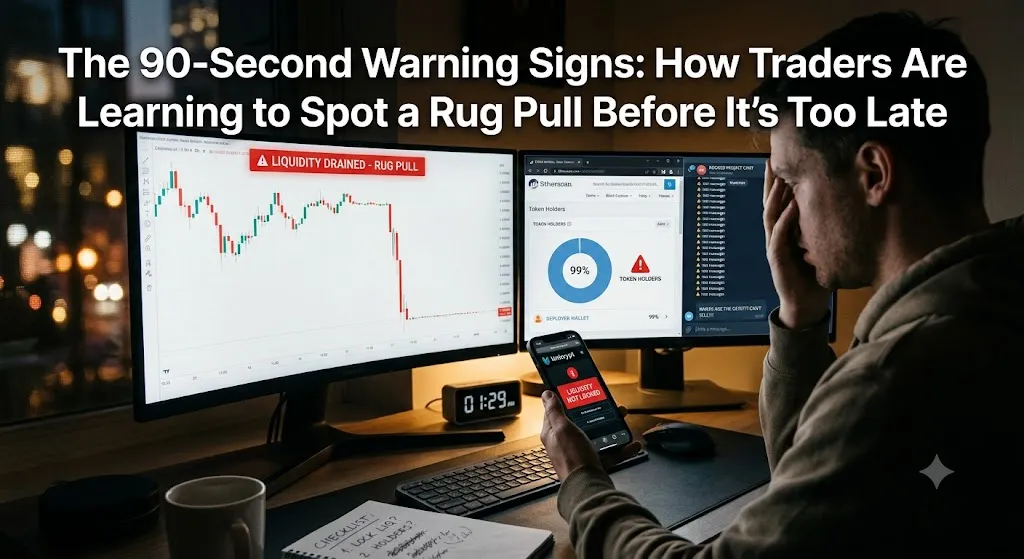
By the time most people hear about a rug pull, it’s already over. The chart has flatlined into a jagged line resembling a cliff edge, the project’s social media accounts have gone dark, and a Telegram group that was buzzing with hype an hour earlier has turned into a wall of angry messages nobody is answering. What’s left behind is usually a token that technically still exists, but that nobody can sell for anything close to what they paid.
Ask around in crypto trading circles, though, and a different picture starts to emerge: a growing number of traders who say they can spot the warning signs within minutes of a token launching, sometimes before a single red candle appears on the chart. Their method isn’t luck or intuition. It’s a checklist, built from watching the same scam play out hundreds of times with only minor variations.
This is that checklist.
What a Rug Pull Actually Is
Before getting into the warning signs, it’s worth being precise about what a rug pull actually is, because the term gets used loosely.
A rug pull happens when the creator of a token, who controls the liquidity pool or the underlying smart contract, drains the funds that give the token its trading value, walks away with the money, and leaves everyone else holding a token that can no longer be sold at any meaningful price. In decentralized finance, this is possible because anyone can create a token and its trading pool without any verification, identity check, or third-party oversight. The same openness that makes meme coins easy to launch is exactly what makes them easy to exploit.
Not every meme coin that crashes is a rug pull. Plenty of tokens simply lose momentum, get abandoned as hype fades, or decline because the broader market turns bearish. A rug pull is specifically an engineered collapse, where the person in control deliberately removes value that other people paid in.
Red Flag One: Liquidity That Isn’t Actually Locked
In legitimate meme coin projects, the liquidity that backs the token’s trading pair is typically locked using a third-party smart contract for a fixed period, preventing the developer from withdrawing it early. This is one of the first things experienced traders check, usually within minutes of a token appearing.
The catch is that “locked liquidity” claims are easy to fake or exaggerate. Some scam projects claim a lock without actually implementing one. Others use a real lock, but for a suspiciously short period, banking on the fact that most buyers won’t bother checking the expiration date. A newer variation involves developers publicly promising to “extend” a lock as it nears expiration, building a false sense of security, only to let the original lock quietly expire and immediately withdraw everything.
The practical takeaway: don’t take a project’s word for it. Liquidity locks can be verified directly on the blockchain using publicly available lock-checking tools, and it takes less time than reading the project’s Twitter bio.
Red Flag Two: A Handful of Wallets Holding Almost Everything
Every token’s ownership is visible on the blockchain, which means wallet concentration is one of the hardest things for a scam project to hide, even while it fakes everything else.
If a small number of wallets, particularly ones connected to the project’s deployer address, hold a large percentage of the total token supply, that’s a serious warning sign. It means a tiny group of people, potentially just one person operating under multiple wallets, can sell enormous amounts of the token at once, crashing the price and cashing out while everyone else is left holding a token in free fall.
Experienced traders generally look for wide, organic-looking distribution across many unrelated wallets, rather than supply concentrated in a handful of addresses that all funded themselves from the same source, a pattern that’s often visible with just a few minutes of looking at a block explorer.
Red Flag Three: You Can Buy, But You Can’t Sell
This is the one that catches people off guard, because everything looks fine right up until it isn’t. Known as a “honeypot” contract, this scheme doesn’t require the developer to remove liquidity at all. Instead, the smart contract itself is written with hidden restrictions that allow the token to be purchased freely but block or heavily tax anyone attempting to sell it, except for a small list of exempted wallets controlled by the creator.
From the outside, a honeypot token can look like a completely normal, thriving project. The price climbs, the chart looks healthy, and new buyers keep arriving, because none of them have actually tried to sell yet. The warning only becomes visible to someone who either simulates a sell transaction before buying, or checks the contract using a token-scanning tool designed specifically to flag this kind of restriction.
Red Flag Four: An Anonymous Team With No Verifiable History
Anonymity by itself isn’t automatically a red flag in crypto; plenty of legitimate developers, including some behind well-established projects, choose to remain pseudonymous. The difference is what surrounds that anonymity.
Scam projects tend to combine anonymity with an absence of anything else that would allow the community to hold the team accountable: no history of previous projects, no code that’s been reviewed by outside developers, no verifiable presence beyond a Twitter account created days earlier and a Telegram group full of accounts that all joined within the same short window. When a project’s entire public identity can be deleted in five minutes without a trace, that’s worth noticing.
Red Flag Five: Marketing That Outpaces the Product
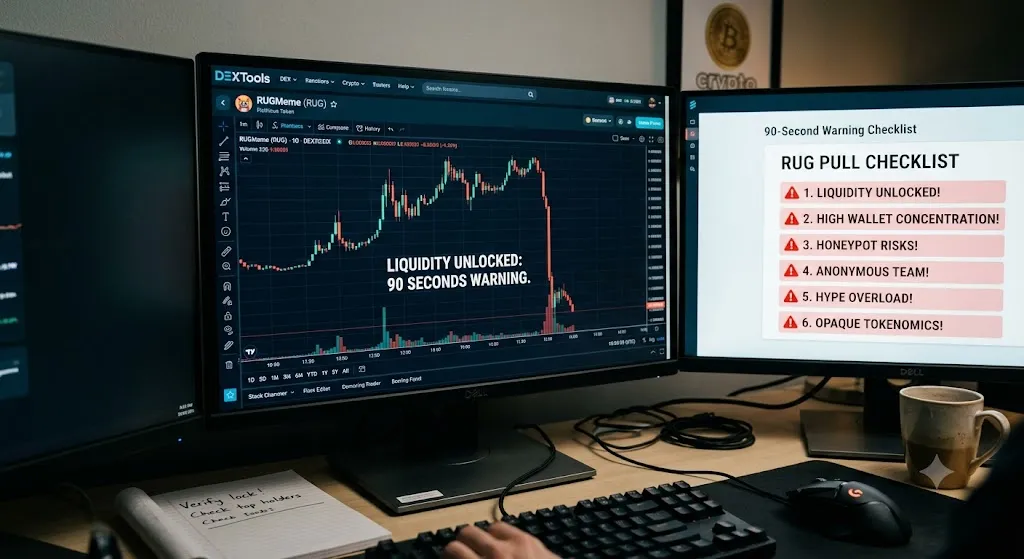
Meme coins are, by design, driven more by community energy and cultural momentum than by underlying utility, and that’s not inherently a scam signal. What is worth noticing is when the marketing effort is dramatically disproportionate to everything else about the project: coordinated waves of hype accounts posting near-identical language, paid influencer promotions that don’t disclose payment, and countdown-style urgency (“only six hours left before this moons”) designed to short-circuit due diligence rather than inform it.
Genuine communities tend to grow at least somewhat organically, with visible disagreement, questions, and skepticism mixed in among the enthusiasm. A comment section that’s uniformly positive, with no critical questions ever appearing, is more often a sign of moderation and bot activity than of universal confidence.
Red Flag Six: Tokenomics Designed to Confuse
Some meme coin projects build unnecessarily complicated tokenomics: reflection mechanisms, multiple wallet taxes, shifting fee structures, and reward systems that are difficult to explain in plain language. Complexity itself isn’t proof of fraud, but it does make it significantly easier to hide something inside the fine print, including fees or restrictions that quietly benefit the deployer wallet at everyone else’s expense.
If you can’t explain, in one or two sentences, exactly how buying and selling the token works and where any transaction fees go, that’s a sign to slow down rather than a detail to skip past.
How Traders Actually Check These Things
None of this requires specialized technical training. In practice, most of the traders who say they catch these warning signs early rely on a fairly consistent, repeatable routine:
They check whether liquidity is genuinely locked, using a public lock-checking tool rather than trusting the project’s own claims.
They pull up the token’s holder distribution on a block explorer to see how concentrated ownership actually is.
They run the contract through a token-scanning tool that flags common honeypot patterns, hidden mint functions, or unusual owner permissions before buying anything.
They look at how old the project’s social accounts are and whether there’s any history behind the team beyond the current launch.
None of these steps guarantee safety. Sophisticated scams have found ways to fake almost every individual signal in isolation. But a scam that fakes a liquidity lock, an authentic-looking wallet distribution, a clean contract scan, and a real project history all at once is rare, precisely because doing so takes real effort that most scammers aren’t willing to put in for a coin they plan to abandon within days.
The Uncomfortable Truth About Meme Coins
None of this is a guarantee, and none of it changes the basic risk profile of the meme coin market. Even projects that pass every check above can still fail simply because the hype fades and buyers stop showing up. Meme coins remain, by nature, speculative assets with no underlying utility beyond community attention, and that attention can evaporate as quickly as it arrived, with or without a scam involved.
What the checklist above actually protects against isn’t bad luck or a project simply losing steam. It’s protection against a specific, engineered kind of theft, one that depends almost entirely on buyers not checking things that are, in fact, publicly visible on the blockchain the entire time. The information needed to catch most rug pulls before they happen already exists, in public, for free. The traders who avoid getting caught are, for the most part, simply the ones who took the few extra minutes to look.
This article is for informational purposes only and does not constitute financial advice. Cryptocurrency investments, and meme coins in particular, carry a high level of risk, including the potential for total loss. Anyone considering an investment should conduct independent research and consult a licensed financial advisor.
About the Author:
Ana Milojevic is a crypto writer and the creator of basedmoondog.com. She writes in-depth guides on Web3, DeFi liquidity, and AI trading technologies, including insights on MoonDog AI. When she isn’t breaking down complex crypto mechanics, she is tracking market trends across decentralized ecosystems.
Leave a Reply