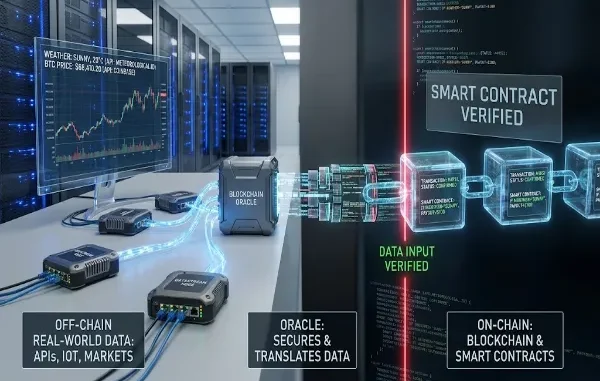
A blockchain oracle is a service that connects a blockchain to external data sources, allowing smart contracts to access real-world information they cannot retrieve on their own. For example, an oracle can provide cryptocurrency prices, weather conditions, or sports results so a smart contract can automatically execute predefined actions. Blockchain oracles can be centralized or decentralized and are essential for applications such as decentralized finance (DeFi), insurance, and supply chain management.
Blockchain technology allows computers to execute transactions and agreements without relying on a central authority. However, blockchains have an important limitation: they cannot independently access information from the outside world. A smart contract may be able to transfer cryptocurrency automatically, but it cannot automatically know the current price of gold, the outcome of a football match, or whether a package has arrived.
This is where a blockchain oracle becomes essential. A blockchain oracle connects smart contracts to external data sources, allowing decentralized applications to respond to real-world information.
Oracles play an important role in decentralized finance, insurance, gaming, supply chain management, and other blockchain-based systems. Understanding how they work helps explain how smart contracts can interact with events and information beyond their own networks.
Key Takeaways
- Blockchain oracles connect smart contracts to the real world: They provide external information that blockchains cannot independently access, such as cryptocurrency prices, weather conditions, and sports results.
- Oracles enable more advanced smart contracts: They allow decentralized applications to respond automatically to external events and changing conditions.
- There are several types of oracles: Software, hardware, inbound, outbound, centralized, and decentralized oracles serve different purposes.
- Decentralized finance relies heavily on oracles: Lending platforms and other DeFi applications use price feeds to calculate collateral values and manage financial risks.
- The oracle problem concerns data reliability: Even a secure blockchain can produce incorrect outcomes if a smart contract receives inaccurate or manipulated external information.
- Oracle security requires multiple safeguards: Independent data sources, validation, aggregation, monitoring, and contingency plans can help reduce risks.
- Oracles have limitations: Data delays, transaction fees, technical failures, and dependence on external providers can affect their performance.
- Blockchain oracles support real-world applications: They help connect smart contracts with financial markets, insurance services, supply chains, blockchain games, and connected devices.
What Is a Blockchain Oracle?
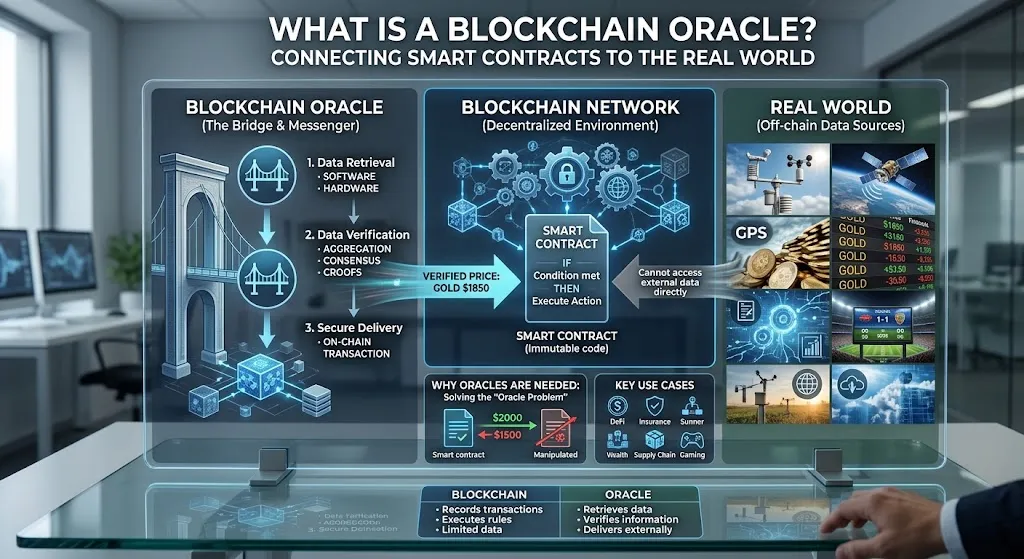
A blockchain oracle is a service or mechanism that provides external information to a blockchain or delivers blockchain information to external systems.
Blockchains generally operate within their own networks. Their nodes can verify transactions and execute smart contracts using information recorded on the blockchain, but they cannot automatically retrieve arbitrary data from websites, databases, sensors, or other external sources.
An oracle acts as a bridge between these environments.
For example, imagine a smart contract that pays a user when the price of Bitcoin rises above a specific threshold. The contract can check its programmed conditions, but it needs a reliable source of Bitcoin price information to determine whether those conditions have been met.
An oracle supplies the price data. The smart contract can then evaluate the information and execute its programmed action.
Importantly, an oracle does not necessarily make a smart contract trustworthy on its own. The contract’s reliability also depends on the quality of the data, the oracle’s security, and the rules governing how information is verified.
Why Do Blockchains Need Oracles?
The main reason blockchains need oracles is that they are designed to verify information within their own environments rather than freely access external systems.
This limitation is sometimes described as the oracle problem. Even when a smart contract operates exactly as programmed, it can produce an incorrect result if the external information it receives is inaccurate or manipulated.
Consider a decentralized lending application. A user deposits cryptocurrency as collateral and borrows another digital asset. The application needs to know the current value of the collateral to determine whether the loan remains adequately secured.
Without an external price feed, the smart contract cannot independently calculate the current market value of that cryptocurrency. An oracle supplies the necessary data so the contract can apply its lending rules.
Oracles can provide many other types of information, including:
- Cryptocurrency and traditional asset prices.
- Weather conditions and temperature readings.
- Sports results and event outcomes.
- Interest rates and economic indicators.
- Shipment status and supply chain information.
- Random numbers for blockchain games and applications.
- Data from external APIs, enterprise databases, and connected devices.
By making this information available, oracles expand what smart contracts can accomplish.
How Does a Blockchain Oracle Work?
Although different oracle systems use different architectures, most follow a similar process.
1. A Smart Contract Requests Information
A decentralized application needs external information to execute a particular rule. For example, a lending protocol may need the current price of Ethereum.
The application uses an oracle system designed to provide the required data.
2. The Oracle Retrieves External Data
The oracle obtains information from one or more sources. These might include cryptocurrency exchanges, financial data providers, weather services, websites, or specialized databases.
The number and quality of these sources can influence the reliability of the information.
3. The Information Is Verified or Aggregated
Depending on the system, the oracle may check data against multiple sources, compare reported values, use cryptographic proofs, or rely on a network of independent data providers.
Some systems aggregate multiple observations to reduce the impact of a single inaccurate or manipulated source.
Not every oracle performs all these checks. The verification process depends on the oracle’s design.
4. The Data Is Delivered to the Blockchain
The oracle transmits the information in a form that the relevant smart contract can access. In many systems, this involves submitting an on-chain transaction that records or updates the data.
Because blockchain transactions may require network fees, oracle updates can have operating costs.
5. The Smart Contract Executes Its Rules
Once the required information is available, the smart contract evaluates its programmed conditions.
For example, if a collateral value falls below a specified threshold, a lending protocol may initiate its liquidation process. The oracle supplies the information, while the smart contract applies the rules.
This process allows blockchain applications to react to external events without requiring a person to manually trigger every action.
What Are the Main Types of Blockchain Oracles?
Blockchain oracles can be classified according to where their data comes from, how they deliver information, and whether they operate through centralized or decentralized arrangements.
Software Oracles
Software oracles retrieve digital information from online sources, including websites, APIs, financial platforms, and databases.
They are commonly used to provide cryptocurrency prices, exchange rates, market information, and other data that can be accessed electronically.
For example, a decentralized exchange or lending protocol may use a software oracle to obtain cryptocurrency price information.
Hardware Oracles
Hardware oracles connect blockchain applications to information collected by physical devices.
These devices may include temperature sensors, GPS receivers, RFID readers, and industrial monitoring equipment.
A supply chain application, for instance, could use sensor data to determine whether goods have remained within a required temperature range during transportation.
Hardware oracles can be useful when the information originates in the physical world, although the accuracy and security of the sensors remain important considerations.
Inbound Oracles
Inbound oracles deliver information from outside a blockchain to a smart contract.
A cryptocurrency price feed is a common example. The contract receives the external price and uses it to evaluate its conditions.
Inbound oracles are particularly important for decentralized finance and applications that depend on external events.
Outbound Oracles
Outbound oracles communicate information from a blockchain to an external system.
For example, a smart contract might trigger a notification or initiate an action in an external application after a payment has been confirmed.
Outbound oracle systems can connect blockchain activity with business software, automation services, and connected devices.
Centralized Oracles
A centralized oracle relies on one primary provider or authority to supply information.
This arrangement can be relatively straightforward to implement, but it creates a potential single point of failure. If the provider supplies incorrect data, becomes unavailable, or is compromised, dependent smart contracts may be affected.
Centralized oracles may be appropriate in some controlled environments, but their trust assumptions should be understood clearly.
Decentralized Oracles
Decentralized oracle systems use multiple independent data providers, node operators, or verification mechanisms to reduce dependence on a single source.
Depending on their design, they may aggregate reports, compare values, and use consensus mechanisms to determine which information is delivered on-chain.
Decentralization can improve resilience, but it does not automatically guarantee accuracy. Multiple providers may rely on the same underlying source, and a poorly designed network may still be vulnerable to manipulation.
What Is the Difference Between a Blockchain and an Oracle?
A blockchain and an oracle perform different functions, even though they often work together.
| Feature | Blockchain | Oracle |
|---|---|---|
| Main purpose | Records and verifies transactions and on-chain state | Supplies or communicates information between systems |
| Data source | Transactions and information available within the network | External sources, other systems, or blockchain data |
| Core function | Executes consensus rules and smart contracts | Retrieves, verifies, aggregates, or delivers data |
| Main risk | Network, protocol, or smart contract vulnerabilities | Inaccurate data, compromised providers, or faulty delivery |
| Example | Executes a loan liquidation rule | Supplies the asset price used by that rule |
The distinction is important because a blockchain can execute a smart contract exactly as written while still producing an undesirable result if the oracle supplies incorrect information.
In other words, blockchain security and data reliability are related but separate concerns.
Real-World Uses of Blockchain Oracles
Oracles support a growing range of blockchain applications. Their usefulness depends on whether an application needs information that cannot be obtained directly from the blockchain.
Decentralized Finance (DeFi)
Decentralized finance platforms use oracles to obtain market prices for lending, borrowing, derivatives, and collateral management.
Accurate price information helps smart contracts calculate collateral ratios and determine when financial conditions require action.
Because incorrect prices can cause substantial losses, oracle security is particularly important in DeFi.
Insurance
Blockchain-based insurance products can use oracles to obtain information about weather conditions, flight delays, or other predefined events.
For example, a weather-related insurance contract might pay a claim when verified rainfall measurements exceed a specified threshold.
Automating the process can reduce administrative work, although the contract still depends on appropriate data sources and clearly defined claim conditions.
Supply Chain Management
Companies can combine blockchain records with data from GPS devices, shipment tracking systems, and temperature sensors.
An oracle can communicate relevant information to a smart contract, which may then update a shipment’s status or release payment when specified conditions are satisfied.
However, the blockchain cannot independently guarantee that a sensor reading accurately reflects the physical goods. The reliability of the underlying data collection process remains essential.
Blockchain Gaming
Games built on blockchain networks may need unpredictable outcomes or external event information.
Randomness oracles can provide random values for applications such as digital collectibles, prize allocation, and game mechanics.
Secure randomness is especially important when outcomes have financial value. A system must be designed to prevent participants from predicting, manipulating, or selectively requesting outcomes.
Prediction Markets
Prediction markets allow users to trade positions based on the outcomes of future events.
An oracle can provide the result of an election, sporting event, or other specified occurrence so the relevant smart contract can settle positions according to its rules.
These systems need clear settlement criteria and trustworthy information sources to reduce disputes.
What Is the Oracle Problem?
The oracle problem refers to the challenge of bringing trustworthy external information into a blockchain system without undermining the security and reliability that the blockchain is intended to provide.
A blockchain can verify that a transaction was submitted correctly, but it cannot necessarily determine whether the external information contained in that transaction is true.
Suppose an oracle reports that a cryptocurrency is worth $2,000 when its actual market price is $1,500. A smart contract that trusts the reported value may execute its rules based on the wrong information.
The problem can arise from several sources:
- Data manipulation: An attacker influences an external data source or the oracle’s reporting process.
- Single points of failure: One provider becomes unavailable or supplies inaccurate information.
- Low-quality sources: Data is outdated, inconsistent, or collected using unreliable methods.
- Collusion: Multiple oracle operators coordinate to provide misleading information.
- Technical failures: Software errors, network disruptions, or incorrect configurations affect data delivery.
There is no universal solution that eliminates every oracle risk. Instead, oracle systems use different combinations of independent providers, cryptographic verification, aggregation, monitoring, and carefully designed update rules.
How Do Blockchain Oracles Improve Security?
Oracle security depends on the specific application and the consequences of receiving incorrect data.
Several design practices can reduce risk.
Use multiple independent data sources. Comparing reports from different providers can reduce dependence on a single source, especially when those sources are genuinely independent.
Apply aggregation and validation rules. Systems can reject outliers, check data formats, and evaluate whether reported values fall within reasonable limits.
Monitor data freshness. Price feeds and other time-sensitive information should be checked for delays or stale updates.
Limit the impact of sudden changes. Some applications use circuit breakers, transaction limits, or other safeguards when data changes unexpectedly.
Review oracle and smart contract security. Independent audits and ongoing monitoring can help identify weaknesses in both the data delivery mechanism and the contract that consumes it.
Plan for outages. Applications should define what happens when an oracle stops updating, returns invalid data, or becomes unavailable.
These measures do not eliminate every possible attack, but they can make oracle-dependent applications more resilient.
What Are the Limitations of Blockchain Oracles?
Despite their usefulness, oracles introduce additional technical and operational considerations.
First, they may add costs. Delivering information to a blockchain can require transaction fees, and oracle services may charge for data access or infrastructure.
Second, updates may not be instantaneous. Network congestion, update schedules, and data-provider delays can affect how quickly a smart contract receives new information.
Third, oracles introduce additional dependencies. A smart contract may rely on external APIs, node operators, software systems, or physical devices that can fail independently of the blockchain.
Finally, decentralization varies considerably between projects. A system described as decentralized may still depend on a small number of providers or share a common underlying data source.
For these reasons, evaluating an oracle requires more than checking whether it uses blockchain technology. Its architecture, data sources, security assumptions, and failure-handling procedures all matter.
Blockchain Oracles and the Future of Smart Contracts
As blockchain applications become more connected to conventional businesses and digital services, reliable external data will remain essential.
Oracles can help connect blockchain networks with financial markets, logistics platforms, Internet of Things devices, and enterprise information systems. They also support more sophisticated smart contracts that respond to changing conditions rather than operating solely on information already recorded on-chain.
Future developments may improve data verification, reduce the cost of updates, and make it easier to prove that certain information came from a particular source or was processed according to specified rules.
Nevertheless, cryptographic verification cannot automatically prove that every real-world statement is true. A system may verify that a sensor signed a reading without proving that the sensor was correctly installed or accurately measured its surroundings.
The central challenge will remain the same: connecting blockchain systems to external information while managing the trust and security risks that connection creates.
Frequently Asked Questions
Is a blockchain oracle a blockchain itself?
No. An oracle is a service or mechanism that connects a blockchain with external information or systems. It can operate alongside one or more blockchains without being a blockchain itself.
Is Chainlink an example of a blockchain oracle?
Yes. Chainlink is a decentralized oracle network ecosystem that provides services such as data feeds and verifiable randomness for smart contracts. It is one of the best-known projects in this field.
Can a smart contract work without an oracle?
Yes. Smart contracts that rely exclusively on on-chain information can operate without external oracles. An oracle becomes necessary when a contract needs information or actions that cannot be accessed directly through its blockchain environment.
Are decentralized oracles completely secure?
No. Decentralized designs can reduce dependence on individual providers, but they may still face inaccurate data, correlated sources, software vulnerabilities, collusion, and operational failures.
Do blockchain oracles charge fees?
Some oracle services charge fees, and submitting oracle updates to a blockchain may require transaction fees. The cost depends on the provider, network, update frequency, and application.
Conclusion
A blockchain oracle is a bridge between smart contracts and information outside a blockchain network. By supplying external data, oracles enable decentralized applications to respond to market prices, physical events, business processes, and other real-world conditions.
They are particularly important in decentralized finance, insurance, gaming, and supply chain management. However, their usefulness comes with a fundamental responsibility: external information must be reliable enough for the smart contracts that depend on it.
Understanding how oracles retrieve data, verify information, and manage risk is essential for anyone exploring blockchain technology. As smart contracts become more widely used, secure and dependable oracle systems will remain a key part of connecting decentralized applications with the wider world.
Leave a Reply