
Cryptocurrency trading has created new opportunities for investors to exchange digital assets, participate in decentralized finance (DeFi), and access financial services without relying on traditional intermediaries. However, the technology behind these markets also introduces risks that traders may not encounter on conventional stock exchanges. One example is the sandwich attack, a form of transaction manipulation that can cause cryptocurrency traders to receive fewer tokens than expected or pay more than necessary for a trade.
Sandwich attacks are particularly associated with decentralized exchanges (DEXs), automated market makers (AMMs), and blockchain networks where pending transactions can be observed before they are confirmed. Attackers exploit this visibility to place transactions immediately before and after a target transaction, influencing the market price to their advantage.
Although the process can appear complicated at first, the underlying idea is relatively straightforward. An attacker identifies a pending trade, buys the relevant cryptocurrency before the trade executes, allows the victim’s transaction to move the price further, and then sells the acquired tokens afterward. The victim’s transaction is effectively caught between the attacker’s two transactions, creating the name “sandwich attack.”
Understanding how this exploit works, why decentralized exchanges can be vulnerable, and what traders can do to reduce their exposure is essential for anyone participating in cryptocurrency markets.
What Is a Sandwich Attack in Cryptocurrency?
A sandwich attack is a type of maximum extractable value (MEV) exploitation in which an attacker uses the ordering of blockchain transactions to profit at the expense of another trader.
MEV refers to the value that can be obtained by influencing the inclusion, exclusion, or ordering of transactions within a blockchain block. Depending on the network and trading environment, this value may be captured by searchers, validators, block builders, or other participants who can influence transaction execution.
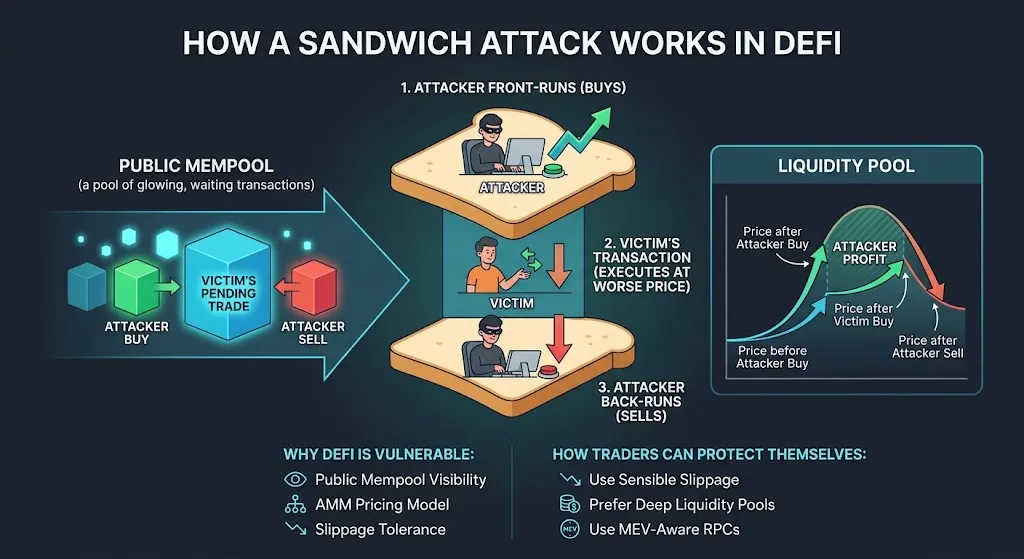
In a sandwich attack, the attacker typically identifies a pending swap on a decentralized exchange and submits two transactions around it:
- Front-running transaction: The attacker buys the target token before the victim’s swap is processed.
- Victim’s transaction: The original trader’s purchase executes at a less favorable price because the attacker’s first transaction has already affected the available liquidity and exchange rate.
- Back-running transaction: The attacker sells the acquired tokens after the victim’s trade, attempting to realize a profit from the resulting price movement.
The victim’s trade sits between the attacker’s transactions, much like the filling between two slices of bread.
The attack does not necessarily involve stealing cryptocurrency directly from a wallet or exploiting a software vulnerability. Instead, it takes advantage of how decentralized exchanges calculate prices and how blockchain transactions are ordered.
A trader may authorize a perfectly legitimate token swap and still experience a worse execution price because another participant has manipulated the conditions under which the transaction is processed.
How Does a Sandwich Attack Work?
To understand the mechanics, it helps to examine how decentralized exchanges differ from traditional trading platforms.
Many decentralized exchanges use liquidity pools rather than a conventional order book. These pools contain reserves of two or more tokens that traders exchange against. The pool’s pricing mechanism adjusts the exchange rate as its token balances change.
When a trader submits a large purchase, the transaction can shift the pool’s price, particularly when the pool has limited liquidity. If an attacker can observe the pending transaction and arrange for their own trades to execute before and after it, they may be able to profit from the price movement.
Step 1: The Attacker Identifies a Pending Trade
A cryptocurrency trader submits a swap transaction, such as exchanging ETH for another token on a decentralized exchange.
Before the transaction is confirmed, it may become visible in a public transaction pool, often called a mempool. The mempool contains transactions waiting to be included in a block.
Specialized automated programs, commonly known as MEV searchers or bots, monitor these pending transactions. They may evaluate trade size, token pair, liquidity, estimated price impact, slippage tolerance, transaction fees, and other factors to identify potentially profitable opportunities.
A large swap in a relatively shallow liquidity pool may be particularly attractive because it can produce a substantial change in the exchange rate.
Not every pending transaction is visible to every participant. Private transaction channels, specialized order-flow arrangements, and differences between blockchain architectures can affect what an attacker can observe.
Step 2: The Attacker Buys Before the Victim
After identifying a suitable transaction, the attacker submits a purchase of the same token.
The attacker may use a higher transaction fee, a specialized transaction-submission method, or another ordering mechanism to increase the likelihood that the purchase executes before the victim’s trade.
When the attacker’s purchase is processed, it changes the liquidity pool’s reserves and moves the token’s price.
As a result, the victim’s transaction encounters a less favorable exchange rate than the one that would have applied if the attacker’s purchase had not occurred.
The extent of the price movement depends on several factors, including the pool’s liquidity, the size of the attacker’s purchase, and the exchange’s pricing formula.
Step 3: The Victim’s Transaction Executes
The victim’s swap is then processed.
Because the attacker has already purchased the token, the pool’s price has moved against the victim. If the victim is buying the same asset, the swap may deliver fewer tokens for the same amount of cryptocurrency.
The victim may still receive the minimum quantity permitted by the transaction’s slippage settings, provided the trade remains within those limits. If the price moves beyond the permitted threshold, the transaction may revert instead.
A successful sandwich attack therefore does not require the victim’s transaction to fail. In many cases, the attacker’s objective is precisely to allow the transaction to succeed at a worse price.
Step 4: The Attacker Sells After the Victim’s Trade
Once the victim’s transaction has executed, the attacker submits a second transaction to sell the tokens acquired during the front-running trade.
The victim’s purchase has typically pushed the token’s price further in the same direction, allowing the attacker to sell at a higher price than the price paid for the initial purchase.
The attacker attempts to capture the difference between the buying and selling prices, after accounting for trading fees, gas costs, and any other expenses.
The attacker’s profit is not guaranteed. Price movements, transaction ordering, competition from other searchers, failed transactions, and execution costs can eliminate the expected return.
A Simple Example of a Sandwich Attack
Consider a hypothetical decentralized exchange where a trader wants to purchase Token X using ETH.
The trader submits a swap worth 10 ETH. The pool has limited liquidity, so a purchase of this size can significantly affect the token’s price.
An attacker detects the pending transaction and executes a smaller purchase immediately before it. This moves the price upward. The victim’s purchase then executes at the higher price, receiving fewer tokens than would otherwise have been available.
The attacker sells the tokens after the victim’s transaction, taking advantage of the additional price movement.
The following simplified example illustrates the potential outcome.
| Transaction | Illustrative outcome |
|---|---|
| Victim submits a swap | Plans to spend 10 ETH on Token X |
| Attacker buys first | Moves the pool price upward |
| Victim’s swap executes | Receives fewer tokens due to the changed price |
| Attacker sells afterward | Attempts to capture the price difference |
| Attacker’s final result | Profit only if proceeds exceed all costs |
The actual amounts depend on the pool’s reserves, pricing curve, fees, and transaction ordering. The table illustrates the mechanism rather than a guaranteed financial outcome.
How Much Could a Victim Lose?
Suppose the victim expected to receive tokens worth approximately $20,000 at the initial market price. After the attacker’s transaction changes the exchange rate, the victim receives tokens worth $19,700 under the same reference-price assumptions.
The difference is $300.
This does not mean that every sandwich attack causes a $300 loss, nor does it establish that the attacker receives the entire difference as profit. Some of the difference may reflect ordinary price impact, exchange fees, and market movement. The attacker’s actual profit depends on the complete sequence of trades and associated costs.
The important point is that a transaction can execute successfully while delivering a materially worse economic result than the trader anticipated.
Why Are Decentralized Exchanges Vulnerable to Sandwich Attacks?
Sandwich attacks arise from the interaction between transaction visibility, transaction ordering, and liquidity-based pricing. Several features of decentralized trading can make these attacks possible.
1. Public Transaction Mempools
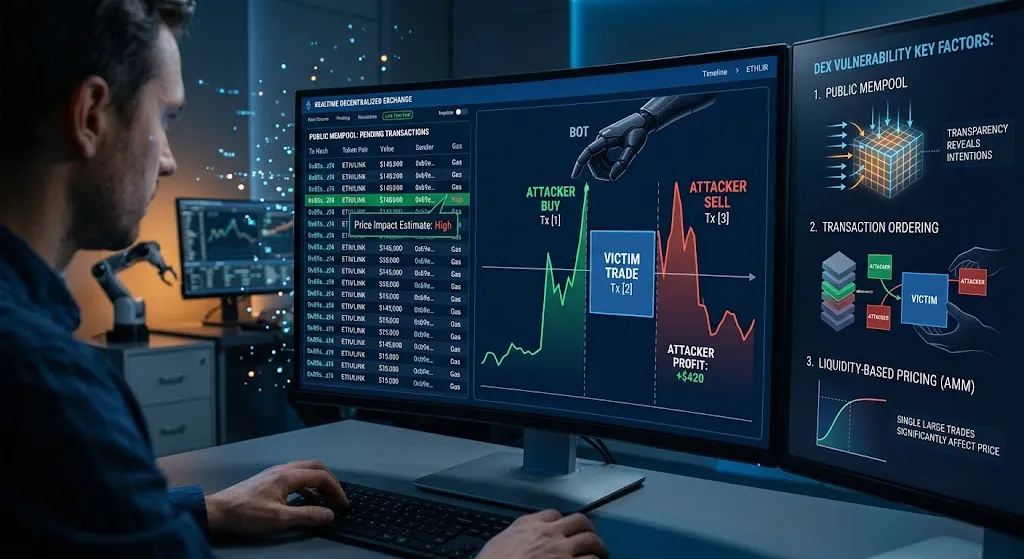
On many blockchain networks, pending transactions are broadcast to participants before they are included in a block.
This transparency is important for the operation of public blockchains, but it can also reveal trading intentions. A bot may detect a large pending swap and estimate how much the transaction is likely to move the market.
The attacker then attempts to place transactions around it.
Public visibility does not automatically make every trade vulnerable. The attack also requires a viable profit opportunity and a way to influence transaction ordering.
2. Automated Market Makers
Automated market makers determine token prices using mathematical relationships between the assets in a liquidity pool.
A widely used constant-product model maintains a relationship commonly expressed as:
x × y = k
Here, x and y represent the quantities of two assets in a pool, while k represents their product under the simplified model.
When someone buys one asset, the pool’s reserves change, affecting the exchange rate. Larger trades relative to available reserves generally produce greater price impact.
This behavior allows decentralized exchanges to facilitate trading without requiring a traditional order book, but it can also create opportunities for traders who anticipate and exploit the price impact of pending swaps.
Not every DEX uses a constant-product AMM. Other pricing models and concentrated-liquidity designs have different mechanics, but many can still experience sandwiching under suitable conditions.
3. Slippage Tolerance
Slippage is the difference between an expected trade price and the price at which the transaction actually executes.
DEX interfaces commonly allow traders to set a slippage tolerance. For example, a trader might permit the transaction to execute even if the received amount is slightly worse than initially estimated.
This setting helps accommodate ordinary price fluctuations between transaction submission and execution.
However, a generous slippage tolerance can also give a sandwich attacker more room to move the price without causing the victim’s transaction to revert.
A lower tolerance may reduce this opportunity, but it does not guarantee protection. If the tolerance is too restrictive, legitimate transactions may fail when market conditions change naturally.
4. Large Trades and Shallow Liquidity
A large transaction in a low-liquidity pool can have a much greater price impact than the same transaction in a deep pool.
This makes certain token pairs particularly attractive to sandwich bots. Newly launched tokens, speculative assets, and trading pools with limited reserves may be more susceptible than highly liquid markets, although no particular pool is automatically immune.
An attacker generally needs enough potential price movement to compensate for trading fees, gas costs, and competition.
5. Transaction Ordering
Blockchains process transactions according to network-specific rules and the choices made by block producers, validators, sequencers, or block builders.
On some networks, transaction fees or specialized order-flow arrangements can influence which transactions are included first.
An attacker attempts to exploit these mechanisms to place a purchase before the target transaction and a sale afterward.
The exact process differs between Ethereum, other EVM-compatible networks, and non-EVM blockchains. The term “sandwich attack” describes the trading pattern, not one universal transaction-ordering mechanism.
What Is the Difference Between a Sandwich Attack and Front-Running?
The terms are related, but they do not mean exactly the same thing.
Front-running occurs when someone places a transaction ahead of another transaction to benefit from information about the expected market impact or outcome.
A sandwich attack includes a front-running transaction, but it also involves a second transaction after the victim’s trade.
| Feature | Front-running | Sandwich attack |
|---|---|---|
| Transaction before the victim | Usually present | Present |
| Transaction after the victim | Not required | Typically present |
| Primary mechanism | Exploiting transaction priority or ordering | Buying before and selling after a target trade |
| Potential source of profit | Subsequent price movement or another transaction-dependent opportunity | Price impact created across the sequence of trades |
| Typical objective | Gain an advantage from acting first | Capture value from a victim’s execution |
A sandwich attack can therefore be understood as a particular form of transaction-ordering exploitation that combines front-running and back-running.
Back-running, considered independently, refers to placing a transaction after another transaction to benefit from its effects. Back-running can occur for legitimate or non-malicious purposes as well as in exploitative trading strategies.
Is a Sandwich Attack Illegal?
The legal status of a sandwich attack depends on the jurisdiction, the precise conduct, the market involved, and the applicable laws.
A sandwich attack is not automatically classified as illegal merely because it uses transaction ordering or produces an unfavorable execution price for another trader. Some MEV strategies operate in a legal and technically permitted environment, although they can still create serious concerns about market fairness and user protection.
However, conduct involving fraud, unauthorized access, deception, market manipulation prohibited by applicable law, or violations of platform rules may create legal liability.
The distinction matters because decentralized exchanges operate across multiple jurisdictions, and different legal systems may treat specific trading practices differently.
A blockchain transaction being technically valid does not establish that the conduct behind it is lawful. Similarly, the absence of a centralized intermediary does not necessarily remove all legal obligations.
Users who believe they have suffered significant losses may wish to preserve transaction records and consult a qualified legal professional familiar with cryptocurrency markets and the relevant jurisdiction.
How Can Traders Detect a Sandwich Attack?
Identifying a possible sandwich attack requires examining transaction activity rather than relying only on a swap’s final result.
A poor execution price alone does not prove malicious activity. Normal volatility, thin liquidity, inaccurate price estimates, and large trades can also cause unfavorable outcomes.
Nevertheless, several indicators can help traders and analysts investigate suspicious transactions.
Look for Three Closely Related Swaps
A common pattern consists of three transactions executed in the same block or in a closely connected sequence:
- A transaction by one address buys a token.
- A transaction by another address executes a swap in the same token pair and direction.
- The first address sells the token after the target transaction.
The pattern becomes more suggestive when the attacker’s first and last transactions are economically linked and the attacker appears to profit from the price movement caused by the middle transaction.
Not all such sequences are malicious. Analysts must examine the transaction details and surrounding market conditions.
Examine the Target Trade’s Execution Price
Compare the victim’s actual execution price with the expected price immediately before the trade and the price that would have resulted without the suspected attacker’s transactions.
This analysis can help distinguish ordinary price impact from price deterioration associated with transaction ordering.
The comparison must account for pool fees, liquidity changes, market movement, and other transactions in the same block.
Check Token Transfers and Wallet Relationships
Blockchain explorers can reveal token transfers, swap events, transaction timestamps, and wallet addresses.
Analysts may investigate whether the same address or a cluster of related addresses performed the initial purchase and subsequent sale.
However, wallet ownership is not always publicly identifiable. A blockchain address alone does not establish a person’s identity, and sophisticated participants may use multiple addresses or intermediary contracts.
Review the Transaction’s Profitability
A suspected attacker may have generated a positive trading result, but the analysis should include transaction fees, gas expenses, liquidity-provider fees, and failed attempts.
The amount of profit retained by the attacker may differ significantly from the gross difference between purchase and sale prices.
Specialized MEV analytics tools can help researchers identify suspected sandwich patterns and estimate their financial effects. Results should be interpreted carefully because automated classifications may produce false positives.
How Can You Protect Yourself From Sandwich Attacks?
Although traders cannot eliminate every risk associated with public blockchain transactions, several practical measures can reduce exposure.
1. Use a Sensible Slippage Tolerance
One of the simplest precautions is to review the slippage tolerance before approving a swap.
A high setting may allow the transaction to execute despite a substantial price change. Reducing it can limit the amount of deterioration the trader is willing to accept.
However, the correct setting depends on the asset, liquidity, volatility, and exchange mechanism. An excessively low setting can cause transactions to fail, potentially resulting in wasted network fees.
Traders should avoid selecting a high tolerance merely because an interface recommends it automatically, especially when purchasing unfamiliar tokens.
2. Prefer Deeper Liquidity Pools
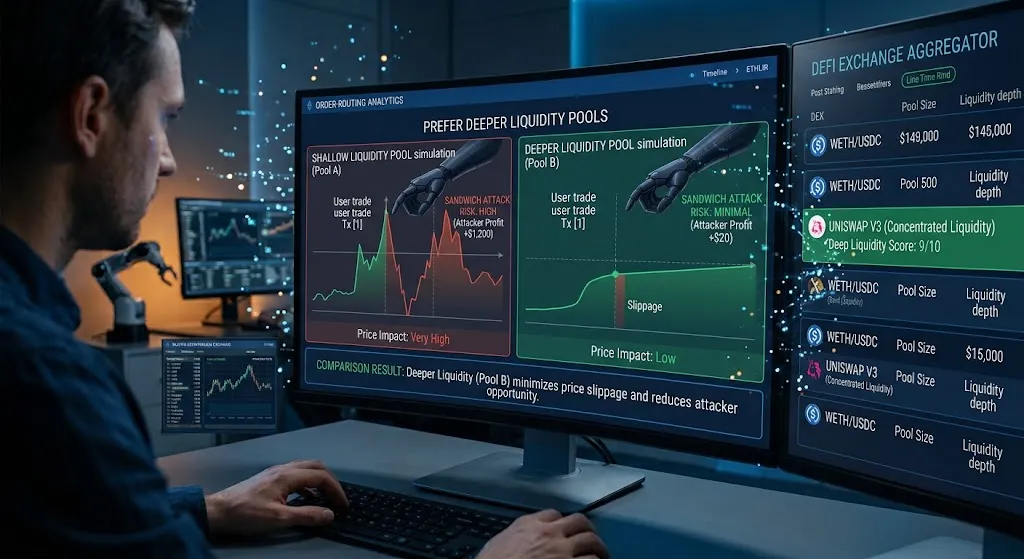
Liquidity is an important factor in execution quality.
For a given trade size, a pool with greater available liquidity will generally experience less price impact than a comparable shallow pool using the same pricing mechanism.
Before trading, examine the pool’s liquidity and compare prices across reputable decentralized exchanges or trading routes.
A large liquidity figure is not a guarantee of safety, but trading against deeper liquidity can reduce the price movement available to a sandwich attacker.
3. Break Up Very Large Trades When Appropriate
A single large swap can cause a substantial change in the pool’s exchange rate.
In some circumstances, dividing a trade into smaller transactions or using an exchange’s supported order-routing tools may reduce the price impact of an individual transaction.
However, splitting a trade is not automatically safer. Multiple transactions can create additional fees, repeated exposure to sandwich attacks, and execution uncertainty. The best approach depends on the market and the available trading infrastructure.
4. Consider Private Transaction Submission
Some wallets, RPC providers, and transaction services offer private submission or protected transaction-routing mechanisms.
These systems may send transactions through channels that reduce their exposure to the public mempool, limiting the ability of ordinary public-mempool bots to identify and target them before execution.
Privacy does not guarantee protection. The effectiveness of a private submission system depends on its design, trust assumptions, network integration, and the parties handling the transaction.
Users should research the provider’s security model and understand any associated fees or trade-offs before relying on such a service.
5. Review the Minimum Amount You Will Receive
Many token-swap interfaces display a minimum amount of tokens that the trader will receive if the transaction succeeds.
This figure is often determined by the quoted output and the selected slippage tolerance.
Checking the minimum output can help traders understand the worst execution outcome their transaction is configured to accept, subject to the exchange’s implementation and the transaction’s other conditions.
If the minimum amount appears unacceptably low, consider changing the settings, reducing the trade size, selecting a different route, or waiting for more favorable conditions.
6. Avoid Rushing Into Unfamiliar Tokens
New or highly speculative tokens can have thin liquidity, volatile prices, and unpredictable trading behavior.
A trader who focuses only on a token’s displayed price may overlook the effect of the actual liquidity pool and the cost of executing a purchase.
Before swapping, verify the token contract, examine liquidity, check the quoted output, and consider whether the transaction size is appropriate for the market.
A token’s popularity or recent price increase does not guarantee that it can be purchased or sold efficiently.
7. Understand the Risks of MEV Protection Tools
Some applications provide transaction simulation, MEV protection, private routing, or warnings about potentially unfavorable execution.
These tools can improve transparency and may reduce certain risks, but their effectiveness varies.
Before using one, check which blockchain networks it supports, whether it works with the intended decentralized exchange, how transactions are routed, and whether protection is guaranteed or merely intended to reduce exposure.
Avoid assuming that any wallet, exchange, or blockchain is completely immune to sandwich attacks.
Can Slippage Settings Completely Prevent a Sandwich Attack?
No. Slippage settings can reduce the attacker’s available opportunity, but they cannot eliminate all possible forms of transaction-ordering exploitation.
Consider a trader who allows a maximum deviation of 0.5% from the expected output. If an attack would push the trade beyond the permitted threshold, the swap may revert instead of executing at that price.
This can protect the trader from accepting an excessively unfavorable exchange rate. Nevertheless, a sufficiently small price movement may still fall within the permitted range, allowing a sandwich attack to succeed.
Furthermore, slippage settings do not address every possible source of poor execution. Price changes may occur naturally, liquidity can change unexpectedly, and transaction fees can remain payable even when a transaction fails.
The objective is not to eliminate all slippage. Rather, it is to establish a reasonable balance between execution reliability and protection against unfavorable prices.
What Is the Role of MEV Bots in Sandwich Attacks?
MEV bots are automated programs that monitor blockchain activity and identify opportunities arising from transaction ordering.
Not every MEV bot performs sandwich attacks. Some searchers identify arbitrage opportunities between exchanges, help restore price consistency across markets, or participate in liquidation processes that maintain the operation of decentralized lending protocols.
Sandwich bots focus on transactions where the expected price impact creates an opportunity to buy before a target trade and sell afterward.
Their operations may involve several components:
- Transaction monitoring: Observing pending swaps and identifying potentially profitable targets.
- Profit estimation: Calculating expected price movement, trading fees, and transaction costs.
- Transaction construction: Preparing the front-running and back-running trades.
- Execution optimization: Attempting to achieve the desired ordering through available network mechanisms.
- Profit evaluation: Measuring the final outcome after accounting for costs and failed transactions.
Competition between searchers can be intense. Several bots may identify the same opportunity and compete to execute first, sometimes driving up transaction fees and reducing the profit available to any one participant.
This competitive environment also means that a strategy that appears profitable before execution may lose money once all costs and ordering uncertainty are considered.
Who Benefits From Sandwich Attacks?
The direct beneficiary is generally the attacker, provided the trading sequence generates a net profit.
The victim may experience a worse execution price, while liquidity providers and network participants may receive fees associated with the transactions. However, the distribution of economic effects varies by exchange, network, and transaction structure.
The attacker does not necessarily capture every dollar of value lost by the victim. Some of the price difference may arise from ordinary price impact, fees, or other market movements, and some may be transferred to other participants.
The broader consequences can include reduced confidence in decentralized trading, higher effective transaction costs, and concerns about whether ordinary users are competing on fair terms with sophisticated automated trading systems.
At the same time, it is important to distinguish sandwich attacks from other MEV activities. Some forms of transaction ordering can improve market efficiency, while others create costs for users. The economic effects depend on the specific mechanism rather than on the label MEV alone.
Are Sandwich Attacks Possible on Every Blockchain?
No. The risk depends on the blockchain’s transaction architecture, the exchange’s design, and the methods available to participants who order transactions.
On networks where pending transactions are publicly observable and transaction ordering can be influenced, sandwich attacks may be possible when a suitable liquidity pool and profitable trading opportunity exist.
Other networks may use different transaction-processing systems, private order flow, sequencers, or mechanisms that alter how pending trades are exposed and ordered.
These differences can reduce certain forms of sandwiching or change how they are performed, but they do not automatically guarantee protection.
Even within one blockchain, the risk can vary between decentralized exchanges, trading routes, liquidity models, wallets, and transaction-submission methods.
It is therefore more accurate to assess a specific trading environment than to declare an entire blockchain either vulnerable or immune.
What Is the Difference Between a Sandwich Attack and a Rug Pull?
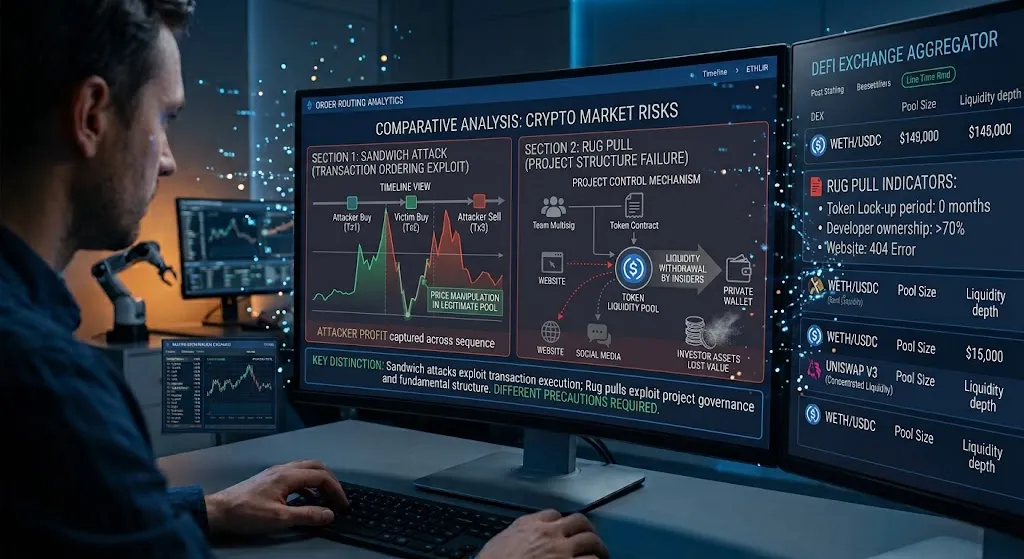
Both terms describe risks in cryptocurrency markets, but they refer to different activities.
A sandwich attack targets the execution of a particular trade by manipulating the sequence of transactions around it. A rug pull generally involves project insiders or other controlling parties withdrawing liquidity, abandoning a project, or using their control over a token or protocol to leave investors with assets that have lost much or all of their value.
A sandwich attack can occur against an otherwise legitimate token traded through an established decentralized exchange. A rug pull, by contrast, is commonly associated with a project’s underlying structure, control, or liquidity arrangements.
Other crypto risks, such as phishing, wallet-draining attacks, fake token contracts, and compromised private keys, involve different mechanisms again.
Recognizing these distinctions helps traders select the appropriate precautions rather than treating every unfavorable cryptocurrency transaction as the same type of exploit.
The Future of Sandwich Attacks and MEV Protection
The cryptocurrency ecosystem continues to develop mechanisms intended to make transaction execution more predictable and reduce harmful forms of MEV.
Researchers, wallet developers, decentralized exchanges, and blockchain infrastructure providers are exploring approaches such as private transaction submission, encrypted or concealed order flow, improved swap routing, transaction simulation, and alternative transaction-ordering mechanisms.
Some decentralized exchanges have also experimented with mechanisms designed to reduce the advantage gained from executing first, including batch auctions and other trading designs that do not rely on the same continuous, transaction-by-transaction price discovery model.
Each approach involves trade-offs. Private order flow can reduce public visibility but introduces questions about trust and access. Encrypted transactions can conceal trading intentions but create technical and operational challenges. Batch execution can reduce certain ordering advantages but may introduce different execution characteristics.
No single solution has eliminated MEV-related concerns across the cryptocurrency industry.
As decentralized finance matures, the challenge will be to preserve the openness and composability of blockchain applications while making trade execution more transparent, predictable, and fair for ordinary users.
For traders, practical risk management remains important even as these technologies evolve.
Frequently Asked Questions About Sandwich Attacks
1. What is a sandwich attack in simple terms?
A sandwich attack occurs when someone buys a cryptocurrency immediately before another trader’s purchase and sells it immediately afterward. The attacker attempts to profit from the price movement caused by the victim’s trade, while the victim receives a less favorable exchange rate.
2. Is a sandwich attack a type of crypto scam?
It is generally considered an exploitative trading strategy rather than a conventional scam involving fake investments or stolen passwords. It takes advantage of transaction visibility, price impact, and transaction ordering. Whether a specific activity is unlawful depends on the circumstances and applicable law.
3. Can a sandwich attack drain my crypto wallet?
A typical sandwich attack does not directly drain a wallet or require access to its private keys. Instead, it makes a swap less favorable for the trader. Wallet-draining attacks generally involve different mechanisms, such as phishing, malicious transaction approvals, or compromised credentials.
4. Why do sandwich attacks happen on decentralized exchanges?
Many decentralized exchanges use liquidity pools that adjust prices when traders buy or sell assets. If pending transactions are visible and an attacker can influence transaction ordering, the attacker may be able to trade around a target swap and profit from the resulting price movement.
5. Does low slippage prevent sandwich attacks?
Lower slippage tolerance can reduce the amount by which an execution price may deteriorate before a swap reverts. However, it cannot guarantee complete protection. An attack may still succeed if the resulting price movement remains within the permitted tolerance.
6. Can a sandwich attack happen on Ethereum?
Yes. Ethereum-based decentralized exchanges can be vulnerable when public transaction visibility, liquidity-pool pricing, and transaction ordering create a profitable opportunity. The actual risk depends on the exchange, liquidity pool, transaction-submission method, and market conditions.
7. How can I check whether my transaction was sandwiched?
Review the transaction on a blockchain explorer and examine the surrounding swaps, token transfers, wallet addresses, execution prices, and transaction ordering. A suspected pattern usually involves a purchase before the target trade and a sale afterward by the same address or a related participant. A detailed analysis is necessary to distinguish a genuine attack from ordinary price impact.
8. Who pays the gas fees during a sandwich attack?
Each transaction generally incurs the applicable network or execution costs according to the blockchain’s rules. The attacker typically pays the costs associated with their own transactions, while the victim pays the costs associated with their swap. If the victim’s transaction fails, network fees may still be charged depending on the blockchain and execution method.
9. Are all MEV bots harmful?
No. MEV bots can participate in arbitrage, liquidations, and other activities that support market efficiency or protocol operation. Sandwich bots are controversial because they can deliberately worsen another trader’s execution price to generate a profit.
10. Is it safe to trade on decentralized exchanges?
Decentralized exchanges offer important benefits, including direct access to on-chain markets and reduced dependence on traditional intermediaries. However, they also involve risks such as smart-contract vulnerabilities, price volatility, liquidity problems, malicious tokens, transaction-ordering exploitation, and irreversible transfers. Users should understand these risks before trading.
Key Takeaways
A sandwich attack is an important example of how blockchain transparency and automated trading can create unintended disadvantages for cryptocurrency users.
The main points to remember are:
- A sandwich attack places an attacker’s transaction before and another after a target swap.
- The attacker attempts to profit from the price movement associated with the victim’s trade.
- Publicly visible pending transactions, automated market makers, shallow liquidity, and generous slippage settings can contribute to the risk.
- An unfavorable execution price does not automatically prove that a sandwich attack occurred.
- Lower slippage tolerance, deeper liquidity, careful trade sizing, and suitable transaction-protection tools can help reduce exposure.
- No single setting, wallet, exchange, or blockchain guarantees complete protection against every form of MEV exploitation.
Understanding these mechanisms can help cryptocurrency traders make better-informed decisions and recognize why the price displayed before a swap may differ from the economic outcome after execution.
As decentralized finance continues to evolve, awareness of transaction ordering and execution risks will remain an important part of responsible cryptocurrency trading. By understanding how sandwich attacks work and applying sensible precautions, users can improve their ability to navigate decentralized markets with greater confidence.
Leave a Reply