
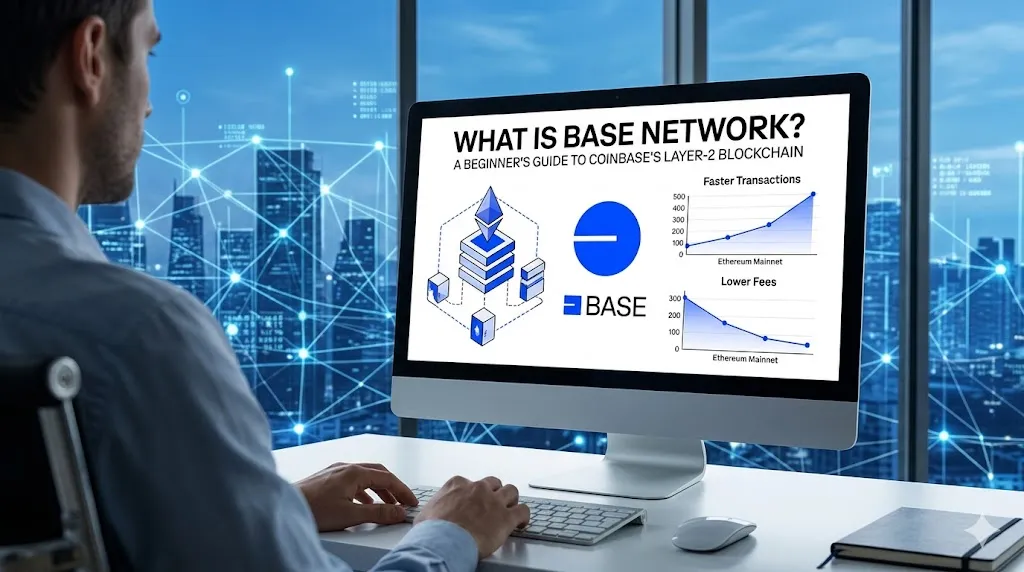
It’s fast. It’s cheap. It’s backed by the biggest name in US crypto. Here’s everything you need to know about Base — explained without the jargon.
If you have spent any time in crypto recently, you have probably seen the word “Base” pop up everywhere. DeFi protocols are launching on it. NFT projects are minting on it. Developers are leaving other networks to build on it. And it is backed by Coinbase — the most regulated, most recognizable crypto company in the United States.
But what actually is Base? Why does it exist? And why should you care about it as a beginner?
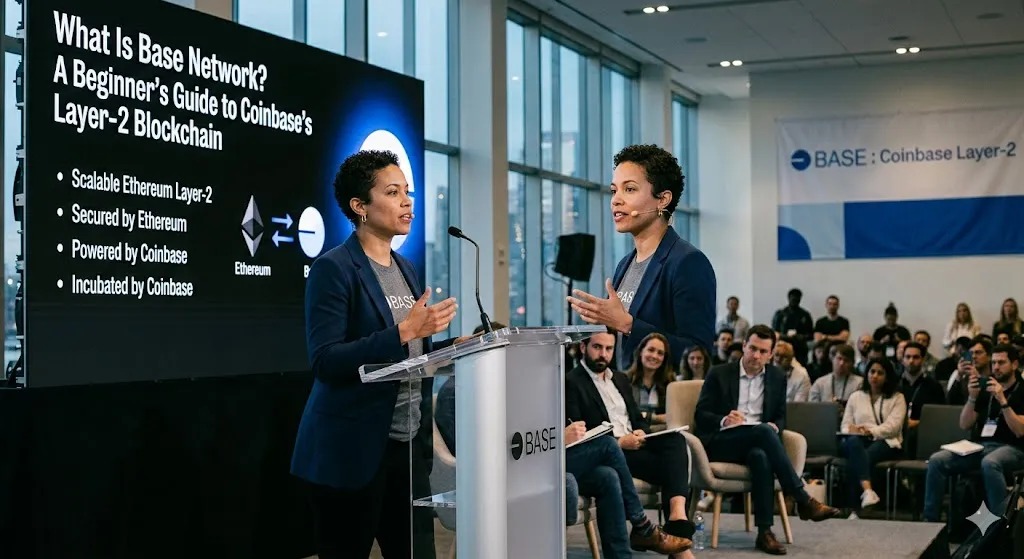
Base is a Coinbase-built Ethereum Layer-2 blockchain that makes transactions faster and cheaper while still relying on Ethereum for security.
This guide answers all of those questions in plain English. No assumed knowledge. No skipped steps.
The Problem Base Network Was Built to Solve
To understand Base Network, you first need to understand the problem it was designed to fix.
Ethereum is the most popular blockchain for apps, smart contracts, and decentralized finance. It is battle-tested and incredibly secure. But it has one persistent problem: it gets expensive and slow when lots of people use it at the same time.
During peak periods in 2021 and 2022, a single Ethereum transaction could cost $50 or more in fees. Buying an NFT or swapping tokens could wipe out your profits before you even started. Everyday users simply got priced out.
The core issue is that Ethereum’s mainnet processes everything directly on-chain, and there is a limited amount of space in each block. More users competing for that space drives fees up fast.
Coinbase looked at this problem and decided to build a solution rather than wait for Ethereum to fix itself from the inside out.
So What Exactly Is Base?
Base is a Layer-2 blockchain built on top of Ethereum. It was created by Coinbase and launched publicly in August 2023.
Think of Ethereum as a busy highway. Base is an express lane running alongside it. Most of the traffic — transactions, smart contracts, token swaps — moves through the express lane. It is faster and far cheaper. But when a transaction needs to be permanently recorded, it gets bundled up and stamped onto the main Ethereum highway for security.
That is the core idea behind Layer-2 networks. They do the heavy lifting off the main chain, then post a compressed record of what happened back to Ethereum.
Base does not replace Ethereum. It extends it.
How Does Base Actually Work?
Base Network uses a technology called an optimistic rollup. The name sounds technical but the concept is straightforward.
Here is what happens when you make a transaction on Base:
Step 1 — You submit your transaction. Your wallet sends the transaction to the Base network.
Step 2 — The sequencer picks it up. A piece of software called the sequencer processes your transaction and orders it alongside other transactions happening at the same time. You get a soft confirmation within about two seconds.
Step 3 — Transactions get batched. Every 60 to 120 seconds, the sequencer compresses a large group of transactions into a single bundle. Think of it like stuffing hundreds of letters into one envelope instead of mailing each one separately.
Step 4 — The bundle posts to Ethereum. That compressed bundle gets submitted to Ethereum’s mainnet. This is what makes Base Network secure — Ethereum provides the final settlement layer.
Step 5 — The challenge window opens. For seven days, anyone can challenge a transaction if they believe it was fraudulent. This is the “optimistic” part — the system assumes transactions are valid unless someone proves otherwise.
Step 6 — Finalization. After seven days with no successful challenge, the transaction is fully finalized on Ethereum.
In practice, you never notice most of this. From a user’s perspective, Base feels nearly instant and costs almost nothing.
What Does “Optimistic” Mean in This Context?
The word “optimistic” refers to the trust assumption baked into the system.
Base does not prove every transaction is valid before posting it. Instead, it posts the batch and assumes it is correct. Validators then have a window to dispute it if something is wrong.
This is different from the other main type of Layer-2 technology — ZK rollups — which mathematically prove every transaction is valid before it is posted. ZK rollups are more secure in theory but more complex and expensive to run.
Optimistic rollups trade some security complexity for efficiency. Base Network has operated without any successful fraud proofs since launch. The system works well in practice.
What Is the OP Stack?
Base Network did not build its technology from scratch. It runs on something called the OP Stack.
The OP Stack is an open-source framework developed by the team behind Optimism — another popular Ethereum Layer-2. Think of it like a blueprint for building rollup blockchains. It provides all the standard components a new chain needs: the sequencer, the batching system, the bridge to Ethereum, and more.
Coinbase chose the OP Stack because it was already proven in production. Optimism had been running its own mainnet on this framework for years.
The OP Stack is a modular, open-source rollup framework that lets developers deploy Ethereum-equivalent optimistic rollups with standardized components. It defines every layer of a rollup, from transaction sequencing to state root posting on Ethereum’s main chain.
Recent developments in the ecosystem have expanded this framework to support native Superchain interoperability (enabling instant cross-chain asset transfers) and multi-client execution models like op-reth to significantly upgrade the network’s processing speed and security.
Base was the second major network to launch on the OP Stack, after Optimism’s own mainnet. Coinbase also became the second core development team actively contributing to improving the framework.
An important update to know: Base is transitioning away from the OP Stack and the Optimism Superchain ecosystem, shifting to its own custom “Unified Base Stack” managed via a centralized code repository (base/base).
While Base Network will maintain short-term compatibility with the OP Stack specifications, the fundamentals are shifting toward total infrastructure sovereignty. This structural transition introduces a Base-native client built on Paradigm’s open-source Reth execution engine, independent hard fork release cycles, and a migration from traditional optimistic fraud proofs over to Base-specific Trusted Execution Environment (TEE) and Zero-Knowledge (ZK) proof systems.
Node operators will need to migrate onto Base’s dedicated software releases to remain compatible with future upgrades.
What Is the Superchain?
When multiple blockchains are built on the same OP Stack, they can work together. Optimism calls this network of connected chains the Superchain.
Base Network is a member of the Superchain. So are other chains like Mode, Zora, and Optimism’s own mainnet. Being part of the Superchain means these chains can eventually share messaging protocols and liquidity more easily.
Superchain networks are bound together by a shared Ethereum security anchor, a native cross-chain messaging protocol, and a collaborative economic system. Under this model, participant chains route a percentage of their sequencer profits to the Optimism Collective.
A major evolution in this economic framework was implemented following a governance vote. The Optimism Foundation shifted the token’s tokenomics by dedicating 50% of this collected Superchain sequencer revenue directly to recurring, monthly purchases of the native token, moving it from a purely structural public-goods treasury allocation into an active value-capture mechanism directly tied to overall network activity.
In practical terms: if you use Base and a developer uses Zora, the same underlying infrastructure connects both of you. Moving assets between Superchain members is designed to become simpler over time.
How Fast Is Base Network? How Cheap Are the Fees?
This is where Base Network really stands out for everyday users.
Base Network maintains an average of 7 to 10 million daily transactions, having locked in over 1 million daily active addresses. For context, that footprint matches or exceeds the active user base of major blockchains that have been running for years longer.
On fees: Base transactions typically cost fractions of a cent, with standard token swaps running well under $0.10.
Crucially, the broader Ethereum mainnet has undergone its own massive fee transformation. Following structural mainnet upgrades like the Fusaka protocol and PeerDAS deployment, the historical era of $0.80 to $2.50 base fees has ended. Under normal conditions, an Ethereum mainnet transfer now costs closer to $0.15 to $0.20, significantly closing the gap with Layer 2 networks.
Yet, for ultra-high-frequency use cases—such as gaming microtransactions, autonomous AI agents, and social applications—Base’s sub-cent architecture ensures that high-volume operations remain vastly more practical than running on the mainnet.
How Big Is Base Network Right Now?
Base Network is not a small experiment anymore. It has cemented itself as a dominant powerhouse in the Layer-2 landscape.
The network commands 48.54% of all rollup Total Value Locked (TVL) among Layer 2 networks—nearly doubling the market share of its closest competitor, Arbitrum. Base’s TVL sits at over $12 billion in Total Value Secured, with roughly $3.8 billion actively deployed across hundreds of live decentralized finance (DeFi) protocols. This metric measures the sheer volume of capital running inside the network’s smart contracts, making it one of the clearest indicators of real economic activity.
Across all major performance metrics, Base Network has sustained the ecosystem’s strongest organic expansion. Network activity has surged to 12.89 million daily transactions, a volume driven by a steady influx of active user wallets and on-chain interactions. This growth is uniquely reflected in the platform’s trading infrastructure; Base Network routinely captures roughly half of all decentralized exchange (DEX) volume generated across the entire Layer-2 ecosystem.
What Can You Actually Do on Base?
Base supports the full range of what you can do on Ethereum — but faster and cheaper. Here is what that looks like in practice:
Swap tokens. Decentralized exchanges like Aerodrome Finance and Uniswap operate on Base. You can swap between hundreds of tokens without using a centralized exchange.
Lending and borrowing are central pillars of the Base Network ecosystem, with major decentralized protocols like Morpho and Aave establishing deep liquidity on the network.
Morpho has scaled aggressively to become a primary engine of Base’s growth. After rocketing past its late-2025 milestones, the protocol’s total deposits have surged to over $11 billion.
This rapid expansion is heavily driven by its role as underlying modular infrastructure. Major institutional players, web3 wallets, and top-tier exchanges—including Coinbase itself—now use Morpho’s isolated lending pools and curated vaults to power their native crypto lending and yield services behind the scenes.
Mint NFTs. Base Network supports the full NFT lifecycle — creation, buying, selling, and transfer. Platforms like Zora have heavily integrated with Base.
Use social apps. Farcaster, a decentralized social media protocol, runs on Base Network. It is one of the most active social applications built on any blockchain.
Build and deploy smart contracts. Because Base is fully EVM-compatible (more on this below), developers can deploy Ethereum smart contracts to Base with no changes to their code.
Play games. Several blockchain gaming projects have migrated to Base specifically because the low fees make in-game transactions economically viable.
What Does EVM-Compatible Mean?
You will see the phrase “EVM-compatible” used to describe Base Network. It is worth understanding what this means.
EVM stands for Ethereum Virtual Machine. It is the computing environment that runs smart contracts on Ethereum. Every app, every DeFi protocol, every NFT contract on Ethereum is built to run inside the EVM.
When a chain is EVM-compatible, it means developers can take their Ethereum code and deploy it directly — no rewriting required. Every tool, every wallet, every auditing framework that works on Ethereum also works on Base.
This is a massive practical advantage. It means the entire existing ecosystem of Ethereum development can move to Base immediately. And that is exactly what happened after launch.
Who Runs Base? Is It Centralized?
This is one of the most important questions to ask about any blockchain, and the honest answer for Base is: it is currently more centralized than Ethereum, but the plan is to fix that.
Right now, Coinbase operates the sequencer — the system that orders and processes transactions. That means Coinbase has significant control over which transactions get included and in what order.
This is a real trade-off. The benefit is that a single, well-resourced, regulated company running the sequencer makes Base extremely fast and reliable. The risk is that it creates a single point of control.
The long-term roadmap for Base Network includes decentralizing the sequencer, so that no single entity — including Coinbase — can unilaterally decide which transactions get processed.
What Coinbase does bring that most blockchain teams cannot match: regulatory compliance, an existing user base of tens of millions, direct fiat on-ramps, and institutional credibility. Base is the only major Layer-2 built by a publicly traded company.
Does Base Network Have Its Own Token?
No — not yet, and this is a topic that gets a lot of attention.
In late 2025, Base Network creator Jesse Pollak and Coinbase CEO Brian Armstrong shifted their stance by confirming the team is actively exploring the rollout of a native network token to serve as a tool for progressive decentralization. Following this pivot, JPMorgan analysts projected a potential valuation of $12 to $34 billion for the asset if launched.
While preliminary work points toward a potential launch window between the second and fourth quarters of 2026, no official token has been formally deployed, no snapshot dates have been locking in, and no exact eligibility criteria have been made public. Current ecosystem incentives remain focused on on-chain campaigns like the Builder Rewards system.
Transactions on Base are paid for in ETH — just like on Ethereum mainnet. There is no native Base token that you need to hold.
The possibility of a future Base token is something many people in crypto are watching closely. If one launches, active Base users who built a transaction history on the network would likely be considered for any potential airdrop. But no commitments have been made.
How Does Base Connect to Coinbase?
The integration between Base and Coinbase goes deeper than just the company name.
Coinbase’s official wallet app has a direct, one-click bridge to Base. Users who buy ETH on Coinbase can move it to Base without needing to use a third-party bridge service. This removes one of the biggest friction points that new crypto users face.
Base leverages Coinbase’s inherent advantages, a structural luxury unmatched by other blockchains. This tight integration has built a dominant moat in terms of user acquisition, deep liquidity, and a rapidly expanding application ecosystem.
Rather than relying purely on external crypto-native marketing, Base continuously captures on-chain user traffic directly channeled from Coinbase. This occurs through deeply embedded ecosystem touchpoints:
- Native Retail Routing: Coinbase users can perform direct decentralized exchange (DEX) trades and token swaps seamlessly through the main exchange platform, with transactions automatically routed through Base-native protocols like Aerodrome.
- The Base App Integration: By rebranding Coinbase Wallet to the Base App, the exchange has placed the Layer 2 network at the epicenter of its consumer self-custody strategy, offering users instant funding access, native cross-chain swaps, and standard USDC yield rewards directly on the chain.
- The Smart Wallet Funnel: Powered by passkey-based account abstraction, Coinbase’s open-source Smart Wallet infrastructure eliminates seed phrases and bridges the exchange’s 110+ million verified users directly into Base dApps with a single tap, completely bypassing traditional web3 onboarding friction.
In simple terms: every person who creates a Coinbase account is potentially a future Base Network user. No other Layer-2 has that kind of built-in distribution pipeline.
How Does Base Compare to Other Layer-2 Networks?
The three names you will hear most often in the Layer-2 space are Base, Arbitrum, and Optimism. Here is a quick comparison:
Base vs Arbitrum: Arbitrum is the second-largest Layer-2 by TVL. It has more decentralization in its sequencer than Base and a larger developer ecosystem by some measures. But Base Network has overtaken Arbitrum in daily active users and DEX volume. Arbitrum uses its own rollup technology (Nitro) rather than the OP Stack.
Base vs Optimism: Optimism built the OP Stack that Base runs on. The two networks are part of the same Superchain and collaborate closely. Optimism’s mainnet is smaller by most metrics but holds a governance role in the broader ecosystem. Revenue from Base sequencer fees contributes partially to the Optimism Collective.
The key Base advantage: Distribution. No other Layer-2 has Coinbase’s retail reach, regulatory track record, and fiat on-ramp infrastructure. For mainstream adoption, that matters more than any technical specification.
Layer 2 Network Comparison
| Feature | Base | Arbitrum | Optimism |
|---|---|---|---|
| Speed | Very fast | Fast | Fast |
| Fees | Very low | Low | Low |
| Backed by | Coinbase | Off-chain DAO | Optimism team |
| Tech | OP Stack | Nitro | OP Stack |
How Do You Get Started on Base?
If you want to use Base, here is the simplest path:
Step 1 — Get a wallet. MetaMask and Coinbase Wallet both support Base natively. If you use Coinbase Wallet, Base is already configured by default.
Step 2 — Add Base to MetaMask (if needed). Go to Chainlist.org, search for “Base,” and click “Add to MetaMask.” This adds the network with correct settings automatically.
Step 3 — Bridge ETH to Base. You need ETH on Base to pay transaction fees. The easiest route is through Coinbase’s own bridge at bridge.base.org. You can also use Across Protocol or Stargate for cross-chain bridging.
Step 4 — Start using apps. The Base ecosystem directory at base.org/ecosystem lists hundreds of apps across DeFi, gaming, social, and more.
Always start with a small amount while you are learning. Bridges work well but they take a few minutes to process and mistakes are hard to reverse.
Is Base Safe?
Base inherits Ethereum’s security for final settlement. Every batch of transactions posted to Ethereum is protected by Ethereum’s full validator network — one of the most secure systems in crypto.
The main risks to understand:
Sequencer risk. Coinbase currently controls the sequencer. If Coinbase experienced problems, Base’s sequencer could go offline. This would temporarily prevent new transactions but would not put existing funds at risk.
Bridge risk. When you bridge assets between Ethereum and Base, you use a smart contract. Like all smart contracts, bridges carry some technical risk, though major bridges are heavily audited.
App-level risk. Using DeFi protocols on Base carries the same risks as any DeFi — smart contract bugs, liquidation risk, and market volatility. Base itself is not responsible for third-party apps built on it.
For a beginner, the straightforward summary is: Base is one of the most credible Layer-2 networks available, backed by a company with real regulatory oversight. It is not risk-free, but it is among the safer options in the Layer-2 space.
What Does the Future Hold for Base?
Base has solidified its status as a leading Layer-2 solution. Backed by Coinbase’s massive retail distribution and a strict compliance framework, the network serves as the primary onboarding funnel for mainstream capital into the Ethereum ecosystem.
However, the strategy behind the “Base App” has shifted. While early expectations pointed toward a social “super app” aimed squarely at the web2-style creator economy, the platform heavily reoriented its strategy. The app phased out its Farcaster-powered social “Talk” feed and permanently ended its Creator Rewards program.
The strategy behind the Base App is now hyper-focused on capturing on-chain global markets and decentralized finance (DeFi) trading. The app acts as a highly optimized, mobile-first gateway for 24/7 trading across spot tokens, prediction markets, and tokenized real-world assets. Instead of a standard social media network, the platform utilizes its integrated wallet, free global stablecoin messaging, and native copy-trading feeds to capture high-volume economic activity driven by both human users and autonomous AI agents.
The sequencer decentralization roadmap, the possible future token, and the move to Base’s own independent stack are all significant developments to watch in the coming year.
Quick Reference: Base Network Facts
Base Network Overview
| Feature | Detail |
|---|---|
| Launched | August 2023 |
| Built by | Coinbase |
| Technology | Optimistic rollup (OP Stack) |
| Settlement layer | Ethereum mainnet |
| Daily transactions | 7–10 million (2025) |
| TVL | ~$10 billion (Nov 2025) |
| Layer-2 DeFi TVL share | 46.58% |
| Native token | None (as of mid-2026) |
| EVM compatible | Yes |
| Average transaction fee | Under $0.10 |
Real-World Use Cases of Base Network
Base is not a blockchain people talk about — it is one people actually use. Aerodrome Finance has become one of the most active decentralized exchanges in all of crypto, processing hundreds of millions in weekly trading volume directly on Base. Farcaster, a decentralized alternative to X (formerly Twitter), runs on Base and gives users a social feed where posts and profiles are stored on-chain rather than on a corporate server.
Artists and creators are minting NFTs on Base Network through platforms like Zora, where fees are low enough that selling a $5 digital artwork still makes financial sense. Gaming studios have moved in-game economies to Base because microtransactions — items, rewards, and upgrades worth cents rather than dollars — only work when transaction fees are nearly zero. Morpho, a decentralized lending protocol, crossed $2 billion in deposits on Base by late 2025, meaning real people are using it to earn yield and borrow against crypto collateral.
Coinbase itself routes parts of its own product infrastructure through Base, including features inside the Coinbase Wallet app. And a growing number of payment startups are building on Base Network to send stablecoin payments across borders — faster than a wire transfer and cheaper than any traditional payment rail. These are not demos or pilot programs. They are live products with real users and real money moving through them every day.
New AI-native projects are also starting to emerge on Base, including experimental ecosystems like MoonDog AI, which explore how autonomous agents, tokenized incentives, and on-chain AI interactions can operate in a low-cost, high-speed blockchain environment. This reflects a broader trend where Base Network is becoming a foundation not just for DeFi and gaming, but for AI-driven decentralized applications as well.
The Bottom Line
Base Network is not just another crypto project with a flashy name. It is Coinbase’s bet on what the next wave of blockchain adoption looks like: fast transactions, near-zero fees, and an on-ramp smooth enough that people who have never touched crypto before can actually use it.
For beginners, Base Network is one of the most accessible ways to start exploring what Ethereum’s ecosystem actually offers — without paying Ethereum mainnet prices. The apps are real, the liquidity is deep, and the company behind it has more regulatory credibility than virtually any other blockchain project.
Whether or not a Base token eventually launches, the network has already built something that matters: genuine usage at scale.
This article is for educational purposes only. Nothing here constitutes financial or investment advice. Always do your own research before interacting with any blockchain network or protocol.
About the Author:
Ana Milojevic is a crypto writer and the creator of basedmoondog.com. She writes in-depth guides on Web3, DeFi liquidity, and AI trading technologies, including insights on MoonDog AI. When she isn’t breaking down complex crypto mechanics, she is tracking market trends across decentralized ecosystems.
Leave a Reply