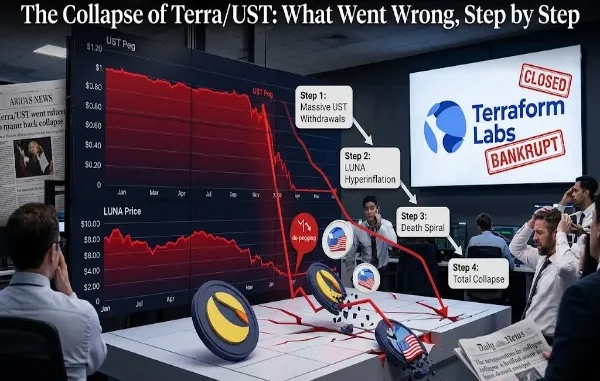
Introduction
In May 2022, one of the cryptocurrency industry’s most dramatic financial collapses unfolded in a matter of days. TerraUSD (UST), a digital currency designed to maintain a value of $1, lost its dollar peg. Its sister cryptocurrency, LUNA, then experienced an extraordinary collapse in value as investors rushed to exit the Terra ecosystem.
The consequences extended far beyond two cryptocurrencies. Investors lost billions of dollars, decentralized finance platforms faced severe disruption, and confidence in algorithmic stablecoins suffered a major setback. The event also raised fundamental questions about financial engineering, market incentives, investor protection, and the risks of building an entire financial ecosystem around a mechanism that depends on continued market confidence.
Terra’s collapse is particularly important because UST was not a small, experimental project by the time it failed. It had become one of the largest stablecoins in the cryptocurrency market, with a reported market capitalization of approximately $18.7 billion at its peak. Its sister token, LUNA, had also attracted substantial investment.
So what went wrong?
The answer involves several interconnected problems: an unstable stabilization mechanism, heavy dependence on an attractive lending product, insufficient confidence in the system during a crisis, and a feedback loop that turned falling prices into an accelerating collapse.
Understanding the failure requires examining how Terra worked before the crisis, what happened during the first days of May 2022, and why the system could not recover once investors began losing confidence.
1. Understanding Terra, UST, and LUNA
Before examining the collapse, it is important to distinguish between the three main components of the Terra ecosystem.
Terra was a blockchain ecosystem designed to support cryptocurrency payments, decentralized applications, and financial services.
TerraUSD (UST) was an algorithmic stablecoin intended to maintain a value of approximately one US dollar. Unlike traditional stablecoins that seek to support their value through reserves of cash or other assets, UST primarily relied on a market mechanism involving its sister token.
LUNA was the ecosystem’s native cryptocurrency. It played a central role in the mechanism intended to keep UST close to $1. LUNA was also used for network-related functions and had become an important speculative investment.
The relationship between UST and LUNA was the foundation of Terra’s monetary design. It was also the central weakness that became apparent during the collapse.
The system assumed that market participants would continue to trade UST and LUNA in ways that helped restore UST’s dollar peg. As long as sufficient demand and confidence existed, the mechanism could appear to work effectively.
However, a system that relies on confidence in one cryptocurrency to stabilize another faces a serious problem when both assets come under pressure simultaneously.
2. How UST Was Supposed to Maintain Its $1 Value
UST used an algorithmic stabilization mechanism based on the ability to exchange UST for approximately $1 worth of LUNA through the protocol.
The mechanism created an economic incentive for traders to take advantage of price differences.
When UST traded above $1
Imagine that demand for UST increased and its market price rose to $1.02.
Under the protocol’s mechanism, an eligible trader could use $1 worth of LUNA to create one UST. If that newly created UST could then be sold for $1.02, the trader would have an incentive to perform the exchange.
As traders created and sold additional UST, its supply increased. This additional supply could help push its market price back toward $1.
When UST traded below $1
Now imagine that UST fell to $0.98.
An eligible trader could buy one UST for $0.98 and exchange it through the protocol for approximately $1 worth of LUNA, subject to the protocol’s rules, limits, and market conditions.
The trader could then sell the LUNA and potentially earn a profit. The redemption process removed UST from circulation while creating or releasing LUNA, helping UST move toward its intended price.
In theory, this mechanism encouraged arbitrageurs to stabilize the system without requiring every UST token to be backed by a dollar in a bank account.
In practice, however, the mechanism depended on a crucial assumption: LUNA had to retain enough market value and liquidity for the exchanges to function as intended.
If LUNA’s price fell sharply, the system would need to issue increasingly large quantities of LUNA to meet redemptions. If investors then sold that newly issued LUNA, its price could fall even further.
The mechanism that was supposed to stabilize UST could therefore become a source of instability.
3. The Role of Anchor Protocol and Its Attractive Returns
UST’s growth was closely connected to Anchor Protocol, a lending and borrowing platform within the Terra ecosystem.
Anchor became famous for offering UST depositors an advertised annual yield of approximately 20%. For investors seeking returns in a market increasingly filled with volatile assets, this appeared unusually attractive.
The appeal was straightforward. Instead of holding a cryptocurrency whose price might rise or fall dramatically, investors could deposit UST into Anchor and earn returns while expecting each token to remain worth approximately one dollar.
For many users, Anchor became the principal reason to acquire and hold UST.
This created a powerful cycle of demand:
- Investors purchased UST to access Anchor’s deposit yields.
- Demand for UST helped expand its circulation and market capitalization.
- The growing ecosystem attracted additional investors and developers.
- Continued growth strengthened confidence in Terra and its associated tokens.
However, the apparent stability of this arrangement concealed a significant economic problem.
A high deposit yield must ultimately be supported by some combination of income from borrowers, investment returns, fees, or external subsidies. When the returns paid to depositors substantially exceed the income generated by the underlying lending activity, the difference must be funded somehow.
Anchor’s advertised yield was not equivalent to a guaranteed return from a risk-free investment. Its economics depended partly on incentives and reserve support rather than solely on sustainable lending income.
This mattered because Anchor became a major source of demand for UST. If depositors began to doubt the attractiveness or sustainability of its returns, they could withdraw their funds and sell UST.
The ecosystem therefore faced a concentration risk: a substantial portion of demand depended on one product offering a particularly attractive financial incentive.
When that demand weakened, the consequences would affect much more than Anchor itself.
4. Terra’s Growth Created an Illusion of Security
By early 2022, Terra had developed a large and active ecosystem. UST was widely discussed in cryptocurrency markets, Anchor held substantial deposits, and LUNA had become a major digital asset.
The project’s growth reinforced the belief that its stabilization mechanism had been tested and proven.
Yet growth and resilience are not the same thing.
A financial system can function for an extended period under favorable conditions while remaining vulnerable to a sudden change in investor behavior. A stable market price does not necessarily demonstrate that a stabilization mechanism can withstand a large, simultaneous rush toward the exits.
Terra’s apparent strength depended on several related conditions:
- Investors continued to demand UST.
- LUNA retained sufficient market value and liquidity.
- Arbitrageurs remained willing and able to participate in the stabilization mechanism.
- Anchor remained attractive enough to encourage investors to hold UST.
- The wider cryptocurrency market did not experience a shock large enough to undermine confidence.
These conditions reinforced one another during the expansion. However, they could also deteriorate together.
The more investors relied on the same interconnected assets and incentives, the greater the risk that a crisis in one part of the ecosystem would spread rapidly to the others.
This was the central structural problem: Terra’s components were not independent sources of stability. They were connected through the same underlying confidence in the ecosystem.
5. May 7, 2022: The First Signs of Trouble
The crisis began to develop on May 7, 2022, when significant amounts of UST were sold or withdrawn from important trading pools.
One of the most closely watched locations was Curve Finance, a decentralized exchange used to trade stablecoins. Its liquidity pools allowed traders to exchange UST for other stablecoins, including assets designed to maintain their own dollar pegs.
When a large amount of UST entered the market for sale, the balance between the assets in these pools changed. Liquidity became less favorable for sellers, and UST began trading below its intended dollar value.
The initial deviation was relatively small. UST briefly fell below $1, reaching approximately $0.985 during the first stage of the disruption.
Under normal circumstances, such a deviation might not have been alarming. Stablecoins can experience temporary price fluctuations when markets become volatile, and arbitrage activity often helps restore their pegs.
However, the situation was different for UST because its stability depended heavily on confidence in the LUNA conversion mechanism.
The initial price decline raised an important question: if UST was supposed to be stable, why were investors selling it, and would the system be able to absorb continued selling pressure?
As withdrawals from Anchor increased and LUNA’s price began to weaken, the market started to reveal how closely the system’s different components were connected.
The first decline did not immediately destroy Terra. Instead, it exposed a vulnerability that became much more dangerous as selling intensified.
6. May 8: Confidence Begins to Weaken
On May 8, the initial disruption developed into a broader test of Terra’s stabilization mechanism.
Investors monitored UST’s price, Anchor’s withdrawals, and the behavior of LUNA. Some participants viewed the deviation as a temporary market imbalance, while others became concerned that the system might struggle if large numbers of holders attempted to exit simultaneously.
Anchor began experiencing substantial withdrawals. As investors removed their deposits, they needed to decide whether to keep holding UST elsewhere, exchange it for another asset, or leave the Terra ecosystem altogether.
Each withdrawal reduced the amount of capital remaining within the platform and potentially increased the supply of UST available for sale.
The Luna Foundation Guard (LFG), an organization established to support UST’s stability, announced plans to deploy substantial reserves to defend the dollar peg.
Its reserves included Bitcoin and other cryptocurrency assets intended to provide an additional source of support during a crisis.
The intervention demonstrated that the ecosystem had access to resources beyond the automatic UST-LUNA conversion mechanism. Nevertheless, the existence of reserves did not guarantee that the peg could be maintained under every market condition.
The reserves were finite, market liquidity was limited, and restoring confidence required more than simply purchasing UST.
Investors needed to believe that the intervention would work and that future selling pressure could be absorbed without exhausting the available resources.
By this stage, Terra faced both a liquidity problem and a confidence problem. The two were becoming increasingly difficult to separate.
7. May 9: UST Loses Its Peg More Dramatically
On May 9, selling pressure intensified, and UST fell much further below $1. At points during the day, it traded at approximately $0.60 on major exchanges.
The significance of this decline went beyond the immediate loss in market price.
A stablecoin trading at $0.60 creates a powerful incentive for holders to question whether they should continue accepting the possibility of further losses. At the same time, the discount indicates that the market is no longer confident that the stabilization mechanism can restore the intended value quickly and reliably.
Investors who believed they could exchange UST for another stable asset began seeking exits. Others attempted to exploit the difference between UST’s market price and its intended redemption value.
However, the system’s capacity to absorb these transactions was not unlimited.
The LUNA token was now under substantial pressure. As UST redemptions increased, the protocol’s mechanism could create more LUNA. That additional supply had to be absorbed by a market already becoming less willing to hold the token.
The result was a dangerous combination:
- UST holders wanted to leave the system.
- The mechanism responded by creating additional LUNA.
- The market sold LUNA, pushing its price lower.
- The falling LUNA price weakened confidence in UST’s stabilization mechanism.
- More investors sought to exit UST.
This was the beginning of the feedback loop that would ultimately destroy both assets.
The critical point is that the mechanism could continue operating according to its rules while failing to achieve its economic objective. A protocol can process redemptions without actually restoring confidence or delivering the market value that investors expect.
8. The Death Spiral: How UST and LUNA Destroyed Each Other
The term death spiral describes the self-reinforcing collapse that occurred when UST’s falling price triggered more LUNA issuance, which then contributed to further declines in LUNA’s price.
Consider a simplified example.
Imagine that UST is trading at $0.80. An arbitrageur purchases 100,000 UST for $80,000.
Under the protocol’s conversion mechanism, those tokens could be redeemed for approximately $100,000 worth of LUNA at the applicable protocol valuation, subject to its operational rules and limits.
The arbitrageur might then sell the newly created LUNA to realize the difference.
Under favorable conditions, this activity would reduce the supply of UST and help restore its peg. But during a severe crisis, the newly created LUNA could enter a market where buyers were disappearing and existing holders were already selling.
If LUNA’s market price fell, each subsequent redemption required an even greater number of LUNA tokens to represent the same dollar value.
That additional issuance increased the potential selling pressure on the token.
The process could be summarized as follows:
UST falls below $1 → redemptions increase → more LUNA is issued → LUNA’s price falls → confidence deteriorates → more UST is sold.
This feedback loop was especially destructive because the two assets depended on each other for their economic credibility.
UST needed LUNA to support its stabilization mechanism. LUNA, in turn, depended on confidence in Terra’s broader ecosystem, including the belief that UST could maintain its dollar peg.
Once confidence in UST collapsed, LUNA could no longer serve as a credible stabilizing asset at the scale required.
The mechanism was not simply facing a temporary price fluctuation. It was confronting a crisis in which the asset intended to absorb losses was itself losing value rapidly.
Why the mechanism became ineffective
The design relied on arbitrageurs treating the protocol’s conversion value as an opportunity. But an exchange mechanism cannot guarantee that the resulting assets will retain the expected market value.
If traders can receive LUNA with a nominal value of $100,000 but must sell it into a market with insufficient demand, their actual proceeds may be substantially lower.
As confidence weakens, the gap between theoretical redemption value and realizable market value becomes increasingly important.
The protocol could therefore create enormous quantities of LUNA without generating enough genuine buying demand to support its price.
Eventually, the very process intended to stabilize UST accelerated the collapse of both tokens.
9. May 10: Emergency Interventions Fail to Restore Stability
By May 10, the crisis had spread across the Terra ecosystem.
The Luna Foundation Guard deployed substantial reserves in an effort to support UST. Its Bitcoin holdings were particularly important because Bitcoin could potentially be exchanged for other assets used to defend the peg.
The intervention was intended to create buying demand for UST and reduce the imbalance between sellers and buyers.
However, using reserves to defend a currency works only if the resources available are sufficient relative to the scale and duration of the selling pressure, and if the intervention can restore market confidence.
Terra’s reserves were substantial, but the market was experiencing a rapidly escalating crisis.
LFG later reported that its Bitcoin holdings had fallen from 80,394 BTC before the collapse to just 313 BTC by May 16. The organization stated that the reserves had been used in attempts to support UST.
The depletion of the reserves highlighted a fundamental limitation: external assets could provide temporary assistance, but they could not indefinitely compensate for the loss of confidence in the underlying stabilization mechanism.
At the same time, UST continued to trade far below its intended value, while LUNA’s price declined sharply.
The market was increasingly treating both tokens as distressed assets rather than as components of a functioning monetary system.
Emergency purchases could influence prices temporarily, but they could not easily reverse the expectations of investors who believed that further losses were likely.
By this point, the crisis had moved beyond what the original mechanism was designed to handle.
10. May 11–12: LUNA’s Supply Explodes
As redemptions continued, the amount of LUNA in circulation increased dramatically.
The protocol’s mechanism allowed UST holders to redeem their tokens for LUNA based on the intended dollar value of the exchange. As LUNA’s market price collapsed, increasingly large quantities of the token were needed to represent each dollar of redemption value.
This caused an extraordinary expansion in LUNA’s supply.
The growing supply created additional pressure on an already distressed market. Existing holders faced the prospect of dilution, while potential buyers had little reason to purchase the token if they expected further issuance and falling prices.
The market capitalization of LUNA fell sharply, undermining the economic credibility of the mechanism intended to support UST.
The system was caught in a destructive contradiction: the more it attempted to process redemptions through LUNA, the more LUNA it created, and the less credible its stabilization mechanism became.
Meanwhile, UST continued to lose value.
The result was a collapse in which the two assets reinforced each other’s decline rather than providing mutual support.
As the crisis worsened, Terra’s blockchain validators also halted the network temporarily during the emergency. Trading conditions across cryptocurrency exchanges became increasingly chaotic, and some platforms restricted or suspended trading in the affected assets.
By May 12, the original Terra system had suffered a catastrophic loss of market confidence.
11. Why the Bitcoin Reserves Could Not Save UST
The Luna Foundation Guard’s Bitcoin reserves were intended to provide an additional line of defense.
The basic idea was that, if UST lost its peg, reserve assets could be sold or deployed to purchase UST. This would create additional demand and help restore the stablecoin’s price.
But the strategy faced several limitations.
Reserves were finite
Even a reserve worth billions of dollars can be overwhelmed if the market value of the assets requiring support is large and investors attempt to exit at the same time.
The larger UST became, the more capital potentially needed to defend its peg during a severe crisis.
Reserve assets were volatile
Bitcoin is itself a volatile cryptocurrency. Its market value can change significantly, especially during periods of stress.
A reserve held in Bitcoin is therefore not equivalent to a reserve held entirely in cash or short-term government securities. The value available to defend UST could fluctuate precisely when the system needed certainty.
Market liquidity was limited
Large transactions can move market prices. Selling or exchanging substantial quantities of reserve assets under pressure can create unfavorable execution prices and additional market volatility.
The ability to transfer reserves to an exchange is not the same as being able to restore a stablecoin’s peg at an acceptable cost.
Confidence was already damaged
Perhaps the most important limitation was psychological and economic.
Investors needed to believe that UST would remain stable after the immediate intervention ended. If they expected another wave of selling, they had an incentive to exit while they still could.
A reserve can help meet immediate demand, but it cannot automatically eliminate fears about future solvency, liquidity, or the sustainability of the system.
The failure of the intervention demonstrated that reserve support and a credible stabilization mechanism are different things. One can supplement the other, but neither guarantees success during a crisis.
12. How Much Value Was Lost?
The Terra collapse destroyed an extraordinary amount of cryptocurrency market value.
At its peak, UST had a reported market capitalization of approximately $18.7 billion. LUNA had also reached a market capitalization measured in tens of billions of dollars.
During the collapse, both assets fell to a small fraction of their previous values. By the end of May 2022, UST’s reported market capitalization had fallen to roughly $220 million, while LUNA’s value had nearly disappeared.
The combined losses are often described as approximately $40 billion to $60 billion, depending on the assets included, the valuation date, and the calculation method.
These figures refer primarily to the destruction of market value. They should not be interpreted as a precise measurement of cash withdrawn by investors or the amount of money lost by every individual holder.
Market capitalization is calculated by multiplying an asset’s market price by its circulating supply. When prices collapse, market capitalization can disappear much faster than investors could collectively withdraw equivalent amounts of cash.
Nevertheless, the financial damage was severe. Investors who purchased UST expecting stability suffered losses, while many LUNA holders saw the value of their investments collapse.
The event also affected lending platforms, liquidity providers, funds, and other businesses with exposure to Terra.
13. Was Terra Brought Down by a Coordinated Attack?
One of the most debated questions following the collapse was whether a coordinated attacker deliberately targeted UST.
The initial selling activity included large transactions that affected liquidity in important trading pools. Some market observers suggested that these transactions might have been designed to destabilize UST and profit from falling cryptocurrency prices.
Others argued that the initial transactions could have reflected ordinary portfolio adjustments, liquidity management, or investors responding to changing market conditions.
A distinction is necessary between identifying the transactions that preceded a crisis and proving that a coordinated attack caused it.
The available evidence does not establish a single, universally accepted explanation for every participant’s motives. Research examining the Terra collapse has also noted uncertainty surrounding claims of a coordinated attack.
More importantly, the system’s underlying vulnerabilities existed regardless of whether an attacker initiated the first major wave of selling.
A robust stabilization mechanism should be evaluated according to its ability to withstand foreseeable market pressure, including large withdrawals, concentrated selling, reduced liquidity, and a sudden loss of confidence.
Even if a deliberate attack had triggered the initial disruption, Terra’s subsequent collapse depended on the interaction between its economic design, the behavior of market participants, and the inability of its safeguards to restore confidence.
The question is therefore not simply who sold first. It is why the system could not survive once large-scale selling began.
14. The Regulatory Consequences
Terra’s collapse attracted intense scrutiny from regulators because it demonstrated how a cryptocurrency marketed as stable could expose investors to enormous losses.
In February 2023, the US Securities and Exchange Commission charged Terraform Labs and its founder, Do Kwon, with securities fraud involving UST and other crypto assets. The SEC alleged that investors had been misled about important aspects of the ecosystem, including the stability of UST and the use of the Terra blockchain in a prominent payment application.
These were allegations in a regulatory enforcement action, not merely conclusions drawn from the market crash itself.
In April 2024, a federal jury found Terraform Labs and Do Kwon liable for civil fraud in the SEC’s case. Later that year, the parties reached a settlement that included substantial financial remedies and restrictions concerning Terraform’s business.
The legal proceedings underscored the importance of distinguishing between a financial product’s advertised characteristics and the risks inherent in its actual design.
Calling a cryptocurrency a stablecoin does not make its price stable. Similarly, offering a high yield does not mean the return is guaranteed or supported by sustainable economic activity.
The collapse became an important case study in the relationship between financial innovation, disclosure obligations, and investor protection.
15. What Happened to Terra After the Collapse?
The original Terra ecosystem did not simply recover its former position.
In May 2022, a new blockchain network known as Terra 2.0 was launched following a community-led revival proposal. The new network introduced a new LUNA token, while the original chain continued under the name Terra Classic.
The original LUNA token subsequently became known as LUNC, and the original UST stablecoin became known as USTC.
Crucially, Terra 2.0 did not restore the original UST algorithmic stablecoin mechanism as the foundation of the new network.
The relaunch represented an attempt to continue some of the ecosystem’s development while moving away from the failed structure that had linked UST’s stability to LUNA’s market value.
However, launching a new token and blockchain could not reverse the losses suffered by investors in May 2022.
Nor did a new network automatically recreate the demand, trust, liquidity, or economic activity that had supported the original ecosystem.
The collapse remained a permanent reminder that restarting a protocol is not the same as repairing the financial damage caused by its failure.
16. The Main Lessons from Terra’s Collapse
Terra’s failure offers several important lessons for cryptocurrency investors, developers, and anyone evaluating a financial product that promises stability or unusually attractive returns.
Lesson 1: A stable price does not prove that a system is safe
UST remained close to $1 for an extended period before its final collapse. That historical stability did not guarantee that the mechanism could withstand a severe crisis.
Investors need to examine how a product behaves under stress, not only how it performs during favorable market conditions.
Lesson 2: The quality of collateral matters
An asset intended to stabilize another asset must have credible economic value when support is needed.
When the stabilizing asset is itself volatile and dependent on confidence in the same ecosystem, the two assets can become vulnerable to simultaneous losses.
This is fundamentally different from holding sufficient high-quality liquid reserves to meet redemption demands.
Lesson 3: High yields require careful examination
An advertised return of approximately 20% annually attracted substantial demand to Anchor.
However, investors must understand where a yield comes from, whether it is supported by sustainable income, whether subsidies are involved, and what risks remain if those subsidies end.
A high return is not necessarily fraudulent, but it should never be confused with a guaranteed or risk-free return.
Lesson 4: Liquidity can disappear when it is needed most
A financial asset may trade actively under normal conditions yet become difficult to sell at a reasonable price during a crisis.
Terra demonstrated how rapidly liquidity conditions can deteriorate when many investors seek the same exit simultaneously.
Investors should consider not only whether they can sell an asset in normal markets but also what might happen during a period of extreme stress.
Lesson 5: Incentives can amplify a crisis
Terra’s arbitrage mechanism was intended to encourage behavior that restored UST’s peg.
But when the underlying assumptions failed, the same incentives contributed to additional LUNA issuance and further selling pressure.
A mechanism that works in one set of market conditions can produce destructive outcomes in another.
Lesson 6: Interconnected systems can transmit losses rapidly
UST, LUNA, Anchor, and other Terra applications were closely connected.
The failure of one component affected the others, and losses spread through the ecosystem rather than remaining confined to a single product.
Investors evaluating decentralized finance projects should understand how assets, lending platforms, collateral, and stabilization mechanisms depend on one another.
Lesson 7: Reserves are useful only when they are credible and sufficient
Terra’s Bitcoin reserves represented a serious attempt to provide additional support. Yet the reserves were finite, and their deployment did not restore confidence.
A reserve fund should be assessed in relation to the liabilities it is expected to support, the liquidity of its assets, the conditions under which it can be used, and the transparency of its operations.
The mere existence of a reserve does not establish that every holder can redeem an asset at its advertised value.
Conclusion
The collapse of Terra and UST was not simply a story about a cryptocurrency price falling unexpectedly. It was a demonstration of how a financial mechanism can become unstable when its components depend on the same source of market confidence.
UST was designed to maintain a value of $1 through its relationship with LUNA. Anchor helped generate substantial demand by offering attractive deposit yields. Bitcoin reserves provided an additional attempt to defend the peg. Yet these elements could not prevent the system from unraveling once selling pressure intensified and investors began to doubt the mechanism.
The sequence was devastatingly simple in retrospect: UST lost its peg, redemptions increased, LUNA issuance expanded, LUNA’s price collapsed, and confidence in UST deteriorated further. Emergency interventions could not reverse the process, and the market value of both tokens was largely destroyed.
The broader lesson is that financial stability requires more than an algorithm, a popular investment product, or a reserve fund. It requires credible backing, sustainable incentives, adequate liquidity, transparent risk disclosures, and a structure capable of surviving periods of extreme uncertainty.
Terra’s failure remains one of the clearest examples of what can happen when a system designed to create stability instead depends on a fragile cycle of confidence and speculative demand.
Leave a Reply