
Cryptocurrency mining is often described as the process of creating new coins. While that explanation is technically correct, it misses the larger story.
Mining is not primarily about producing cryptocurrency. Its main purpose is to secure decentralized networks, verify transactions, and ensure that no single person or organization controls the ledger. New coins are simply the economic incentive that keeps the system running.
At its core, cryptocurrency mining transforms electricity, computing power, and cryptography into a shared form of trust.
Why Cryptocurrency Mining Exists
Traditional payment systems rely on intermediaries. Banks maintain account balances, payment processors verify transactions, and governments oversee monetary systems.
Cryptocurrencies were designed to operate differently.
Instead of trusting a central authority, users trust a network of independent computers spread across the world. The challenge is ensuring that all participants agree on which transactions are valid.
This is where mining comes in.
Mining enables thousands of computers to work together to maintain a single, accurate version of a blockchain without requiring a central operator. It solves one of the oldest problems in digital finance: preventing the same digital asset from being spent twice.
Without mining, many cryptocurrencies would not be secure, decentralized, or resistant to censorship.
The Simple Explanation: How Mining Works
Imagine a public notebook that records every transaction ever made.
Anyone can read the notebook, but no one can erase previous entries or secretly change them. Before a new page is added, the network needs proof that every transaction on that page is legitimate.
Miners compete to provide that proof.
They collect pending transactions, organize them into blocks, and use specialized computers to solve a complex mathematical challenge. The first miner to solve the challenge earns the right to add the next block to the blockchain.
In return, that miner receives a reward consisting of newly created cryptocurrency and transaction fees paid by users.
The process then starts again.
This continuous cycle allows blockchains to operate around the clock without relying on a central institution.
Mining Does Not Solve Equations
A common misconception is that miners solve complicated mathematical problems.
In reality, miners repeatedly guess random numbers until they discover one that satisfies the network’s requirements.
The process is similar to trying billions or even trillions of combinations every second until a winning result appears.
This guessing game is known as a cryptographic hash function.
For example, the Bitcoin network uses the SHA-256 algorithm. Miners input transaction data and a random value into the algorithm, which produces a unique output called a hash.
The goal is to generate a hash that meets specific conditions set by the network.
Finding the correct hash is extremely difficult, but verifying it takes only a fraction of a second. This asymmetry allows blockchains to remain secure while enabling anyone to confirm the results.
Proof of Work: The Foundation of Mining
Most cryptocurrency mining operates through a mechanism called Proof of Work.
Proof of Work requires miners to demonstrate that they have invested real-world resources, primarily electricity and computing power, before they can add new blocks.
This requirement prevents malicious actors from rewriting transaction history or manipulating the network.
To attack a Proof-of-Work blockchain successfully, someone would need to control enormous amounts of computing power, which would be extraordinarily expensive.
The cost of attacking the network becomes higher than the potential reward.
This economic design is one of the reasons why Bitcoin has remained secure since its launch in 2009.
The Hidden Economics of Mining
Mining is often portrayed as a technical activity, but it is fundamentally an economic competition.
Every miner asks the same question:
Can I produce digital security at a lower cost than everyone else?
Success depends on balancing several factors:
- Electricity prices
- Hardware efficiency
- Equipment costs
- Cooling expenses
- Mining difficulty
- Cryptocurrency prices
- Regulatory conditions
Profitability can change rapidly.
A mining operation that generates strong returns during one market cycle may become unprofitable if electricity costs rise or cryptocurrency prices fall.
As a result, miners constantly seek regions with inexpensive energy, favorable regulations, and reliable infrastructure.
Mining Difficulty: The Network’s Self-Regulating Mechanism
Cryptocurrency networks are designed to maintain a consistent pace for creating new blocks.
Bitcoin, for example, aims to produce a block approximately every ten minutes.
If more miners join the network and computing power increases, blocks would be discovered too quickly.
To prevent this, the network automatically increases mining difficulty.
If miners leave and total computing power decreases, difficulty adjusts downward.
This self-correcting mechanism ensures predictable issuance regardless of how many miners participate.
Mining is one of the few industries where increased competition automatically raises production costs for everyone involved.
The Evolution of Mining Hardware
In the early days of cryptocurrency, mining could be performed on a standard home computer.
As competition intensified, miners adopted increasingly powerful hardware.
The industry evolved through several stages:
- CPUs (central processing units)
- GPUs (graphics processing units)
- FPGAs (field-programmable gate arrays)
- ASICs (application-specific integrated circuits)
Modern Bitcoin mining relies almost entirely on ASIC machines, which are designed specifically for mining and perform no other tasks.
These specialized devices can generate trillions of calculations per second while consuming significantly less electricity than earlier technologies.
The shift toward specialized hardware transformed mining from a hobby into a global industry.
What Is a Mining Farm?
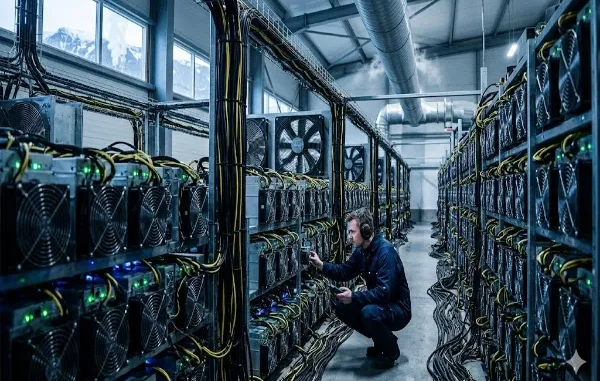
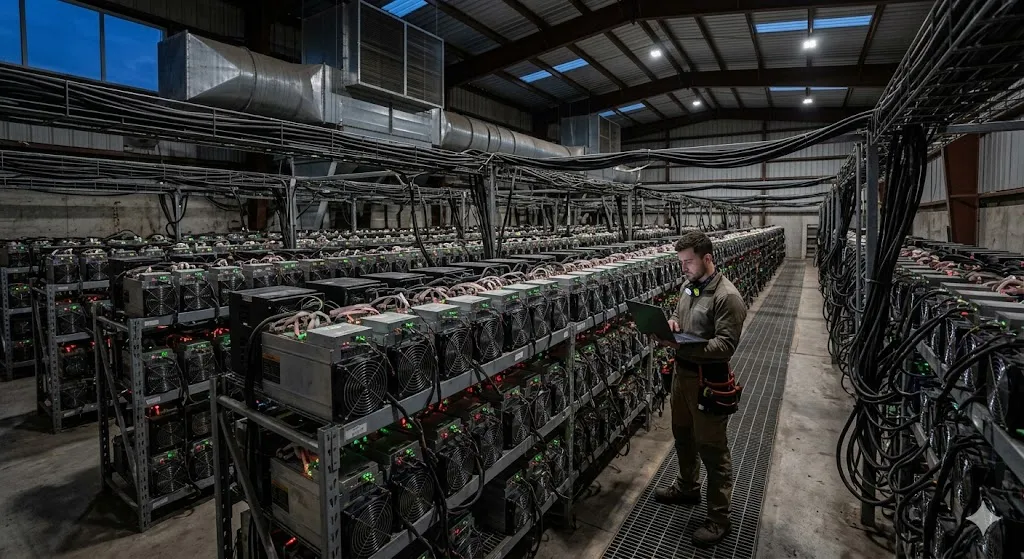
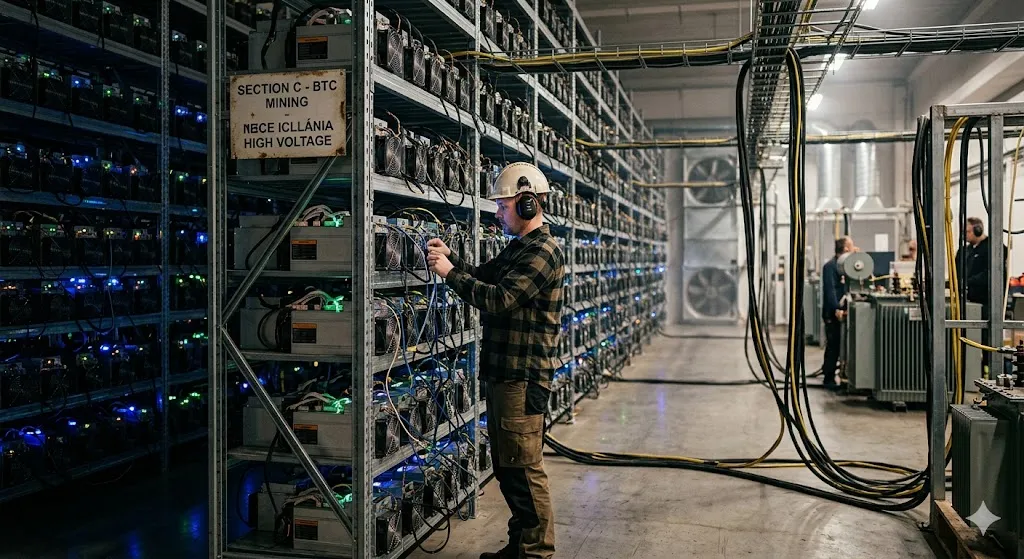
A mining farm is a facility that houses large numbers of mining machines operating simultaneously.
These facilities range from small warehouses with dozens of machines to industrial-scale operations containing hundreds of thousands of devices.
Mining farms require:
- Reliable electricity infrastructure
- Advanced cooling systems
- High-speed internet connections
- Physical security
- Technical maintenance teams
The largest mining operations resemble data centers more than traditional industrial sites.
Their primary product is not cryptocurrency itself, but network security.
Can You Mine Cryptocurrency at Home?
For most people, home mining is no longer practical for major cryptocurrencies such as Bitcoin.
Modern mining equipment is expensive, noisy, and generates significant heat.
Electricity costs are often the deciding factor.
In regions with high energy prices, home miners may spend more on electricity than they earn in rewards.
However, some smaller cryptocurrencies remain accessible to hobbyist miners using GPUs.
Home mining can still be valuable as an educational experience, but it is rarely a reliable source of income.
Anyone considering mining should calculate hardware costs, energy expenses, and potential returns before investing.
Mining Pools: Strength in Numbers
Mining rewards are distributed unpredictably.
Even powerful miners may wait weeks or months to discover a block independently.
To reduce this uncertainty, miners join mining pools.
A mining pool combines the computing power of thousands of participants and distributes rewards according to each member’s contribution.
Pools provide smaller but more consistent payouts.
Today, most cryptocurrency mining occurs through pools rather than individual mining operations.
Cloud Mining: Convenience With Caution
Cloud mining allows users to rent computing power from a third-party provider instead of purchasing hardware.
While the concept is appealing, cloud mining has a mixed reputation.
Many services charge high fees, offer limited transparency, or promise unrealistic returns.
Before using any cloud mining platform, investors should verify its track record, business model, and operating history.
If guaranteed profits are advertised, caution is warranted.
The Environmental Debate Around Mining
Few aspects of cryptocurrency generate more discussion than mining’s energy consumption.
Critics argue that mining uses excessive amounts of electricity.
Supporters counter that the comparison is incomplete because it ignores mining’s role in securing a global financial network.
The reality is more nuanced.
Mining consumes energy because energy is the source of its security. The cost of electricity makes attacks expensive and helps protect the network.
At the same time, the industry is increasingly shifting toward renewable energy, stranded energy sources, and excess power that might otherwise go unused.
Many mining operations now partner with hydroelectric, wind, solar, and natural gas recovery projects.
The long-term environmental impact of mining will likely depend on how quickly the industry continues to adopt cleaner energy sources.
Why Some Cryptocurrencies No Longer Use Mining
Not all cryptocurrencies rely on mining.
Many newer blockchains use an alternative mechanism called Proof of Stake.
Instead of using computing power, participants lock up their cryptocurrency holdings to help validate transactions.
This approach significantly reduces energy consumption.
In 2022, Ethereum transitioned from Proof of Work to Proof of Stake, eliminating traditional mining on its network.
As a result, mining is no longer the dominant security model across the entire cryptocurrency industry.
However, Proof of Work remains essential for networks that prioritize maximum decentralization and long-term security.
The Future of Cryptocurrency Mining
Cryptocurrency mining continues to evolve.
The industry is becoming more professional, energy-efficient, and geographically diverse.
Several trends are shaping its future:
- Greater use of renewable energy
- Increased hardware efficiency
- Integration with energy grids
- Expansion into emerging markets
- More regulatory oversight
- Growth of mining powered by excess or stranded energy
Rather than disappearing, mining is adapting to economic and environmental pressures.
Its long-term success will depend on balancing profitability, sustainability, and network security.
Final Thoughts
Cryptocurrency mining is not merely a method for creating digital coins.
It is a system that converts real-world resources into digital trust.
Every block mined represents a combination of electricity, hardware, competition, and cryptography working together to secure decentralized networks.
Understanding mining means looking beyond headlines about energy consumption or mining rewards. It means recognizing mining as the mechanism that allows strangers around the world to agree on who owns what without relying on a central authority.
For investors, miners, and anyone interested in the future of digital finance, mining remains one of the most important innovations in the cryptocurrency ecosystem.
Frequently Asked Questions
Cryptocurrency mining is the process of verifying blockchain transactions and adding new blocks to a decentralized network using computing power. Miners earn rewards in the form of newly created coins and transaction fees.
Miners use specialized hardware to solve cryptographic puzzles. The first miner to find the correct solution validates a block of transactions and receives a reward from the network.
Bitcoin, Litecoin, Monero, and Dogecoin are among the most popular mineable cryptocurrencies. Many newer blockchains use Proof of Stake instead of mining.
Home mining is possible for some cryptocurrencies, but mining major coins like Bitcoin is usually not profitable without specialized equipment and access to low-cost electricity.
Depending on the cryptocurrency, miners may use CPUs, GPUs, or ASIC machines. Bitcoin mining typically requires ASIC hardware designed specifically for the SHA-256 algorithm.
Mining profitability depends on factors such as hardware efficiency, electricity costs, mining difficulty, and the market price of the cryptocurrency being mined.
A mining pool is a group of miners who combine their computing power to increase their chances of earning rewards, which are then shared among participants based on their contribution.
Cryptocurrency mining can consume significant amounts of electricity because computing power secures the network. However, many mining operations increasingly rely on renewable and surplus energy sources.
Disclaimer
This article is for informational and educational purposes only and does not constitute financial, investment, legal, or tax advice. Cryptocurrency mining involves financial, technical, and regulatory risks, and profitability depends on factors such as electricity costs, hardware expenses, network difficulty, and market conditions. Always conduct your own research before purchasing mining equipment or investing in cryptocurrencies.
About the Author:
Ana Milojevic is a crypto writer and the creator of basedmoondog.com. She writes in-depth guides on Web3, DeFi liquidity, and AI trading technologies, including insights on MoonDog AI. When she isn’t breaking down complex crypto mechanics, she is tracking market trends across decentralized ecosystems.
Leave a Reply