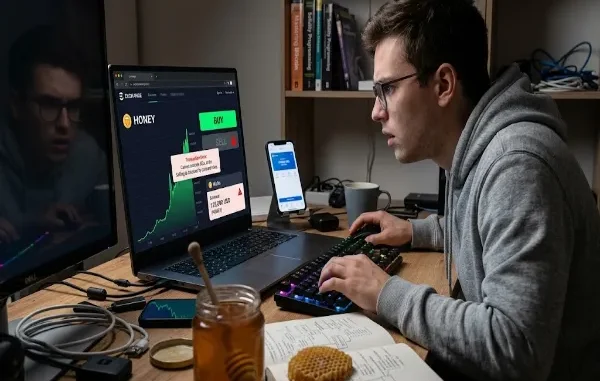
Buying a cryptocurrency token can look simple. You find a project, check the price, connect your wallet, and make a swap. But sometimes a token is designed to make that process work in only one direction: you can buy it, but you cannot sell it.
This type of malicious or deceptive token is commonly called a honeypot token.
A crypto honeypot is designed to attract buyers with the appearance of a normal trading opportunity while preventing them from selling their tokens later. In some cases, the token contract blocks selling completely. In others, it allows only certain wallets to sell, imposes extremely high sell taxes, or uses contract rules that make selling practically impossible.
The result can be particularly dangerous for inexperienced traders. A token may appear to be rising rapidly because new buyers are entering the market. Your wallet may show that your tokens have increased significantly in value. However, if you cannot actually sell those tokens for cryptocurrency or fiat value, the displayed balance does not represent money you can freely access.
Understanding how honeypot tokens work and learning how to check a token before buying can help you identify potential problems before connecting your wallet or spending funds.
What Is a Honeypot Token?
A honeypot token is a cryptocurrency token that uses its smart contract, trading rules, liquidity structure, or other mechanisms to prevent buyers from successfully selling their tokens.
The name comes from the idea of a trap. The token attracts buyers with an apparently profitable opportunity, but once they purchase it, they discover that getting their money back is difficult or impossible.
A typical honeypot can follow this pattern:
- A new token is created.
- The project adds liquidity to a decentralized exchange.
- Buyers are allowed to purchase the token.
- The token price begins increasing.
- More traders notice the rising price.
- New buyers purchase the token.
- Holders attempt to sell.
- The transaction fails, or the amount received is extremely small.
- The trapped buyers are unable to recover their funds normally.
This is one reason a rapidly rising token price should never be treated as proof that a cryptocurrency is legitimate.
A token can have an attractive chart while its smart contract contains rules that make selling extremely difficult.
How Does a Crypto Honeypot Work?
Honeypot schemes can use different technical mechanisms. The exact implementation depends on the smart contract and the person who created it.
1. Selling Is Completely Blocked
The simplest type of honeypot prevents ordinary users from selling their tokens.
The contract may allow purchases but reject transactions when a holder attempts to send tokens to the decentralized exchange’s trading contract.
From the trader’s perspective, everything appears normal until the first attempt to sell.
This is why simply checking whether a token can be bought is not enough.
A token should also be tested for whether a normal wallet can sell it.
2. Only Certain Wallets Can Sell
Some contracts use allowlists or privileged addresses.
The developer may allow specific wallets to sell while ordinary buyers are prevented from doing so.
This can make a token appear to have normal trading activity even though most holders are trapped.
Looking at the transaction history can sometimes reveal that selling activity is concentrated among a small number of wallets.
However, on-chain activity alone does not prove that a token is safe. Contract behavior needs to be examined as well.
3. Extremely High Sell Taxes
Another technique is to allow selling but impose an extremely high tax.
For example, a token could technically permit a sale while taking most of the transaction value as a fee.
In this situation, the holder may technically be able to sell, but the economic result can be so unfavorable that the position is effectively trapped.
A normal-looking buy tax does not guarantee that the sell tax is reasonable.
Always check both.
4. Maximum Transaction Restrictions
Some tokens impose maximum transaction or wallet limits.
These restrictions are not automatically malicious. Legitimate projects sometimes use limits during launches to reduce extreme volatility or prevent a small number of wallets from purchasing a large portion of the supply.
The problem occurs when these restrictions are configured so aggressively that ordinary holders cannot realistically sell.
For example, a contract might impose a maximum sell amount that is tiny compared with the amount a holder owns.
5. Blacklists
A smart contract may contain functions that allow particular addresses to be blacklisted.
Blacklisting is not automatically evidence of a scam. Some legitimate contracts use restrictions for regulatory, security, or administrative reasons.
However, it becomes a significant risk factor when the contract gives an owner or administrator broad power to prevent individual holders from transferring or selling tokens.
A trader should understand what administrative permissions exist before purchasing a token.
Why Honeypots Can Look Profitable
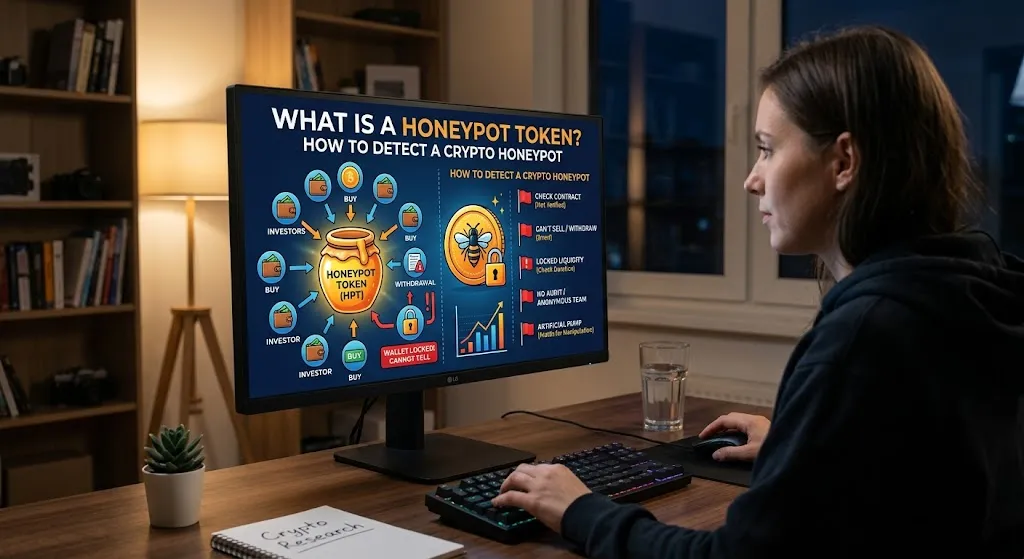
One of the most confusing aspects of honeypot tokens is that the price chart can look extremely attractive.
Imagine buying a token for $100.
A few hours later, your wallet shows that your tokens are worth $1,000.
It may appear that you have made a 900% gain.
But there is an important difference between displayed value and realizable value.
If you cannot sell the tokens, the $1,000 shown by a wallet or price-tracking service does not mean that you can withdraw $1,000.
This is why traders should never evaluate a token solely by looking at its percentage increase.
The more important question is:
Can an ordinary holder actually sell the token under reasonable conditions?
How to Detect a Crypto Honeypot Before Buying
There is no single test that can guarantee that a token is safe.
Instead, use several checks together.
Check 1: Test Whether the Token Can Be Sold
One of the most important checks is whether the token can actually be sold.
Specialized token-analysis tools may simulate a buy and sell transaction without requiring you to commit the full amount of money you intend to invest.
A successful simulated transaction does not guarantee safety, but a failed sell simulation is a major warning sign.
Never assume that because other people appear to be buying the token, you will necessarily be able to sell it.
Check 2: Examine the Smart Contract
The smart contract contains the rules governing the token.
Look for functions and permissions involving:
- Buying
- Selling
- Transfers
- Taxes
- Blacklists
- Whitelists
- Maximum transaction limits
- Maximum wallet limits
- Trading activation
- Ownership
- Administrative controls
- Fee changes
- Transfer restrictions
A contract that gives its owner extensive control over trading conditions deserves additional scrutiny.
If you are unfamiliar with smart-contract code, use established contract-analysis tools and read their results carefully rather than trying to interpret complex Solidity code from scratch.
For more information about checking token contracts, see our guide:
How to Check a Token Contract Before Buying a Meme Coin: A Step-by-Step Guide
Check 3: Look at the Contract on BaseScan
If the token operates on Base, BaseScan can provide useful on-chain information.
You can use a blockchain explorer to examine the token contract, transactions, holders, transfers, and other publicly visible activity.
For example, you can investigate:
- The contract address
- Contract verification status
- Token holders
- Recent transfers
- Large wallet movements
- Contract interactions
- The deployer’s activity
- Liquidity-related transactions
A blockchain explorer cannot tell you everything about a project’s intentions, but it can help you verify what is actually happening on-chain.
Our guide What Is BaseScan? How to Track Crypto Transactions on Base explains how blockchain explorers can be used for this type of research.
Check 4: Examine Token Holder Distribution
Look at who owns the token.
If a small number of wallets control a very large percentage of the supply, the token may carry significant concentration risk.
Large holders can potentially sell substantial quantities, influence liquidity, or affect the market price.
Holder concentration does not automatically mean that a token is a honeypot. It is simply one piece of the overall risk assessment.
Also remember that one person or organization may control multiple addresses.
Therefore, wallet distribution should be interpreted carefully.
Check 5: Examine Liquidity
Liquidity is another important factor.
A token can have a large market capitalization while having relatively little liquidity available for actual trading.
For example, suppose a token’s displayed market capitalization is $10 million, but only a small amount of assets is available in its liquidity pool.
A holder attempting to sell a large position could experience substantial slippage.
Low liquidity is not the same thing as a honeypot. A legitimate token can have low liquidity, especially shortly after launch.
However, extremely low or suspicious liquidity should make you investigate further.
For an explanation of liquidity, liquidity pools, trading volume, slippage, and liquidity risk, see:
What Is Crypto Liquidity? A Beginner’s Guide to Liquidity Pools, Trading Volume, and Liquidity Risk
Check 6: Look for Suspicious Taxes
Check the token’s buying and selling fees before making a purchase.
Some tokens have legitimate transaction taxes. However, unusually high sell taxes can make a token extremely difficult to exit.
Pay particular attention to contracts where the owner can change taxes after launch.
A token may begin with a reasonable tax and later change it.
Therefore, the question is not only:
What is the tax today?
It is also:
Who has the ability to change it?
Check 7: Examine Ownership and Administrative Powers
Smart-contract ownership can matter significantly.
Depending on the contract design, an owner or administrator may be able to:
- Change fees
- Pause transfers
- Modify trading restrictions
- Add addresses to a blacklist
- Change transaction limits
- Withdraw certain funds
- Alter other contract parameters
The existence of administrative functions does not automatically mean that a token is fraudulent.
What matters is understanding what those functions can do and who controls them.
A contract with extensive centralized control deserves more scrutiny than one with fewer mutable parameters.
Check 8: Examine the Token’s Transaction History
Blockchain transactions can reveal information that is not obvious from a price chart.
Look for:
- Large transfers
- Repeated transfers between related wallets
- Sudden liquidity movements
- Unusual trading patterns
- Concentrated ownership
- Wallets receiving large amounts shortly before selling
- Repeated contract interactions
You should not assume that every unusual transaction indicates malicious behavior.
Blockchain activity needs to be considered in context.
Still, unusual patterns can provide reasons to investigate further before buying.
Check 9: Don’t Trust Social Media Alone
Honeypot tokens can be heavily promoted through social media.
You may see:
- “100x potential”
- “Next Bitcoin”
- “Guaranteed profits”
- “Massive breakout coming”
- “Don’t miss this launch”
- “Whales are buying”
- “Exchange listing confirmed”
Marketing claims should never replace technical due diligence.
A token’s social-media popularity does not tell you whether its smart contract allows you to sell.
Before purchasing, verify the actual contract address and investigate the on-chain information independently.
Check 10: Verify the Contract Address
One of the simplest mistakes a trader can make is analyzing the wrong token.
Scammers can create tokens with names and symbols that are almost identical to legitimate projects.
For example, several unrelated tokens can use similar names such as:
- Doge
- Shiba
- Bitcoin
- AI
- Base
- Inu
- Moon
The name and ticker are not sufficient.
Always verify the exact contract address from a trustworthy project source before performing your own analysis.
Never copy a contract address blindly from an anonymous social-media post.
Honeypot vs. Rug Pull: What’s the Difference?
Honeypots and rug pulls are related to crypto scams, but they are not exactly the same thing.
A honeypot generally focuses on trapping buyers by preventing or severely restricting their ability to sell.
A rug pull can involve developers or insiders removing liquidity, selling their holdings, or otherwise abandoning the project after attracting buyers.
The two can sometimes overlap.
For example, a project could use restrictive contract mechanics to trap holders and later remove liquidity.
However, not every rug pull is a honeypot, and not every honeypot works by removing liquidity.
Understanding the distinction helps traders identify different types of risk.
Can a Honeypot Token Be Sold?
Sometimes.
Leave a Reply