If you have spent any time browsing the intersection of artificial intelligence and cryptocurrency in 2025, you have likely come across MoonDog AI and its native token, MDOGAI. Positioned as the utility token powering the ChadFi trading ecosystem, MDOGAI has attracted attention from traders looking to combine AI-driven market intelligence with decentralised finance. But beneath the hype and the dog-themed branding lies a set of economic mechanics — tokenomics — that every investor should understand before putting money at risk.
This article breaks down everything you need to know about MoonDog AI tokenomics: how the token supply is structured, what genuine utility MDOGAI offers inside the ChadFi platform, how the token has performed so far, and the very real risks that come with a project of this size and stage. This is not financial advice. It is an educational guide for anyone who wants to look past the surface and make an informed decision.
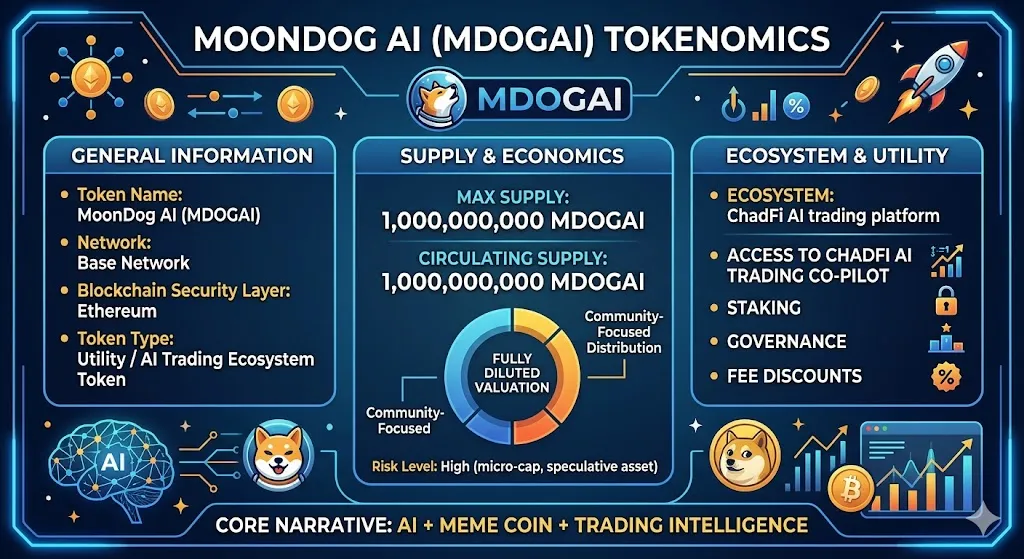
QUICK FACTS: MoonDog AI (MDOGAI) Tokenomics
Token Name: MoonDog AI (MDOGAI)
Network: Base Network
Blockchain Security Layer: Ethereum
Token Type: Utility / AI Trading Ecosystem Token
Max Supply: 1,000,000,000 MDOGAI
Circulating Supply: 1,000,000,000 MDOGAI
Primary Utility: Access to ChadFi AI trading co-pilot, staking, governance, fee discounts
Ecosystem: ChadFi AI trading platform
Risk Level: High (micro-cap, speculative asset)
Core Narrative: AI + meme coin + trading intelligence
What Is MoonDog AI (MDOGAI)?
Before diving into tokenomics, a quick overview of the project itself is worthwhile.
MoonDog AI is the native utility token of ChadFi, an all-in-one cryptocurrency trading platform built around an AI co-pilot called MoonDog. The central idea behind ChadFi is to address three pain points that frustrate active crypto traders: information overload from tracking dozens of markets simultaneously, security concerns around keeping assets safe, and the sheer time commitment required to trade competitively.
The MoonDog AI co-pilot sits at the heart of the platform and is designed to provide real-time market analysis, surface high-probability trading setups, and deliver personalised trading recommendations to individual users. Rather than forcing traders to sift through endless charts and Twitter threads, the platform aims to consolidate market intelligence into a single, AI-driven interface.
MDOGAI is the economic glue that ties this ecosystem together. It governs access, incentivises participation, and is intended to appreciate in value as platform usage grows. Whether that thesis plays out depends heavily on the token’s underlying economic design — which is exactly what we are here to explore.
The Token Supply Structure
One of the first things a serious investor examines when evaluating any crypto project is the token supply. Supply mechanics determine how scarce a token is, how much inflation holders face over time, and whether the economic model is sustainable.
Total Supply and Maximum Supply
MDOGAI has a total supply of 1,000,000,000 tokens — one billion MDOGAI — and that number is also its maximum supply. There is no additional minting mechanism. The hard cap is set, meaning no more MDOGAI can ever be created beyond the initial one billion.
This is meaningful because many crypto projects retain the ability to mint additional tokens, which can silently dilute the value held by existing token owners. A fixed maximum supply removes that risk entirely, creating a deflationary bias over time if tokens are burned, locked in staking contracts, or simply lost.
Circulating Supply
The circulating supply of MDOGAI is also reported at 1,000,000,000 — the full one billion tokens are already in public circulation. This is an important detail. It means there are no large tranches of tokens sitting in vesting schedules waiting to be unlocked and dumped on the market. The supply overhang risk that plagues many early-stage crypto projects — where team allocations, investor allocations, or ecosystem reserves unlock gradually and pressure the price downward — appears limited here, at least in terms of new issuance.
When circulating supply equals maximum supply, buyers know that whatever tokens exist are already on the market. There is no hidden supply shock waiting around the corner.
Fully Diluted Valuation (FDV)
Because the circulating supply and maximum supply are identical, the Fully Diluted Valuation (FDV) of MDOGAI equals its current market capitalisation at any given moment. There is no gap between the two, which removes one common source of overvaluation in new tokens. A large gap between market cap and FDV — where market cap appears low but FDV is enormous because most tokens have not yet entered circulation — is a classic red flag in tokenomics analysis. MDOGAI does not have that problem by design.
As of mid-2026, MDOGAI’s market capitalisation has fluctuated significantly since its launch, with its all-time high reached in July 2025 at approximately $0.0139 per token. Since that peak, the price has pulled back substantially, which is consistent with the speculative lifecycle seen in most early-stage AI and meme-adjacent tokens.
Where MDOGAI Trades
MDOGAI is a Base-chain token, built on Coinbase’s Layer 2 blockchain network. The primary trading venue is Uniswap V2 on the Base network, where it is paired against WETH (Wrapped Ether). It has also been listed on centralised exchanges including MEXC and LBank, extending its reach to a broader audience of retail traders.
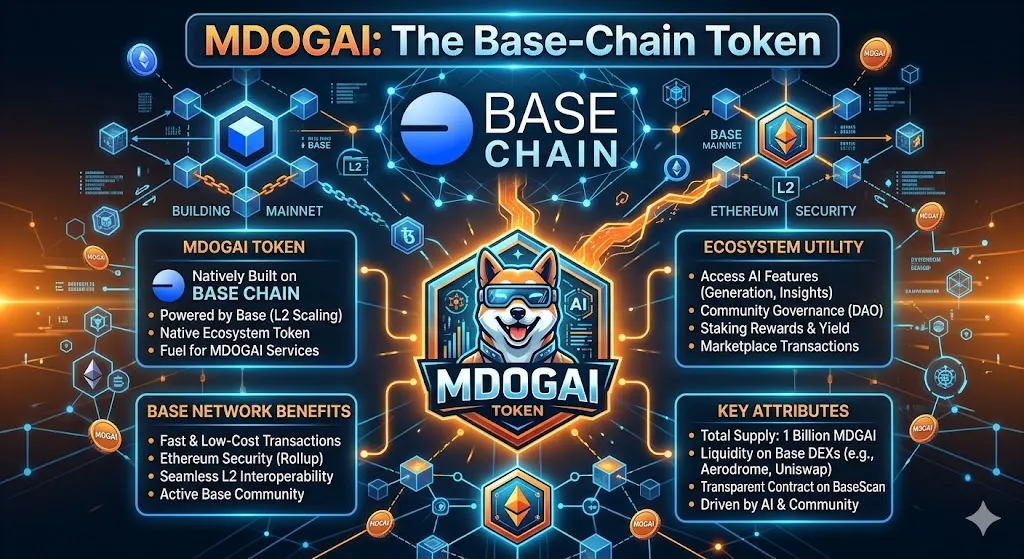
The Base chain was chosen deliberately. Base offers significantly lower transaction costs than Ethereum mainnet while inheriting Ethereum’s security guarantees. For a platform targeting active traders who want to swap, stake, and interact with the MoonDog AI ecosystem frequently, low gas fees are a practical necessity rather than a marketing point.
The Utility of MDOGAI: What the Token Actually Does
Token utility is arguably the most important factor in determining whether a crypto project has long-term legs or whether it is a speculative vehicle with little underlying demand. Here is what MDOGAI is designed to do within the ChadFi ecosystem.
Access to the MoonDog AI Co-Pilot
The most direct utility of MDOGAI is gating access to the MoonDog AI trading co-pilot features within ChadFi. Holding a sufficient quantity of MDOGAI tokens unlocks premium functionality, including the AI’s real-time market analysis feeds, high-probability trade signal identification, and personalised recommendations. This creates organic buy-side demand — traders who want access to the AI tools must acquire and hold MDOGAI.
This model mirrors the token utility mechanics used successfully by other AI and trading platforms in the crypto space, where the token acts as a subscription mechanism but one that can appreciate in value rather than simply being consumed as a fee.
Staking and Passive Income
MDOGAI holders can participate in staking to earn passive rewards. The staking mechanism serves two purposes simultaneously: it rewards long-term holders for their loyalty and commitment to the ecosystem, and it reduces the effective circulating supply of tokens available for trading, which can contribute to price stability during periods of high demand.
Staking integrations have been noted across multiple platforms, and the longer a user commits their MDOGAI to a staking contract, the higher the potential reward yield. This time-preference reward structure encourages conviction holding rather than short-term speculation.
Governance Participation
Like many DeFi-native tokens, MDOGAI is intended to carry governance rights within the ChadFi ecosystem. Token holders can participate in protocol decisions, including feature prioritisation, fee structure changes, and the direction of platform development. This moves the project incrementally toward community ownership, where the people who have skin in the game also have a voice in shaping the product.
Governance utility tends to become more meaningful as a project matures and its community grows. In early-stage projects it is often more symbolic than operational, but the mechanism is worth tracking.
Trading and Fee Utility
MDOGAI can be used to pay for platform fees within ChadFi, with token holders often receiving discounts relative to paying in other assets. Fee discount mechanics create a real economic incentive to hold MDOGAI rather than converting it to other assets, reducing sell pressure over time.
How to Evaluate the Token Distribution
The distribution of tokens across different stakeholders — team, investors, liquidity, community, ecosystem — is one of the most revealing aspects of any tokenomics model. Centralised control of a large token supply by a small number of wallets is a significant risk factor, as a coordinated sell can devastate price.
Based on available information, MDOGAI launched with a community-forward approach. The fact that 100% of the supply is in circulation from launch, rather than trickling out through vesting schedules, suggests the project did not follow the typical venture-backed tokenomics template where early investors hold large locked allocations.
That said, on-chain analysis of wallet concentration is always advisable before investing in any token. Tools like Etherscan (or the Base chain equivalent) allow anyone to view the largest token holders and the percentage of supply each controls. If a handful of wallets hold an outsized portion of the total supply, that is a risk that no amount of utility design can fully offset.
The AI and Crypto Intersection: Why Tokenomics Matters More Here
The convergence of artificial intelligence and blockchain technology is one of the most discussed themes in crypto in 2025 and 2026. Projects that credibly combine AI capabilities with on-chain economic models have attracted significant speculative interest, and for good reason — if the AI utility is real and the token captures a portion of that value, the upside can be substantial.
However, the AI narrative also creates conditions where speculative interest can run far ahead of actual platform usage. This means the tokenomics of an AI crypto project must be especially robust, because the token price will inevitably be tested by market cycles that strip away hype and leave only genuine utility demand.
For MDOGAI specifically, the question investors should be asking is: if the AI co-pilot functionality of ChadFi genuinely saves traders time and improves their decision-making, how many active users does the platform need before token demand from utility alone justifies the market capitalisation? That calculation is speculative at this stage, but it is the right frame for long-term analysis.
Risks You Need to Understand
No tokenomics analysis is complete without a frank discussion of the risks. MDOGAI carries several that prospective holders should weigh carefully.
Low Market Capitalisation and Liquidity
As of mid-2026, MDOGAI’s market capitalisation sits in the range of several hundred thousand to low millions of dollars depending on market conditions. This is a micro-cap token. While small market caps offer the highest potential percentage returns, they also come with extremely low liquidity. Buying or selling even a modest position in dollars can move the price significantly. Slippage — the difference between the expected price and the execution price — can be punishing in thin order books.
Investors in micro-cap tokens should only allocate capital they can genuinely afford to lose entirely.
Price Volatility
MDOGAI has already demonstrated extreme price volatility. Its all-time high was reached in July 2025 at approximately $0.0139, after which the token retraced more than 90% from peak. This kind of drawdown is common in micro-cap crypto tokens but devastating for those who bought near the top without understanding the volatility profile. Anyone entering a position must be prepared for large swings in both directions.
Smart Contract and Technical Risk
MDOGAI operates on Base chain, and interactions with the ChadFi platform occur through smart contracts. Smart contract code can contain bugs or vulnerabilities, and if a contract is exploited, token holders can lose funds. Before interacting with any DeFi protocol, it is good practice to check whether the smart contracts have been audited by a reputable third-party security firm and whether those audit reports are publicly available.
Platform Execution Risk
The token’s utility is entirely contingent on the ChadFi platform successfully delivering and iterating on its AI trading co-pilot. If development stalls, if the AI capabilities prove less useful than marketed, or if the platform fails to attract and retain active traders, the demand drivers for MDOGAI diminish. This is execution risk, and it is the most fundamental risk in any early-stage project.
Regulatory Uncertainty
AI and crypto both face an evolving regulatory landscape globally. A token that functions as a utility access mechanism today could face reclassification under future regulatory frameworks. Projects operating across multiple jurisdictions need to navigate this complexity carefully, and regulatory developments can affect token value independent of platform performance.
Concentrated Holder Risk
As noted above, if a small number of wallets control a large proportion of the one billion MDOGAI supply, those holders have the ability to move the market significantly with a single transaction. On-chain analysis of holder distribution should be conducted before investing.
How MDOGAI Compares to Other AI Token Tokenomics Models
The AI crypto space includes a broad range of tokenomics models. Some projects — particularly those targeting institutional infrastructure — have complex multi-token systems with separate utility and governance layers. Others, particularly those targeting retail traders, use simpler single-token models where one asset serves all purposes.
MDOGAI falls into the simpler single-token category. The advantage of this approach is clarity. There is one token to track, one supply curve to understand, and one set of demand drivers to evaluate. The disadvantage is that the token must serve multiple masters simultaneously — utility, governance, staking rewards, and speculative value — which can create tension between these functions.
The fixed one billion supply cap also places MDOGAI in a category of tokens where scarcity is structural rather than programmatic. Unlike Bitcoin, which has a mathematically decreasing emission schedule that creates a supply shock narrative every four years, MDOGAI’s full supply is already out. This means price appreciation must come primarily from demand growth rather than from supply contraction.
📦 Supply Side (Token Structure)
✔ Fixed supply (1,000,000,000 MDOGAI)
✔ No additional minting possible
✔ Fully circulating supply
✖ No deflationary burn mechanism (currently)
✖ High float = limited scarcity growth
⚙️ Utility Side (Demand Drivers)
✔ AI trading co-pilot access (ChadFi)
✔ Staking rewards for holders
✔ Governance participation rights
✔ Fee discounts within ecosystem
✖ Utility depends on platform adoption
What Would Need to Be True for MDOGAI to Succeed Long-Term
Asking what would need to be true for a token to succeed long-term is one of the most useful exercises in crypto due diligence. For MDOGAI, the conditions include:
The ChadFi platform must attract a substantial and growing user base of active traders who find the AI co-pilot genuinely useful. Without real users paying for access with MDOGAI, the token’s demand is speculative.
The AI technology must improve over time. The AI trading assistant space is competitive. If the MoonDog AI co-pilot delivers analysis that is demonstrably better than free alternatives or rival paid services, that creates durable demand. If it does not, users will not hold MDOGAI to access it.
The staking and governance mechanisms must deepen over time. As the platform matures, staking participation that meaningfully reduces liquid supply combined with genuine community governance creates a more robust economic ecosystem.
Liquidity must grow. Higher trading volume and deeper liquidity pools reduce slippage, attract more sophisticated traders, and improve the token’s stability profile.
Market conditions must be broadly supportive. Micro-cap tokens like MDOGAI tend to perform well in bull markets when risk appetite is high and collapse dramatically in bear markets when investors exit speculative positions. Timing matters.
MDOGAI Tokenomics Summary
- Token Name: MoonDog AI (MDOGAI)
- Network: Base
- Max Supply: 1,000,000,000
- Circulating Supply: 1,000,000,000
- Utility: AI trading access, staking, governance
- Risk Level: High (micro-cap crypto)
| Feature | MDOGAI (MoonDog AI) | Typical AI Crypto Token | Traditional DeFi Token |
|---|---|---|---|
| Network | Base L2 | Ethereum / Solana / Multi-chain | Ethereum |
| Supply Model | Fixed (1B max, fully circulating) | Often inflationary or partially vested | Varies |
| Utility | AI trading access + staking + governance | AI tools, data, agents | Lending, trading, governance |
| Speculation Level | High | High | Medium |
| Revenue Link | Platform usage (ChadFi) | Mixed / unclear | Fee-based protocols |
| Investor Type | Retail + meme traders | Retail + VC-backed | DeFi users |
Conclusion: A Tokenomics Model With Clear Structure, But Real Unknowns
MoonDog AI’s tokenomics offer some genuinely sensible design choices. The fixed one billion maximum supply with no further issuance removes inflation risk. The full circulation from launch reduces the supply overhang risk that undermines so many newer tokens. The utility design — AI access, staking rewards, governance rights, fee discounts — creates multiple demand vectors rather than relying solely on speculative buying.
At the same time, MDOGAI is a micro-cap token at an early stage of development. Its price has already experienced a dramatic peak and a steep retracement. Its utility is tied entirely to the execution success of the ChadFi platform, which remains unproven at scale. Liquidity is thin, and the regulatory environment for AI-crypto projects continues to evolve.
For investors drawn to the AI trading assistant narrative, MDOGAI deserves serious research before any capital commitment. Read the project documentation. Examine on-chain wallet distribution. Evaluate whether the platform is genuinely growing its user base. Understand that micro-cap positions require not just conviction but also a risk tolerance that accommodates the possibility of total loss.
Tokenomics is the foundation of any crypto project’s long-term viability. MoonDog AI has built a foundation with some defensible characteristics. Whether the structure built on top of it justifies an investment is a question only you — with the help of your own thorough research — can answer.
Disclaimer: This article is for informational and educational purposes only. It does not constitute financial or investment advice. Cryptocurrency investments, particularly in micro-cap tokens, carry a high degree of risk including the potential loss of all capital invested. Always conduct your own research and consult a qualified financial adviser before making any investment decisions.
Key Takeaways
- MDOGAI has a fixed 1B supply with no inflation
- Utility is tied to AI trading access in ChadFi
- Main risks are execution + liquidity + volatility
- Token value depends on real platform adoption
FAQ — MoonDog AI (MDOGAI) Tokenomics
MDOGAI is the utility token that powers the ChadFi AI trading ecosystem. It is used for accessing AI trading tools, staking rewards, governance participation, and platform fee discounts.
Yes. MDOGAI has a fixed maximum supply of 1,000,000,000 tokens. No additional tokens can be minted.
No. Since the full supply is already in circulation, there is no ongoing token inflation from new issuance.
MDOGAI is built on the Base Network, which is an Ethereum Layer-2 scaling solution.
The biggest risks include low liquidity, high volatility, execution risk of the ChadFi platform, and reliance on AI trading adoption.
No crypto asset of this type is “safe.” MDOGAI is a high-risk micro-cap token and should only be considered by users who understand speculative crypto markets.
Unlike pure meme coins, MDOGAI claims utility through an AI trading system (ChadFi), combining meme culture with functional trading tools.
About the Author:
Ana Milojevic is a crypto writer and the creator of basedmoondog.com. She writes in-depth guides on Web3, DeFi liquidity, and AI trading technologies, including insights on MoonDog AI. When she isn’t breaking down complex crypto mechanics, she is tracking market trends across decentralized ecosystems.
Leave a Reply