Meme coins have become one of the most unpredictable parts of the cryptocurrency market. Built around internet jokes, viral images, celebrities, or online communities, these digital tokens can attract thousands of investors in a remarkably short time. Some experience explosive price increases within days, creating stories of early buyers making substantial profits. However, many more lose most of their value, become almost impossible to sell at a reasonable price, or disappear from public attention entirely.
Understanding why most meme coins go to zero requires looking beyond their entertaining branding and sudden popularity. Unlike traditional investments, which may represent ownership in a business or generate income, many meme coins depend primarily on speculation, community enthusiasm, and the expectation that someone else will buy them at a higher price.
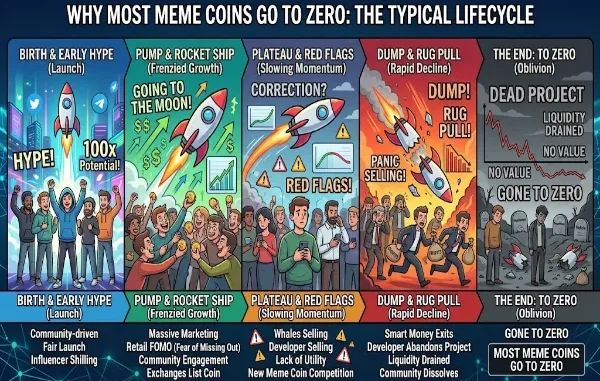
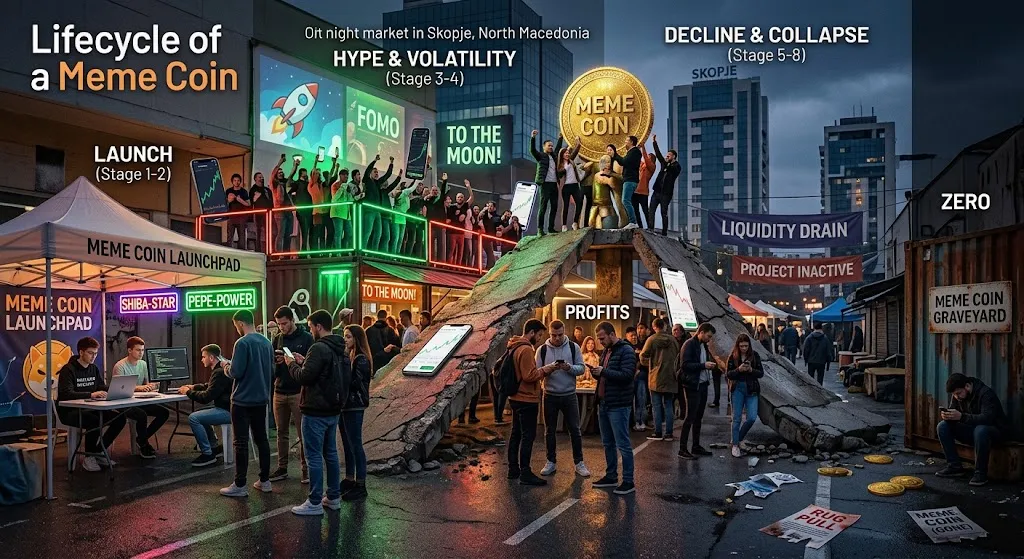
Although not every meme coin becomes worthless, many follow a similar lifecycle: creation, initial excitement, viral growth, speculative trading, declining interest, and eventual collapse. Recognizing these stages helps explain why spectacular early gains often end in significant losses for later investors.
What Is a Meme Coin?
A meme coin is a cryptocurrency inspired by an internet meme, popular joke, fictional character, celebrity, or online cultural trend. These tokens are often designed to attract attention through humor, recognizable branding, and social media engagement rather than through a clearly defined technological purpose.
Dogecoin is one of the best-known examples of a meme coin. Originally introduced as a joke in 2013, it developed a large community and achieved widespread recognition. Other tokens, including Shiba Inu and numerous newer projects, have also attracted substantial interest through online communities and speculative trading.
The important distinction is that a meme coin’s popularity does not necessarily reflect its economic value. A token can have a large following, extensive online discussions, and a high reported market capitalization without generating revenue or offering a sustainable reason for people to continue buying it.
Some meme coins develop useful features, payment applications, or lasting communities. Nevertheless, many depend heavily on attention, making them particularly vulnerable when public interest shifts elsewhere.
Stage 1: The Coin Is Created
Every meme coin begins with an idea. A developer or project team creates a token, usually on an existing blockchain, and gives it a recognizable name, symbol, and visual identity.
The process can be relatively inexpensive compared with building an entirely new blockchain. Depending on the network and the token’s design, a creator may be able to launch a new token without developing complicated infrastructure.
At this early stage, the project may have little more than a website, a social media account, a token contract, and a promotional story. Some creators establish transparent distribution rules and attempt to build a legitimate community. Others launch tokens primarily to profit from initial interest.
Several factors can make a new meme coin attractive to speculators:
- A funny or memorable name.
- A recognizable internet meme or celebrity connection.
- A limited-looking token supply or appealing tokenomics.
- Promises of future exchange listings.
- Claims that the project could become the next major cryptocurrency.
However, none of these characteristics guarantees lasting demand. A token can be created in minutes, but building trust, establishing genuine utility, and maintaining a community over several years is considerably more difficult.
Stage 2: Early Buyers Enter the Market
Once the token launches, early buyers may begin purchasing it through decentralized exchanges or other available trading platforms.
At this stage, liquidity is often limited. Liquidity refers to how easily an asset can be bought or sold without substantially changing its price. In a newly launched meme coin, even relatively small trades may cause dramatic price movements because there are few buyers and sellers.
Early participants may include the creator, the project team, experienced cryptocurrency traders, and speculators searching for new opportunities. If a small number of buyers purchase significant amounts of the available supply, the token’s quoted price can rise rapidly.
This creates the appearance of a promising investment before the project has established meaningful demand.
Token distribution is particularly important. If a few wallets control a large share of the supply, those holders may have considerable influence over the market. When they sell, the resulting increase in available tokens can overwhelm buying demand and cause the price to fall sharply.
Not every concentrated token distribution indicates fraud, but it creates risks that investors should understand before purchasing.
Stage 3: Social Media Creates Viral Hype
The next stage often begins when the token attracts attention on platforms such as X, Reddit, Telegram, Discord, and other online communities.
Supporters share memes, screenshots of profits, price predictions, and claims that the token could increase many times in value. Influencers may discuss the project, and traders may promote it as an opportunity to enter before the broader market discovers it.
The growing attention can create a powerful feedback loop.
More online discussion attracts new buyers. Their purchases push the price higher, making early investors appear successful. Screenshots of those gains attract additional participants, who purchase the token because they fear missing the opportunity.
This behavior is commonly associated with fear of missing out, or FOMO.
However, social media engagement does not necessarily represent genuine demand. Some followers may be bots, paid promoters, or inactive accounts. Others may participate in discussions without buying the token at all.
Promotional campaigns can also exaggerate potential returns while minimizing the possibility of losses.
During this stage, the token’s price may become increasingly disconnected from any practical use or sustainable source of demand. Its value depends more heavily on the belief that enthusiasm will continue.
Stage 4: The Price Explodes and New Investors Rush In
When a meme coin becomes widely discussed, speculative buying can accelerate dramatically.
A relatively small amount of additional buying pressure may produce large percentage gains, especially when the token has limited liquidity. Traders see the rising price and assume that the trend will continue.
Some projects also attract attention after listings on larger cryptocurrency exchanges, although listing requirements and availability vary. Greater accessibility can introduce the token to more potential buyers and increase trading activity.
At this point, headlines may describe extraordinary gains, and early participants may appear to have transformed small investments into substantial sums.
Yet a rising price does not mean that every holder can sell at the displayed market price.
Market capitalization is commonly calculated by multiplying a token’s current price by its circulating supply. It is not the same as the total amount of money invested in the token. If trading activity is thin, the last traded price may not represent what would happen if many holders attempted to sell simultaneously.
This distinction becomes critical during a market reversal.
A token can display a large market capitalization while having insufficient liquidity to support substantial selling without a major price decline.
Stage 5: Early Investors Begin Taking Profits
Eventually, some early buyers decide to sell.
For investors who purchased at extremely low prices, selling a portion of their holdings can produce significant profits. Others may sell because they believe the price has risen too far, the promotional campaign is weakening, or better opportunities are emerging elsewhere.
Their decisions introduce additional selling pressure.
If new buyers continue entering the market, the price may remain elevated for some time. But when selling increases faster than fresh demand, the token begins losing momentum.
This is a crucial stage in the typical meme coin lifecycle because the interests of different participants are no longer aligned.
Early holders may have already achieved their profit targets. Later buyers, however, may still be expecting further price increases. When the early holders sell, newer participants can end up holding tokens purchased at much higher prices.
There is nothing inherently improper about taking profits. The problem arises when buyers underestimate the number of people who may be waiting to sell or assume that every participant will continue holding indefinitely.
In speculative markets, the decision to sell is often easier than finding enough willing buyers at a desirable price.
Stage 6: Momentum Weakens and the Price Starts Falling
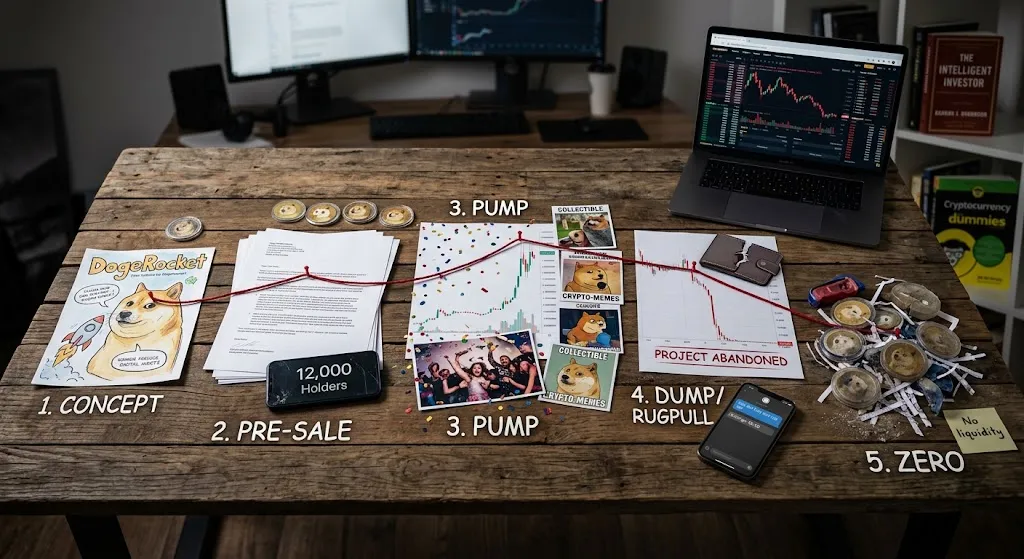
Once buying enthusiasm fades, the token may enter a prolonged decline.
Several developments can trigger this change:
- Social media discussions become less frequent.
- Influencers move on to newer projects.
- Investors become concerned about large holders selling.
- The broader cryptocurrency market experiences a downturn.
- Promised features or developments fail to materialize.
- Trading volume and available liquidity decrease.
A falling price can create another feedback loop, this time working in the opposite direction.
Investors who fear larger losses begin selling. Their sales push the price lower, encouraging other holders to exit. As confidence deteriorates, fewer buyers are willing to enter the market.
Some traders may attempt to buy the dip, expecting a recovery. However, a temporary price rebound does not necessarily indicate that the underlying project has recovered.
Without renewed demand, the token may continue declining even if its community remains active.
Stage 7: Liquidity Disappears and Selling Becomes Difficult
One of the most serious risks associated with failing meme coins is declining liquidity.
A token can remain visible on a blockchain explorer or cryptocurrency tracking website long after meaningful trading activity has disappeared. Its displayed price may therefore create a misleading impression of its practical value.
Consider a hypothetical meme coin trading at $0.01. If the available liquidity is limited, a holder attempting to sell a large position may receive a much lower average price than expected.
The situation can become even worse when trading volume falls dramatically. Buyers may become scarce, and the gap between buying and selling prices may widen.
In decentralized exchanges, liquidity pools typically contain two assets that traders exchange against each other. When one side of the pool becomes depleted or liquidity providers withdraw their funds, large trades can produce substantial price changes.
Some tokens also impose transaction restrictions, unusually high selling fees, or other contract-level limitations. In malicious projects, these mechanisms may prevent ordinary holders from selling altogether.
A token with these characteristics can become effectively worthless to its holders even if a quoted price remains visible somewhere online.
Stage 8: The Project Becomes Inactive or Collapses Completely

The final stage often arrives when the project no longer attracts enough attention or trading activity to sustain itself.
Developers may stop publishing updates. Community discussions become quieter. Promotional accounts disappear, and exchange support may be reduced or discontinued. Some tokens remain technically functional on their underlying blockchain but have almost no meaningful market activity.
In other cases, a project collapses much more abruptly.
A rug pull occurs when people controlling a project exploit their position to extract funds or undermine the market, leaving other participants with substantial losses. Depending on the project’s design, this may involve removing liquidity, selling large token holdings, or using malicious smart-contract functions.
A rug pull is different from an ordinary market decline. A legitimate project can fail because demand disappears, whereas a rug pull involves deceptive or exploitative conduct.
Not every meme coin that loses nearly all its value has been deliberately designed as a scam. Some simply fail to maintain interest, while others are overwhelmed by competition or broader market conditions.
Nevertheless, the end result for an investor can be similar: the original investment loses most or all of its economic value.
Why Most Meme Coins Fail
Although individual projects differ, several recurring weaknesses explain why many meme coins cannot maintain their early valuations.
1. They Depend on Attention Rather Than Sustainable Demand
Attention is a valuable resource in online markets, but it moves quickly. A new meme, celebrity, or cryptocurrency trend can capture the public’s interest and displace an older project almost overnight.
When a token’s main attraction is its popularity, declining attention can remove much of the reason people were buying it.
Projects with continuing practical uses or other durable sources of demand may have more ways to remain relevant. Even then, utility alone does not guarantee investment success.
2. They Often Have No Independent Economic Foundation
Many meme coins do not represent ownership in a company, provide claims on profits, or generate cash flows for holders.
Their market prices are therefore often driven primarily by expectations about future demand and the willingness of other participants to pay more.
This does not mean an asset must generate income to have value. However, when a token lacks both cash flows and meaningful utility, its price can be especially sensitive to changes in sentiment.
3. Token Ownership May Be Concentrated
If a small number of wallets hold a substantial portion of the supply, their decisions can influence market prices.
Large holders may sell for entirely legitimate reasons, but their transactions can create significant downward pressure when liquidity is limited.
Blockchain explorers and independent analytics tools can help investors examine token distribution. However, wallet analysis has limitations: one person may control several wallets, while a single wallet may belong to an exchange serving many customers.
4. Speculative Demand Is Not the Same as Long-Term Adoption
A token can attract buyers who have no intention of using it for payments, accessing a service, or participating in a functioning ecosystem.
Instead, they may be purchasing it because they expect a quick price increase.
When most participants share this motivation, the market becomes dependent on a continuing supply of new buyers. If that demand slows, there may be little else supporting the price.
5. Competition Never Stops
Launching another meme coin is often relatively easy. As a result, successful trends quickly inspire imitations.
A token that dominates online discussions today may lose attention to a new project tomorrow. Established coins with larger communities may also face competition from tokens offering more aggressive marketing or more appealing narratives.
Because attention is limited, not every project can remain a market favorite.
6. Emotional Trading Encourages Poor Decisions
Meme coins can encourage unusually emotional investing because their communities often celebrate dramatic gains and portray buying as participation in a shared movement.
Investors may become reluctant to sell because they believe the community will eventually push the price higher. Others buy additional tokens after a decline simply because the price appears cheaper than before.
Yet a lower price does not automatically make an asset undervalued. If demand is disappearing, a token can continue losing value regardless of how far it has already fallen.
Warning Signs That a Meme Coin May Be at Risk
No checklist can reliably predict the future of a cryptocurrency, but several warning signs deserve careful attention.
| Warning sign | Why it matters |
|---|---|
| Anonymous or unverifiable team | Accountability may be limited, although anonymity alone does not prove misconduct. |
| Concentrated token ownership | Large holders may exert considerable selling pressure. |
| Unusually low liquidity | Investors may struggle to exit without sharply affecting the price. |
| Guaranteed profit claims | No legitimate investment can guarantee that a meme coin will rise in value. |
| Aggressive influencer promotion | Marketing may create artificial urgency or obscure financial incentives. |
| Unclear token distribution | Investors may be unable to assess who controls the supply. |
| Suspicious smart-contract permissions | Certain functions may allow trading restrictions, excessive fees, or other harmful changes. |
| Abandoned development and declining activity | The project may be losing the support needed to remain relevant. |
Investors can also examine whether liquidity is locked, whether the smart contract has been independently reviewed, and whether the project’s claims can be verified. These checks can reduce some risks, but they cannot guarantee safety. Locked liquidity, for example, does not prevent every possible form of fraud or price collapse.
Can a Meme Coin Survive for Years?
Yes. Some meme coins have survived well beyond their original viral moments.
Dogecoin demonstrates that a cryptocurrency initially created as a joke can develop a lasting community and become widely recognized. Other projects may maintain interest through active communities, payment integrations, broader exchange access, or the development of additional features.
However, survival should not be confused with guaranteed profitability.
A meme coin can remain active while trading far below its previous peak. It can also experience renewed popularity after a long decline without recovering its former price.
The most important distinction is between a token that continues to exist and an investment that delivers a positive return. These are separate outcomes.
Investors should also remember that the success of one prominent meme coin does not establish that newly launched tokens are likely to achieve similar results. Highly visible winners can overshadow the much larger number of projects that never become widely known or fail to maintain their initial popularity.
How Investors Can Approach Meme Coins More Carefully
Anyone considering a meme coin should begin by treating it as a highly speculative asset rather than assuming that viral popularity indicates a sound investment.
Several practical steps can help reduce avoidable risks:
- Research the token contract. Confirm that the token is the genuine asset you intend to purchase, and examine available information about its permissions and ownership.
- Check liquidity and trading activity. Look beyond the displayed market capitalization to understand whether meaningful buying and selling are taking place.
- Review token distribution. Investigate whether a small number of wallets control a substantial share of the supply.
- Question promotional claims. Verify announcements and do not rely solely on influencer endorsements or screenshots of profits.
- Set a loss limit in advance. Decide how much you could afford to lose without affecting essential expenses or financial security.
- Avoid borrowing to speculate. Leverage can magnify losses and create obligations that remain even after a token collapses.
- Understand how you would exit. A theoretical profit is not realized until a position can actually be sold at an acceptable price.
These precautions cannot eliminate market risk, particularly when a token’s value depends heavily on changing sentiment. They can, however, help investors make decisions based on evidence rather than excitement.
Conclusion
Most meme coins do not become lasting cryptocurrency projects because their initial popularity is difficult to convert into sustained demand. Their typical lifecycle begins with a simple idea, accelerates through social media promotion and speculative buying, and eventually weakens when early holders take profits and new buyers become harder to find.
As trading activity declines, falling prices can trigger further selling. Liquidity may disappear, communities may lose interest, and some projects become effectively worthless. Others fail more abruptly because of fraud or deliberate manipulation.
The central lesson is that a rising price, a large online following, and a high market capitalization do not guarantee lasting value. Meme coins can produce extraordinary short-term gains, but those gains are often accompanied by substantial risks for people who enter late.
Understanding the lifecycle of a meme coin does not make its future predictable. It does, however, help explain why excitement can disappear much faster than it appeared—and why careful research, realistic expectations, and strict risk management matter in a market driven so heavily by attention.
Frequently Asked Questions
1. Why do most meme coins go to zero?
Most meme coins lose value because they depend on social media hype and speculative demand rather than sustainable utility. When interest declines and investors sell, prices can collapse.
2. How long does a meme coin typically last?
There is no fixed lifespan. Some meme coins lose popularity within days or weeks, while others maintain active communities for years.
3. Can investors make money from meme coins?
Yes, some investors make profits, particularly those who buy early and sell successfully. However, meme coins are highly speculative, and many investors experience substantial losses.
4. What causes a meme coin to crash?
Common causes include declining interest, large holders selling, reduced liquidity, negative publicity, and fraudulent activities such as rug pulls.
5. How can investors identify a risky meme coin?
Warning signs include concentrated token ownership, low liquidity, unrealistic profit promises, suspicious smart-contract permissions, and a lack of transparent project information.
Leave a Reply