
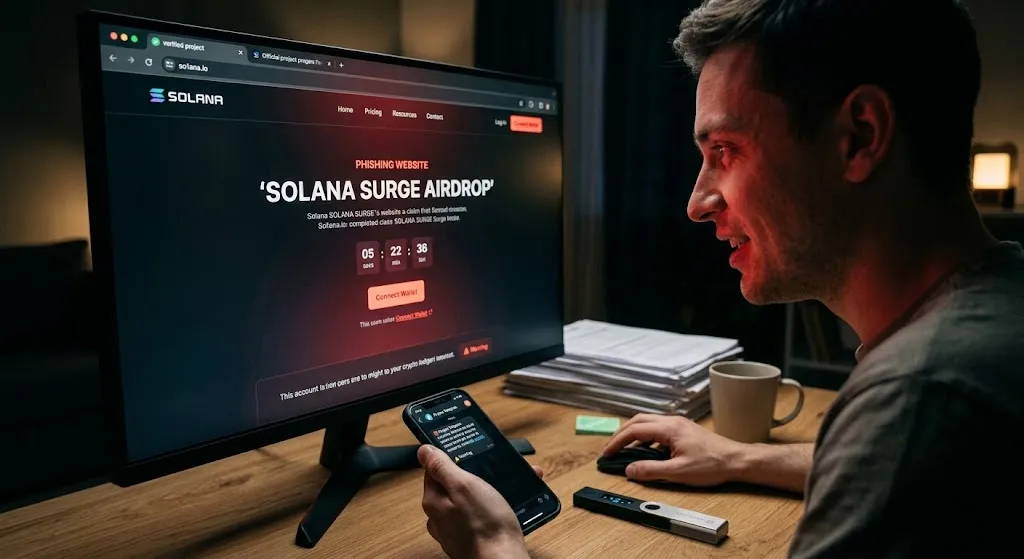
If you’ve spent any time in crypto Telegram groups or on crypto Twitter, you’ve probably seen it happen: a big airdrop gets announced, everyone scrambles to claim it, and within hours someone in the group is posting a screenshot of an empty wallet. Not because the airdrop itself was a scam — but because a fake claim site got to them first.
Airdrops are one of the few genuinely free ways to end up holding a new token before most people have heard of it. They’re also one of the most reliable bait-and-switch tools scammers have. The two things look almost identical from the outside, and that’s exactly the problem.
This guide breaks down how legitimate airdrops actually work, how to find real ones worth your time, and — more importantly — how to avoid the wallet-draining scams that piggyback on every major token launch.
What Is a Crypto Airdrop?
A crypto airdrop is a distribution of free tokens sent by a blockchain project to a group of wallets, usually as a way to reward early users, build a community, or decentralize ownership before or after a token officially launches. Projects use airdrops to reward things like:
- Early testnet usage
- Holding a related token or NFT
- Using a specific app, DEX, or protocol
- Participating in governance or community activity
- Simply being an active wallet on a given network
There are two very different flavors of airdrop, and the distinction matters a lot for your safety:
Automatic airdrops land directly in your wallet with no action required on your part. You didn’t have to sign anything or connect to anything — the tokens just show up. The main risk here is something called “dusting,” where scammers send you a small amount of a fake token hoping you’ll go hunt down a “claim” page for it later. If you never interact with it, an automatic airdrop by itself can’t drain your wallet.
Claim-based airdrops require you to visit a website, connect your wallet, and sign a transaction to actually receive the tokens. This is where nearly all the real danger lives, because it’s also exactly what a scam site is designed to imitate.
Why Airdrops Attract So Many Scams
The mechanics of a legitimate claim and a malicious one look almost the same to an average user: a website, a “Connect Wallet” button, and a transaction to sign. That similarity is the entire business model behind airdrop scams.
When a major project announces a token generation event, attackers move fast — sometimes within hours — registering lookalike domains that are nearly identical to the real one. A single swapped letter, an added hyphen, or a different domain ending (.io instead of .com, for example) is often the only difference, and the fake site is frequently a pixel-perfect copy of the real claim page.
This isn’t a hypothetical problem. It’s played out repeatedly in 2026 alone:
- When Backpack’s token generation event launched in March, copycat phishing sites claiming to offer the same distribution went live within hours of the official claim window opening.
- That same month, the FBI issued a public warning about a fake “FBI Token” airdrop circulating on the Tron network, where unsolicited tokens were dropped into wallets specifically to lure recipients toward a malicious claim site.
- OpenSea’s SEA token airdrop earlier in the year drew such a surge of legitimate claim activity that it triggered a parallel spike in scam attempts trying to ride the same wave.
- Even Vitalik Buterin’s own X account has been hacked and used to promote a fake NFT airdrop, a scam that reportedly cost victims around $700,000 in a matter of hours.
Security researchers have also flagged that “wallet drainer” tools — malicious smart contracts built specifically to strip a connected wallet of its assets — have become an entire underground industry of their own. One drainer kit alone, known as Inferno Drainer, has been linked to more than $80 million stolen through fake airdrop and claim sites before it was shut down. Chainalysis and other blockchain analytics firms have continued tracking new drainer campaigns built on the exact same playbook.
How Wallet Drainers Actually Work
It helps to understand the mechanism, because it’s not what most people picture when they imagine getting scammed. Very few modern airdrop scams ask for your seed phrase directly anymore — most crypto users have learned not to type that into a website. Instead, the scam works through something you’re far more likely to click through without a second thought: a token approval.
A token approval is a permission you grant to a smart contract, allowing it to move a specific token (or, in the worst cases, an unlimited amount of a token) out of your wallet on your behalf. Plenty of legitimate DeFi activity requires approvals — swapping tokens, staking, providing liquidity. That normalcy is exactly what scam sites exploit. A fake “Claim” button can be wired to request the same kind of approval, except this time it hands a scammer’s contract the ability to drain your wallet the moment you sign — sometimes before you’ve even had a chance to read the confirmation prompt closely.
Once that approval is granted, the damage is close to irreversible. Blockchain transactions don’t have an undo button, and unless law enforcement manages to trace and freeze the funds — which is rare and slow — that crypto is gone.
Red Flags That Signal an Airdrop Scam

A few warning signs show up consistently across nearly every airdrop scam on record:
- You’re asked to connect your wallet just to check eligibility. Legitimate projects in 2026 typically let you paste your public wallet address into an eligibility checker with no wallet connection required at all. If a site wants a full connection before it’ll even tell you whether you qualify, that’s a hard stop.
- The URL is almost right, but not quite. Check character-by-character. Scammers frequently register domains with one swapped letter, an inserted hyphen, or a different extension.
- There’s pressure to act immediately. Countdown timers, “limited claim window” banners, and urgent language are classic tactics designed to short-circuit careful thinking.
- You’re asked for a seed phrase or private key. No legitimate airdrop, ever, needs your seed phrase. This one is non-negotiable.
- You’re asked to pay an upfront fee, especially in a different currency, to “unlock” your tokens. Some legitimate distributions do have network gas costs, and some projects cover that cost for you. A demand to buy an unrelated token first, or send funds to a wallet to “activate” your claim, is a scam.
- The link arrived unsolicited in a DM or comment. Real projects announce claim windows through their verified, established channels — not through a stranger sliding into your Discord or X replies.
How to Verify an Airdrop Is Legit Before You Touch It
Before connecting any wallet to any claim site, run through this checklist:
- Go straight to the project’s official channels. Don’t click a link from a group chat or a random tweet — navigate to the project’s verified website or X account yourself and confirm the claim window and URL match exactly what they’ve posted.
- Check the project’s track record. Does it have a public team, a working product, audited contracts, and a history of doing what it says it will? Tools like DeFiLlama (for tracked value locked) and Token Terminal (for actual protocol revenue) can help you separate a project with real usage from one that’s all hype.
- Scan the token contract before interacting with anything. Tools like Token Sniffer or a network’s own block explorer (BaseScan, if you’re checking something on the Base network) can flag common red flags like hidden mint functions or honeypot code.
- Look for organic growth, not sudden spikes. A project with metrics that jumped overnight with no clear reason, or activity that looks disconnected from any real usage, is worth extra scrutiny.
- Cross-check the domain, letter by letter. It sounds tedious because it is — but it’s also the single most common thing scam victims later say they skipped.
How to Claim Airdrops Without Putting Your Real Wallet at Risk
Even with a legitimate airdrop confirmed, smart operators still don’t connect their main wallet — the one holding their actual savings — to any claim site. The standard practice that’s emerged among experienced airdrop hunters in 2026 is simple:
- Keep a separate “claims” wallet. Fund it with only enough for gas fees and whatever the claim requires. If something goes wrong, the damage is capped at whatever’s in that wallet — not your entire portfolio.
- Never let your main holdings touch a claim page. Full stop. If a site is somehow compromised or turns out to be malicious after all, your primary funds were never exposed.
- Review permissions before you sign, every time. Most wallets will show you exactly what a transaction is requesting. If a “claim” is asking for broad, unlimited access to unrelated tokens, that’s your cue to back out.
- Periodically revoke old approvals. Old, forgotten approvals to contracts you no longer use are a lingering risk. Approval-revoking tools let you clean these up so an old, dormant contract can’t be exploited later.
A Quick Word on Taxes
It’s easy to forget in the scramble to claim, but in many jurisdictions, airdropped tokens are treated as taxable income at their fair market value the moment you receive them — separate from any capital gains tax owed later if you sell. Tax treatment varies significantly by country, so keeping a simple record of what you received, when, and its value at the time is worth the five minutes it takes. A spreadsheet with dates, token amounts, and a price reference from a reliable market data source will save you a headache later.
The Bottom Line
Airdrops aren’t going anywhere — they remain one of the few ways in crypto to end up with real value for genuinely being an early, active user of a project. But the same hype that makes a big airdrop worth chasing is exactly what scammers rely on to catch people off guard.
The pattern is consistent enough by now to boil down to a few habits: verify the source yourself instead of trusting a shared link, never connect your main wallet to an unfamiliar site, treat any request for a seed phrase as an automatic red flag, and slow down anytime a page is pushing you to act fast. None of that requires technical expertise — it just requires resisting the urge to click before you check.
This article is for informational and educational purposes only and is not financial advice. Cryptocurrency, including meme coins and airdropped tokens, carries significant risk. Always do your own research before interacting with any project, contract, or claim site.
Leave a Reply