
TL;DR
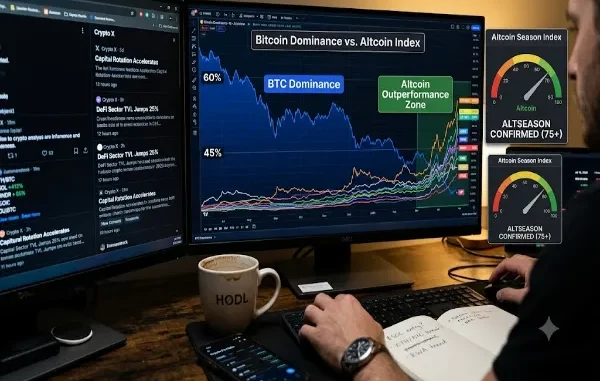
Altcoin season is a market phase when a broad range of cryptocurrencies outperform Bitcoin. This guide explains the Altcoin Season Index, Bitcoin dominance, historical market cycles, key indicators to watch, and why traders use multiple signals rather than relying on a single metric.
If you have spent any time in crypto circles lately, you have probably heard someone mention “altcoin season” the way sports fans talk about playoff time. It is one of those phrases that gets thrown around constantly on crypto Twitter (now X), in Telegram groups, and on YouTube thumbnails promising the next 100x gem. But what does it actually mean, how do you know when it is happening, and more importantly, how do you know when it is not?
This guide breaks down everything you need to know about altcoin season: what it is, how it is measured, what causes it, and where things stand right now heading into the second half of 2026.
Key Takeaways
- Altcoin season occurs when most altcoins outperform Bitcoin.
- The Altcoin Season Index measures this over a rolling 90-day period.
- Falling Bitcoin dominance often accompanies altcoin season.
- No indicator guarantees future market moves.
What Altcoin Season Actually Means
At its simplest, altcoin season is a period when alternative cryptocurrencies, meaning basically anything that is not Bitcoin, start outperforming Bitcoin across the board. Instead of Bitcoin soaking up most of the gains and attention, money starts rotating into Ethereum, Solana, Cardano, XRP, and the thousands of smaller tokens that make up the rest of the market.
It is not just a handful of tokens pumping. That happens all the time and does not qualify as an altcoin season on its own. A genuine altcoin season is a broad, market-wide shift where a large majority of the top coins are beating Bitcoin’s price performance over a sustained stretch, not just a single good week.
Think of it like a rotation in a stock market cycle, where money moves from defensive blue-chip stocks into smaller, higher-growth, higher-risk names once investors feel confident enough to chase bigger returns. Bitcoin plays the role of the “safe” crypto asset in this analogy, even though calling anything in crypto safe is relative. Altcoins play the role of the higher-beta, higher-risk, higher-reward trade.
Many experienced traders use the Altcoin Season Index as one indicator among several, rather than relying on it alone.
The Altcoin Season Index, Explained
Because “altcoins are doing well” is a vague and subjective statement, traders built an actual tool to measure it: the Altcoin Season Index. The most widely cited version comes from Blockchaincenter, though several exchanges and data platforms, including Bitget and CoinMarketCap, now run their own versions with slightly different methodology.
Here is the basic idea. The index looks at the top coins by market capitalization, usually the top 50 or top 100, and excludes stablecoins like USDT and USDC along with wrapped or asset-backed tokens like WBTC. It then checks how many of those coins have outperformed Bitcoin over a rolling 90-day window.
The index produces a single number between 0 and 100:
A reading below 25 means the market is firmly in Bitcoin season. Bitcoin is the place capital wants to be.
A reading between 25 and 75 is a mixed or transitional zone. Some altcoins are doing well, others are not, and there is no clear market-wide trend.
A reading above 75 signals altcoin season. At that point, at least three-quarters of the tracked coins have beaten Bitcoin’s return over the past three months.
It is a simple concept, but it gives traders a quick, data-backed way to answer the question everyone keeps asking in group chats: “is it altseason yet?”
A Quick History Lesson
Altcoin season is not a new phenomenon. It has shown up in recognizable patterns across every major crypto cycle.
The 2017 run is the one most people remember. Bitcoin rallied first, then capital spilled over into Ethereum, Litecoin, Ripple, and an enormous wave of ICO-era tokens. For a few months, it felt like almost every coin with a whitepaper was going up, some by absurd multiples.
2021 brought a repeat performance, but in two distinct waves. The first came in early 2021 alongside DeFi and Ethereum’s ecosystem growth. The second hit later in the year, driven by NFT mania, meme coins, and layer-1 blockchains like Solana and Avalanche trying to position themselves as “Ethereum killers.”
Since then, altcoin seasons have become choppier and harder to call. The 2022 bear market crushed speculative altcoins particularly hard, and the recovery that followed has been far more selective. Rather than a rising tide lifting nearly everything, recent cycles have shown narrower rotations into specific narratives, like AI-related tokens, real-world asset projects, or particular layer-2 networks, while much of the rest of the altcoin market lags behind.
What Actually Triggers an Altcoin Season
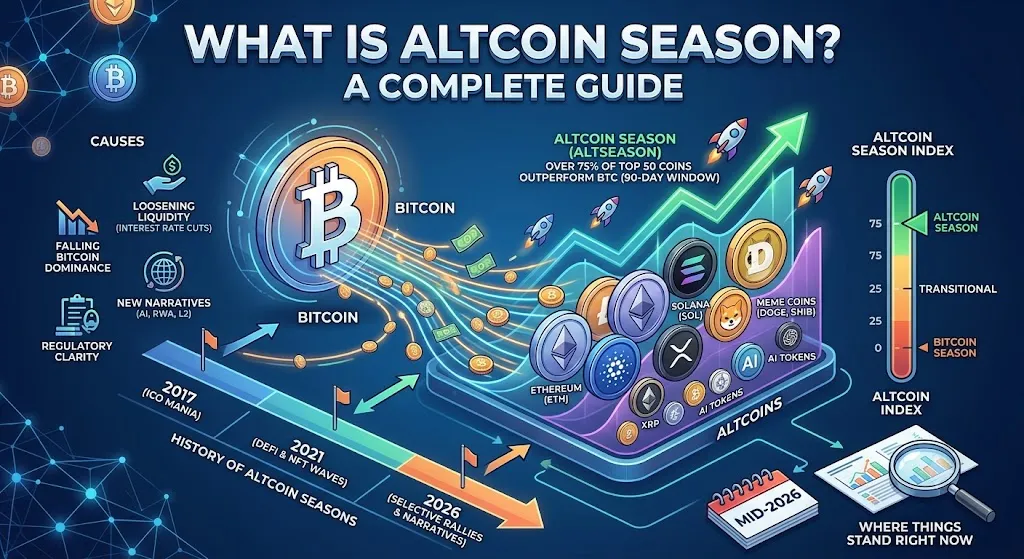
There is no single switch that flips to start a rotation into altcoins, but a few conditions tend to show up together when it happens.
Bitcoin dominance starts to fall. Bitcoin dominance measures Bitcoin’s share of the total crypto market capitalization. When this number is high, usually above 55 to 60 percent, capital is concentrated in Bitcoin. A meaningful and sustained drop in dominance is usually the clearest early signal that money is spreading out into the rest of the market.
Bitcoin’s price stabilizes after a big run. Historically, altcoin seasons tend to follow a period where Bitcoin has already made a strong move and starts to consolidate. Traders who made gains on Bitcoin often rotate profits into altcoins looking for the next leg of upside, since altcoins typically offer more volatility and, in theory, more room to run percentage-wise.
Liquidity conditions loosen. Altcoins are higher-beta assets, meaning they tend to amplify whatever the broader market is doing. When interest rates fall or central banks signal easier monetary policy, risk assets across the board tend to benefit, and altcoins usually benefit the most within crypto specifically.
Regulatory clarity improves. Uncertainty about whether a token counts as a security has kept a lot of institutional money on the sidelines for years. Any real progress on regulatory frameworks that clarify how altcoins are classified tends to open the door for larger, more risk-tolerant capital to get involved beyond just Bitcoin and Ethereum.
A fresh narrative takes hold. Every cycle seems to need a story. DeFi had its moment, NFTs had theirs, and more recently, narratives around artificial intelligence tokens, real-world asset tokenization, and specific layer-2 scaling projects have each drawn concentrated waves of speculative capital.
| Metric / Characteristic | Bitcoin Season | Altcoin Season |
|---|---|---|
| Market Performance | Bitcoin outperforms | Altcoins outperform |
| Market Dominance | High dominance | Falling dominance |
| Risk Profile | Lower risk | Higher risk |
| Primary Drivers | Institutions lead | Retail participation grows |
| Investment Focus | Large-cap focus | Broader market gains |
Where Things Stand Right Now
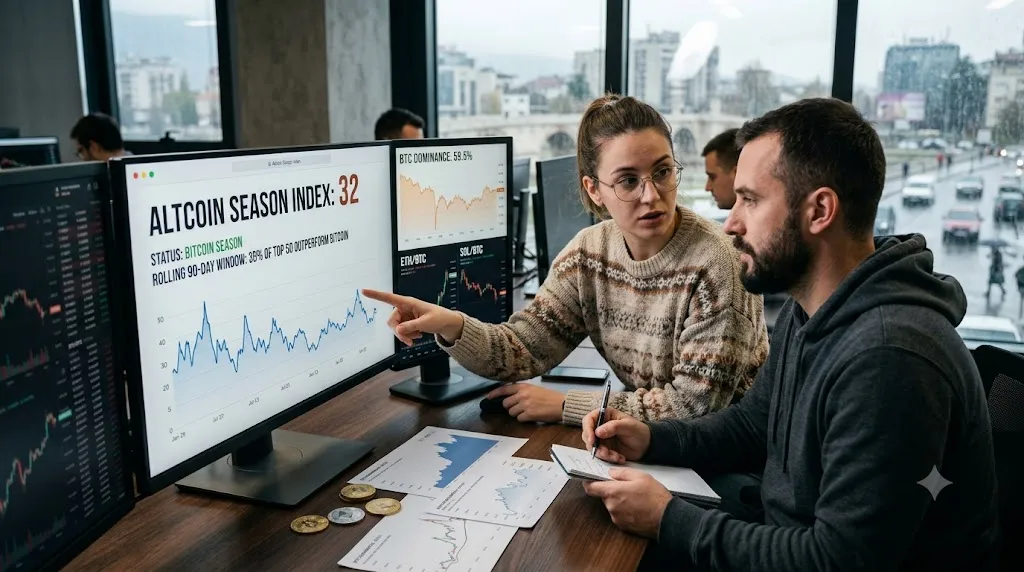
As of the middle of 2026, the market is sitting in a genuinely interesting, transitional spot, and it is worth being honest about that instead of pretending there is a clean answer.
Bitcoin dominance has been hovering in the high 50s to low 60s percentage range for much of the year, and the Altcoin Season Index itself has spent long stretches sitting in the 27 to 35 range, which is squarely inside Bitcoin season territory by the traditional 75-point threshold. That said, the picture underneath the headline number is more mixed than it looks. Certain individual altcoins have posted strong, narrow rallies even while the broad index stays low, which is a pattern that shows up often in the early innings of a rotation: pockets of outperformance before the move becomes broad-based.
Several of the conditions that historically precede a fuller rotation are at least partially in place. Interest rate cuts have been a live topic through the year, and any further easing tends to favor higher-beta assets like altcoins. Progress on U.S. crypto market structure legislation, often discussed under the umbrella of bills aimed at resolving how digital assets are classified, has also been closely watched as a potential unlock for institutional altcoin exposure.
None of this guarantees an altcoin season is imminent. Experienced traders tend to treat the index as one input among several rather than a standalone signal, and many pair it with a look at how Ethereum and Solana are trading against Bitcoin directly, since sustained strength in those pairs is often viewed as an early confirmation that capital is starting to rotate rather than just bouncing.
How to Track It Yourself
You do not need a Bloomberg terminal to follow this. A few free tools cover most of what serious traders use:
Blockchaincenter’s Altcoin Season Index gives you the classic 0 to 100 reading updated regularly.
Bitcoin dominance charts, available on most major charting platforms and data aggregators, show you the bigger structural trend at a glance.
ETH/BTC and SOL/BTC trading pairs are worth watching directly, since sustained upward movement in these pairs against Bitcoin is often treated as a leading signal before the broader altcoin index catches up.
On-chain data and exchange volume for altcoins can also hint at where capital is actually flowing, since a rising index paired with thin trading volume is a weaker signal than one backed by genuine liquidity.
The Risks Nobody Puts on the Thumbnail
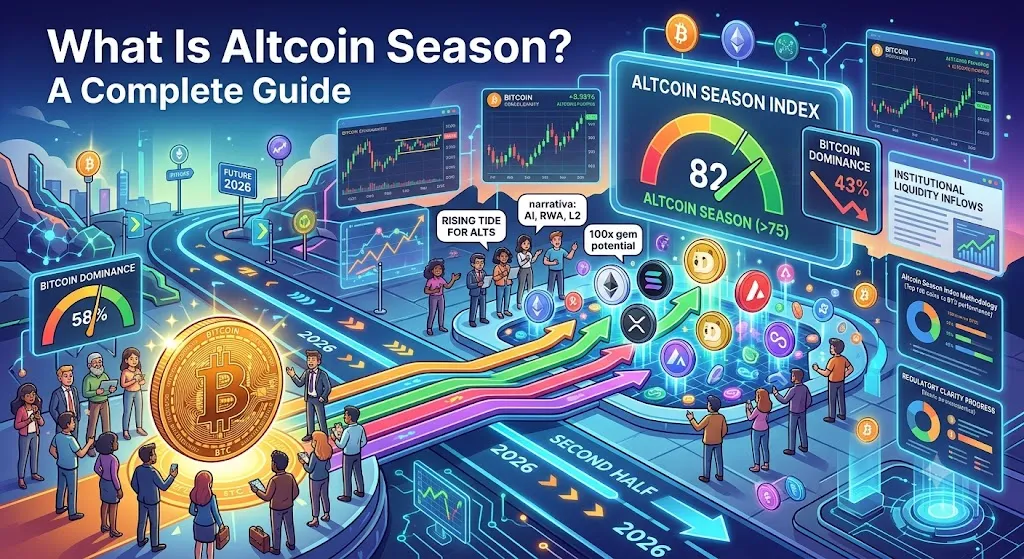
Altcoin season sounds exciting, and it can be genuinely profitable, but it comes with real risks that are worth taking seriously.
Altcoins are far more volatile than Bitcoin in both directions. The same characteristics that make them capable of outsized gains also make them capable of outsized, fast losses when sentiment turns.
Liquidity varies enormously across the altcoin market. Large-cap names like Ethereum or Solana trade with deep order books, but a huge share of altcoins have thin liquidity, meaning prices can be pushed around dramatically by relatively small amounts of capital, in both directions.
Timing is genuinely difficult. Altcoin seasons do not announce themselves in advance. By the time the index crosses well above 75 and it is obvious to everyone that altcoin season is in full swing, a large chunk of the move has often already happened. Chasing coins after they have already doubled or tripled is a common way traders end up buying near a local top.
Scams and low-quality projects proliferate during altcoin seasons. When speculative appetite is high, promoters and outright bad actors tend to flood the market with tokens that have little to no real utility behind them, counting on hype alone to drive short-term price action.
Bitcoin Rally
↓
Bitcoin Consolidates
↓
Ethereum Strengthens
↓
Large-Cap Altcoins Rise
↓
Mid-Cap Altcoins Rise
↓
Small Meme Coins Pump
↓
Market Peak
↓
Bear Market
A Note on Strategy
This is not financial advice, and nobody, including any index or indicator, can tell you with certainty when the next altcoin season will begin or how long it will last. What experienced market participants generally do is treat the Altcoin Season Index as one piece of a broader picture, alongside Bitcoin dominance trends, macro liquidity conditions, and specific sector strength, rather than trading purely off a single number.
Some investors choose to build positions gradually in projects they believe in during quieter Bitcoin-dominant periods, on the theory that accumulating before a rotation is less risky than chasing one that has already started. Others prefer to wait for confirmation, such as a sustained move in the index alongside falling Bitcoin dominance, before increasing altcoin exposure, accepting that they may miss the earliest and often most explosive part of a move in exchange for more certainty. Both approaches carry tradeoffs, and neither guarantees a good outcome, since crypto markets remain highly unpredictable and can reverse trends quickly.
A Timeline of Altcoin Market Cycles
Looking back, the pattern of altcoin seasons tracks pretty closely with the broader arc of crypto itself. In 2017, the ICO boom kicked off a broad altcoin rally, with money pouring into nearly anything with a whitepaper and a Telegram group. By 2021, the rotation looked different, driven less by hype alone and more by real product growth in DeFi, the NFT explosion, and a wave of new layer-1 blockchains competing for Ethereum’s crown. Then came 2022, when the bear market wiped out much of that speculative froth and altcoins got hit far harder than Bitcoin on the way down.
The stretch from 2023 through 2025 brought a more selective kind of recovery, with gains concentrated in specific narratives like AI tokens, real-world assets, and particular layer-2 networks rather than a rising tide lifting everything at once. That brings us to 2026, a transitional period where Bitcoin dominance remains elevated, the Altcoin Season Index has spent much of the year below the threshold for a full rotation, and the market seems to be waiting for the next clear signal before altcoins broadly take the lead again.
5 Common Mistakes During Altcoin Season
Altcoin season has a way of making even careful investors sloppy. The first mistake is the classic one: buying after a coin has already doubled or tripled, chasing a chart instead of an opportunity, then wondering why it stalls out right after you got in. Right behind that is ignoring liquidity — plenty of altcoins look great on a candlestick chart until you actually try to sell a meaningful position and realize the order book is too thin to get out at the price you expected.
Then there’s the tendency to overlook tokenomics entirely, skipping past supply schedules, unlock dates, and insider allocations that can quietly dilute a token’s price no matter how strong the narrative sounds. Following influencers blindly compounds all of this, since plenty of “can’t-miss” calls are timed around the caller’s own exit, not yours. And maybe the most common mistake of all is forgetting to take profits — riding a position all the way up and telling yourself you’ll sell “a little higher,” only to watch the gains evaporate when the rotation reverses just as fast as it started.
Frequently Asked Questions
Is altcoin season happening right now? It depends on the exact week you are reading this, since the index moves regularly, but as of mid-2026 the broad market has spent most of the year in Bitcoin season territory according to the standard Altcoin Season Index, even as individual altcoins have had strong isolated runs.
How long does altcoin season usually last? Historically, these periods have ranged from a few weeks to several months. The 2017 and 2021 rotations each lasted multiple months in total, though they were not smooth in either case and included sharp pullbacks along the way.
Does altcoin season happen every crypto cycle? Broad, market-wide altcoin seasons have shown up in most major cycles so far, but there is no rule guaranteeing that pattern repeats exactly the same way every time. Recent cycles have shown narrower, more selective rotations into specific narratives rather than the kind of market-wide lift seen in 2017.
What is the difference between Bitcoin dominance and the Altcoin Season Index? Bitcoin dominance measures Bitcoin’s share of the total crypto market capitalization. The Altcoin Season Index measures how many of the top altcoins have outperformed Bitcoin’s price over the past 90 days. They are related and tend to move in opposite directions, but they are not the same metric, and traders often watch both together.
Should I buy altcoins based on the index alone? Most experienced traders would say no. The index is a useful piece of context, but it works best combined with other signals like Bitcoin dominance trends, liquidity conditions, and fundamentals of the specific projects being considered, rather than as a standalone buy or sell trigger.
The Bottom Line
Altcoin season describes a real, recurring pattern in crypto markets, not just internet hype, and the Altcoin Season Index gives traders a concrete, data-driven way to track it instead of relying on gut feeling or social media noise. But the index is a lagging and sometimes noisy signal, not a crystal ball. Understanding what actually drives these rotations, falling Bitcoin dominance, loosening liquidity, regulatory progress, and fresh narratives, will tell you far more about where the market might be headed than watching a single number cross an arbitrary threshold.
Whether or not the back half of 2026 brings a full-blown altcoin season, the fundamentals behind the concept are worth understanding for anyone who spends time in this market. It is one of the more useful frameworks for making sense of where crypto capital is flowing, and why.
This article is reviewed regularly to reflect changes in crypto market structure and major indicators such as Bitcoin dominance and the Altcoin Season Index.
About the Author:
Ana Milojevic is a crypto writer and the creator of basedmoondog.com. She writes in-depth guides on Web3, DeFi liquidity, and AI trading technologies, including insights on MoonDog AI. When she isn’t breaking down complex crypto mechanics, she is tracking market trends across decentralized ecosystems.
Leave a Reply