
I Asked a Crypto-Skeptical Friend to Explain Bitcoin. Then I Asked Her to Explain Ethereum. Here’s Why the Second Answer Took Ten Times Longer
Everyone, even people who’ve never touched crypto, has a rough mental model of Bitcoin: digital money, limited supply, no bank required. Ask the same person to explain Ethereum, though, and the conversation usually stalls somewhere around “it’s like Bitcoin, but… more?”
That hesitation is fair. Ethereum isn’t trying to be digital cash. It’s trying to be something closer to a global, programmable computer that nobody owns and nobody can shut off. That’s a harder idea to compress into a single sentence, which is probably why so many beginner explanations either oversimplify it into “Bitcoin’s cousin” or bury newcomers in jargon about gas fees and smart contracts before explaining why any of it matters.
This guide takes the slower route. No prior crypto knowledge required.
What is Ethereum?
Ethereum is a decentralized blockchain network that allows developers to build applications using smart contracts. Unlike Bitcoin, which mainly focuses on digital money, Ethereum is designed as a programmable platform powered by its cryptocurrency ETH.
Start Here: What Problem Was Ethereum Trying to Solve?
Bitcoin, launched in 2009, proved that a network of computers could agree on who owns what, without a bank, government, or company sitting in the middle. It was revolutionary, but deliberately narrow: Bitcoin’s programming language is limited on purpose, built almost entirely around moving a currency from one person to another securely.
A programmer named Vitalik Buterin, along with several collaborators, proposed something broader in a 2013 whitepaper: what if that same trustless, decentralized network could run any program, not just handle currency transfers? Ethereum launched in 2015 with exactly that goal, positioning itself not as “better Bitcoin,” but as a different kind of infrastructure entirely, a decentralized platform for running applications that no single company or server controls.
That distinction matters more than it might sound. Bitcoin answers the question “who owns this coin?” Ethereum answers the much bigger question “how do we let two strangers who don’t trust each other agree on the outcome of literally any digital agreement, automatically, without a middleman?”
The Core Idea: Smart Contracts
The feature that makes this possible is called a smart contract, and despite the intimidating name, the underlying idea is fairly intuitive.
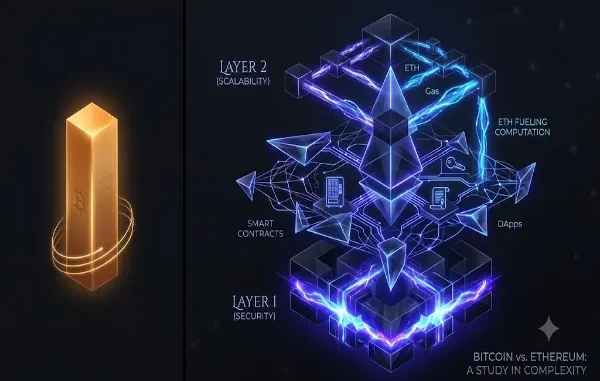
A smart contract is simply a program stored on the Ethereum network that runs exactly as written, with no ability for anyone, including its creator, to alter it after the fact or stop it from executing once its conditions are met. Think of it as a vending machine rather than a legal contract in the traditional sense: you put in the correct input, and the machine performs the agreed-upon action automatically, without needing a cashier, a store manager, or a lawyer to intervene.
This unlocks an enormous range of applications beyond simple payments:
Decentralized finance (DeFi) platforms let people lend, borrow, trade, and earn interest on crypto assets without a bank, using smart contracts to automatically handle what a loan officer or trading desk would normally do.
Non-fungible tokens (NFTs) use Ethereum’s infrastructure to represent verifiable ownership of a unique digital (or sometimes physical) asset, whether that’s digital art, event tickets, or in-game items.
Decentralized applications (dApps) span everything from prediction markets to social platforms to games, all running on code that no single company can unilaterally shut down or alter.
None of this existed on Bitcoin’s original design, which is the real reason Ethereum carved out its own identity rather than simply becoming “Bitcoin 2.0.”
ETH: The Currency Behind the Computer
Ether, usually shortened to ETH, is Ethereum’s native cryptocurrency. It plays a role similar to Bitcoin in one sense, it can be sent, held, and traded as a digital asset, but its primary functional purpose within the network is different.
ETH is what you use to pay for computation on the Ethereum network. Every time a smart contract runs, whether that’s a token swap, an NFT purchase, or a DeFi transaction, it consumes computing resources from the thousands of computers (called nodes) that maintain the network. The fee paid for that computation, denominated in ETH, is commonly called “gas,” a name meant to evoke fuel powering an engine.
This is one of the most consistently confusing points for beginners: Ethereum is the network and the underlying technology; ETH is the currency used to operate on that network. People often use “Ethereum” loosely to refer to both, similarly to how people say “I bought Bitcoin” when they really mean they bought BTC, the currency associated with the Bitcoin network.
How Ethereum Actually Works, Without the Jargon

Ethereum runs on a global network of independent computers, run by individuals and organizations all over the world, that all keep a synchronized copy of the same record: every transaction, every smart contract, and every account balance that has ever existed on the network. No single company’s server holds the “real” version. Instead, the network uses a consensus mechanism, a set of rules for how thousands of independent computers agree on what’s true, without needing to trust each other individually.
For its first several years, Ethereum used a system called proof-of-work, the same energy-intensive method Bitcoin still uses, where computers compete to solve complex mathematical puzzles to earn the right to add new transactions to the network. In September 2022, Ethereum completed a multi-year technical transition known as The Merge, switching to a dramatically more energy-efficient system called proof-of-stake. Instead of computers competing with raw computational power, participants called validators lock up, or “stake,” a set amount of ETH as collateral, and are selected to confirm transactions based on that stake, with penalties for dishonest behavior. This single change reduced Ethereum’s energy consumption by more than 99 percent, addressing one of the most common criticisms of blockchain technology generally.
Why Ethereum’s Story Didn’t End at The Merge
A common misconception is that Ethereum finished its major technical evolution once it completed the shift to proof-of-stake. In reality, the network has continued shipping significant upgrades on a fairly aggressive schedule since then, most of them aimed at the same underlying goal: making Ethereum cheaper and faster to use without sacrificing decentralization.
In March 2024, an upgrade called Dencun introduced a new way of handling data specifically for Layer 2 networks, secondary networks built on top of Ethereum that bundle many transactions together before settling them on the main chain, dramatically reducing the fees those Layer 2 networks charge their users. Two more upgrades, Pectra and Fusaka, followed through 2025, further refining staking flexibility and Layer 2 scalability. As of mid-2026, Ethereum has moved to a more frequent, incremental release schedule rather than infrequent, massive overhauls, with a major upgrade called Glamsterdam expected in the second half of the year, focused on increasing the network’s base-layer transaction capacity, followed by a subsequent upgrade already nicknamed Hegotá.
The practical effect for an ordinary user is straightforward, even if the engineering behind it is not: transactions that were once criticized as slow and expensive during Ethereum’s most congested periods have become significantly cheaper as these upgrades have rolled out, particularly for anyone using Layer 2 networks rather than transacting directly on Ethereum’s base layer.
Layer 1 vs. Layer 2: The Part Beginners Usually Skip
If you spend any time in Ethereum-related communities, you’ll quickly run into the terms “Layer 1” and “Layer 2,” and it’s worth understanding the basic distinction, since it affects both cost and speed.
Layer 1 refers to the Ethereum base network itself, the foundational blockchain that provides the network’s core security. Layer 2 networks are separate systems built on top of Ethereum that handle transactions more cheaply and quickly, then periodically bundle and settle the results back onto the Ethereum base layer. This design lets Ethereum prioritize security and decentralization at its core, while pushing high-volume, everyday activity onto faster, cheaper secondary networks, an approach often described as “rollup-centric” scaling.
For a beginner, the practical takeaway is simple: many popular Ethereum-based apps you might use aren’t actually running directly on Ethereum’s main network, they’re running on a Layer 2 built on top of it, which is part of why fees can vary enormously depending on which network layer a given transaction actually occurs on.
How Ethereum Differs From Bitcoin, in Plain Terms
When researching Ethereum, the biggest beginner mistake I noticed is treating ETH like another version of Bitcoin. The two networks solve different problems.

Purpose: Bitcoin is primarily designed as a decentralized store of value and payment system. Ethereum is designed as a broader platform for building decentralized applications, with ETH functioning as the fuel for that platform rather than its sole purpose.
Programmability: Bitcoin’s scripting language is intentionally limited. Ethereum supports a full programming environment (smart contracts), allowing far more complex applications to be built directly on the network.
Supply structure: Bitcoin has a fixed maximum supply of 21 million coins, hard-coded into the protocol. Ethereum does not have a fixed maximum supply in the same way, though certain upgrades have introduced mechanisms that burn (permanently remove) a portion of transaction fees, which can reduce circulating supply depending on network activity.
Consensus mechanism: Bitcoin still uses proof-of-work. Ethereum moved to proof-of-stake in 2022, using far less energy in the process.
| Feature | Bitcoin | Ethereum |
|---|---|---|
| Main purpose | Digital money | Programmable blockchain |
| Launch year | 2009 | 2015 |
| Currency | BTC | ETH |
| Consensus | Proof of Work | Proof of Stake |
| Main use | Store of value | Smart contracts and apps |
Common Beginner Mistakes Worth Avoiding
Confusing “Ethereum” and “ETH”: As mentioned above, one refers to the network, the other to its currency. It matters when you’re reading technical documentation or trying to understand what a given fee is actually paying for.
Assuming all transactions cost the same: Fees vary significantly depending on network congestion and whether you’re transacting on Ethereum’s Layer 1 or a Layer 2 network. Checking current network conditions before a large transaction can meaningfully affect what you pay.
Treating “decentralized” as “risk-free”: Smart contracts remove the need for a trusted middleman, but they don’t remove risk entirely. Poorly written or maliciously designed smart contracts have been exploited in the past, and once a smart contract is deployed, it generally can’t be altered even if a flaw is later discovered, which makes due diligence before interacting with any application genuinely important.
Chasing every new upgrade headline: Ethereum’s development roadmap moves quickly, and it’s easy to get swept up in the hype around each new named upgrade. What actually matters for most users is far simpler: is the network getting cheaper and more reliable to use over time, a trend that has held up consistently across Ethereum’s recent upgrade history.
Where Ethereum Fits in the Bigger Picture

Ethereum isn’t the only programmable blockchain network, and it faces real competition from other platforms built around similar goals of speed and lower fees. What’s kept Ethereum central to the broader crypto ecosystem is less about being the fastest or cheapest option in isolation, and more about network effects: the largest collection of decentralized applications, developer tools, and Layer 2 networks are built specifically around Ethereum, which makes it the default foundation many new projects choose to build on, even when faster or cheaper alternatives technically exist.
Whether that dominance persists is genuinely an open question, and one that depends heavily on whether Ethereum’s ongoing upgrade roadmap continues to deliver on its promises around scalability, cost, and decentralization simultaneously, three goals that are notoriously difficult to achieve all at once in blockchain design.
The Bottom Line
Ethereum is best understood not as a competitor trying to replace Bitcoin, but as a different category of technology entirely: a decentralized, programmable network that allows software to run exactly as written, without a company or server controlling it. ETH is the currency that fuels that network, paying for the computational work smart contracts require. Since launching in 2015, Ethereum has evolved substantially, from its 2022 shift to a far more energy-efficient consensus mechanism, to a steady stream of upgrades since then aimed at making the network cheaper and more scalable without compromising its decentralized foundation.
For a beginner, the most useful mental shift is simply this: stop thinking of Ethereum as “another cryptocurrency” and start thinking of it as an operating system that happens to have its own currency built in to keep the lights on.
This article is for educational purposes only and does not constitute financial or investment advice. Cryptocurrency markets are highly volatile, and anyone considering buying, holding, or using ETH or Ethereum-based applications should conduct independent research and consider consulting a licensed financial advisor.
About the Author:
Ana Milojevic is a crypto writer and the creator of basedmoondog.com. She writes in-depth guides on Web3, DeFi liquidity, and AI trading technologies, including insights on MoonDog AI. When she isn’t breaking down complex crypto mechanics, she is tracking market trends across decentralized ecosystems.
Leave a Reply