
Scroll through crypto Twitter on any given day and you will almost certainly run into someone blaming “the whales” for a sudden price crash, or hyping up a mysterious wallet that just moved millions of dollars in Bitcoin. The term gets used constantly, sometimes accurately and sometimes as a catch-all excuse for a bad trading day, but the underlying concept is real and genuinely important to understand if you spend any time around crypto markets.
This guide breaks down what a crypto whale actually is, how whale wallets work, the market manipulation concerns tied to them, and the tools regular traders use to track this activity through on-chain analysis.
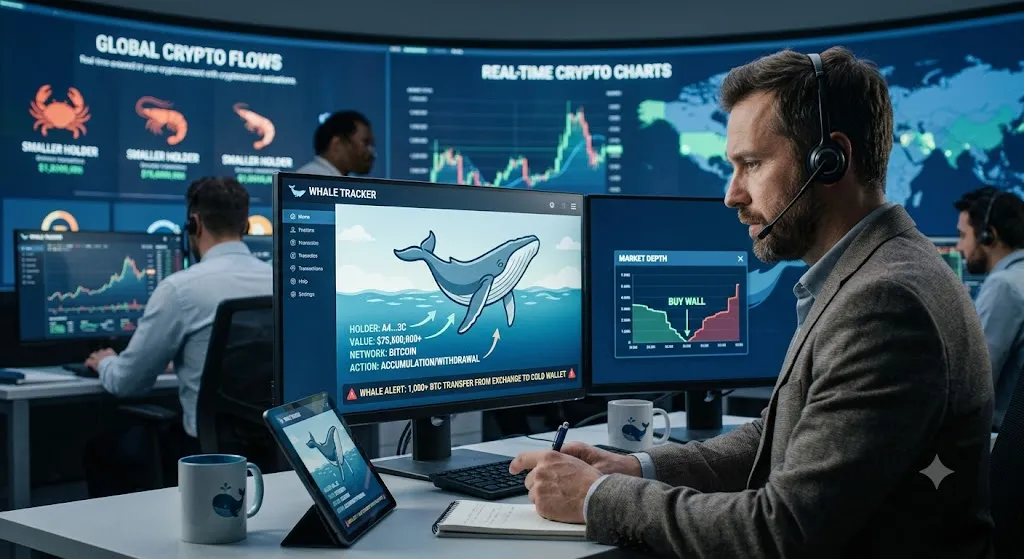
What Actually Defines a Crypto Whale
A crypto whale is simply an individual, fund, or entity that holds a large enough amount of a particular cryptocurrency to meaningfully influence its price through their own buying or selling activity. There is no single official threshold that makes someone a whale, and the definition shifts depending on the asset in question.
For Bitcoin, a common informal benchmark is holding at least 1,000 BTC, though plenty of people in the space use looser definitions closer to a few hundred coins. For smaller altcoins with much lower total supply and market capitalization, a wallet holding even a modest percentage of the circulating supply can qualify as a whale in that specific market, even if the dollar value looks small compared to a Bitcoin whale.
Whales are not a single type of entity either. Early Bitcoin miners and adopters who accumulated large positions when prices were a fraction of today’s value make up part of the picture. Investment funds, family offices, and crypto-native trading firms managing large pools of capital are another major category. Cryptocurrency exchanges themselves often hold enormous balances on behalf of their users, which technically makes exchange wallets some of the largest whale wallets in existence, even though that balance represents thousands of individual account holders rather than one person’s fortune. Founders and early teams behind specific projects frequently hold large allocations of their own token as well, making them whales within that particular altcoin’s ecosystem.
Whale Wallets in Practice
A whale wallet is simply the actual blockchain address holding this large balance. Because blockchains like Bitcoin and Ethereum are public ledgers, anyone can look up how much cryptocurrency sits in a given wallet address, even without knowing who controls it.
This public visibility is part of what makes whale-watching possible in the first place. Every transaction is permanently recorded and viewable by anyone with a block explorer, which is a website that lets you search wallet addresses and transaction histories. What you typically cannot see directly is the real-world identity behind an anonymous wallet address, unless that wallet has been publicly linked to a known entity, like a specific exchange, a well-known fund, or a public figure who has confirmed ownership.
Some whale wallets are well known and closely watched precisely because their owners have been identified or strongly suspected through a combination of on-chain patterns and outside research. Others remain a mystery, tracked purely by their behavior, earning nicknames from the crypto community based on their trading patterns rather than any confirmed identity.
The Market Manipulation Question
This is where whale activity gets genuinely controversial. Because a whale’s trades are large enough to move a market, especially in smaller, less liquid altcoins, there is real potential for that scale to be used in manipulative ways.
Pump and dump schemes are one of the most commonly cited examples. A whale, or a coordinated group acting together, might accumulate a large position in a low-liquidity token quietly, then use hype, social media promotion, or coordinated buying to drive the price up rapidly, drawing in retail traders who see the sudden rally and buy in out of fear of missing out. Once the price has risen enough, the whale sells their position into that demand, causing the price to crash and leaving later buyers holding losses.
Spoofing is another tactic that shows up in discussions of whale manipulation, where a trader places large buy or sell orders they never intend to actually execute, creating a false impression of demand or supply to influence other traders’ decisions, then cancels the order before it fills.
Wash trading, where an entity trades with itself, often across multiple accounts or exchanges, to create the appearance of high trading volume and interest in an asset, is another manipulation tactic that has been documented across parts of the crypto market, particularly on smaller or less regulated exchanges.
It is worth being fair here, though. Not every large transaction from a whale wallet represents manipulation. Whales rebalancing a portfolio, moving funds to a different exchange, or taking profit after a long hold are normal, legitimate market activities that simply happen to be large enough to show up on trackers and spook nervous retail traders watching the numbers scroll by. The panic that spreads when a whale alert bot posts about a large transfer is not always proportional to the actual market impact of that specific move.
Why Wallet Tracking Became a Whole Industry
Because blockchain data is public, an entire ecosystem of tools has emerged specifically to monitor whale activity in something close to real time. This is usually referred to as wallet tracking or whale watching, and it has become a meaningful part of how many traders approach the market.
Whale Alert is probably the most recognizable name in this space, running automated social media accounts that post notifications whenever a transaction above a certain size threshold happens on major blockchains. These alerts do not tell you who sent or received the funds in most cases, but the sheer size of the transfer alone is often enough to catch traders’ attention and spark speculation.
More sophisticated platforms like Arkham Intelligence and Nansen go further, attempting to actually label and identify wallets, tying anonymous addresses to known entities like specific exchanges, funds, or publicly identified individuals wherever possible. These platforms use a combination of on-chain pattern analysis, off-chain research, and sometimes crowd-sourced tips to build out their labeling databases, giving traders a clearer picture of who might actually be behind a given transaction.
Basic block explorers like Etherscan for Ethereum or standard Bitcoin explorers let anyone manually search individual wallet addresses, view their transaction history, and see current balances, without needing a specialized paid platform. For traders who want to keep an eye on one or two specific known whale addresses, this manual approach is often enough.
What On-Chain Analysis Actually Involves

Wallet tracking is really just one piece of a broader practice called on-chain analysis, which involves studying blockchain data directly to understand market conditions and investor behavior, rather than relying solely on price charts.
One common on-chain metric involves tracking exchange inflows and outflows. When large amounts of a cryptocurrency move onto exchanges, it is often interpreted as a signal that holders may be preparing to sell, since exchanges are typically where trading happens. Conversely, large outflows from exchanges into private wallets are often read as a bullish signal, suggesting holders intend to keep their coins for the longer term rather than sell soon, since coins sitting in a private wallet cannot be traded on that exchange.
Another metric involves watching dormant coins, meaning cryptocurrency that has not moved in a very long time, sometimes years, suddenly getting transferred. Since early holders from years ago are sitting on positions acquired at drastically lower prices, any movement of genuinely old coins tends to draw significant attention, since it could signal an early holder deciding to finally sell after a long period of inactivity.
Distribution analysis looks at how concentrated or spread out a cryptocurrency’s supply is across different wallet sizes. A token where a tiny number of wallets hold the overwhelming majority of the supply is generally considered more vulnerable to manipulation and sudden price swings than one with a more evenly distributed holder base, since a small number of large holders acting in coordination could have an outsized impact on price.
How Retail Traders Should Actually Read Whale Activity
Given how much attention whale movements get, it is worth being honest about how much weight any single alert deserves. A large transaction alone rarely tells the full story. A whale moving coins from one wallet to another they also control is not the same as that whale selling on the open market, even though both can look similar in a basic transaction alert. Context, including which type of wallet received the funds, whether it was an exchange deposit address specifically, and what has historically followed similar movements from that same wallet, matters far more than the raw transaction size.
Traders who take on-chain analysis seriously tend to treat it as one input alongside traditional technical and fundamental analysis, rather than trading purely off a whale alert notification. Reacting instantly to every large transfer, especially in a market where plenty of movements are simple portfolio management rather than an imminent dump, is a good way to make decisions based on noise rather than signal.
The Bottom Line

Crypto whales are a real and influential part of how digital asset markets function, and the transparency of public blockchains has given rise to an entire discipline built around tracking their movements. Understanding whale wallets, the manipulation tactics some bad actors employ, and the tools available for wallet tracking and on-chain analysis gives traders a genuinely useful lens for understanding market dynamics that goes beyond price charts alone. The key is treating this information as context rather than gospel, since even the biggest, most closely watched wallets do not move the market in a way that is always as dramatic, or as predictable, as the headlines and alert bots make it seem.
Frequently Asked Questions
There is no official cutoff, but a commonly used benchmark for Bitcoin is holding around 1,000 BTC or more. For smaller altcoins, the threshold is usually based on percentage of circulating supply rather than a fixed number, since a much smaller dollar amount can still represent enough of a token’s total supply to move its price.
Not directly in most cases. Blockchains show wallet addresses and transaction histories publicly, but they do not show real-world identities by default. Platforms like Arkham Intelligence and Nansen try to label wallets by linking them to known entities, such as exchanges or publicly identified individuals, through outside research and pattern analysis, but plenty of whale wallets remain anonymous.
Tactics like wash trading and spoofing are considered market manipulation and are illegal in traditional financial markets, and regulators have increasingly applied similar scrutiny to crypto. Enforcement varies significantly depending on the exchange, the jurisdiction, and whether the asset in question is classified as a security, which makes crypto market manipulation harder to police consistently than in traditional markets.
Not reliably. A large transaction alert only shows that coins moved between wallets, not why. Whales frequently move funds between wallets they personally control, transfer to cold storage for safekeeping, or shift assets between exchanges without any intention of immediately buying or selling. Treating every alert as an imminent signal tends to lead to reactive, noise-driven decisions.
An individual whale wallet typically represents one person or entity’s holdings. An exchange wallet often holds enormous balances because it represents the combined deposits of thousands of individual users, not one person’s fortune. Both can appear as large balances on a block explorer, which is why context about wallet type matters when interpreting on-chain data.
No. Plenty of whale activity is completely legitimate, including long-term investors holding large positions, funds managing client capital, or early adopters gradually taking profit after years of holding. Concentrated ownership does create manipulation risk in theory, but a large holder is not automatically acting in bad faith.
Free block explorers like Etherscan for Ethereum-based tokens or standard Bitcoin explorers are a good starting point for looking up specific wallet addresses. Whale Alert’s social media accounts post real-time notifications of large transactions across several blockchains and require no technical setup. More advanced platforms like Nansen and Arkham offer deeper wallet labeling and analytics but typically come with a subscription cost.
Most experienced traders would say no. On-chain data is best used as one piece of context alongside price action, market conditions, and fundamentals, rather than a standalone signal. A single large transfer rarely tells the full story, and reacting to every alert can lead to decisions based on incomplete information.
Key Takeaways
Whale wallets, market manipulation, wallet tracking, and on-chain analysis are all connected pieces of the same story: because blockchains are public, large holders can be watched in a way that has no real equivalent in traditional finance. A crypto whale is any individual, fund, or entity holding enough of a given asset to influence its price, and the definition shifts depending on the coin’s total supply and liquidity.
Manipulation tactics like pump-and-dumps, spoofing, and wash trading are real risks tied to concentrated holdings, but not every large transaction represents bad intent. Tools like Whale Alert, Arkham, Nansen, and standard block explorers have made wallet tracking accessible to anyone, and on-chain metrics like exchange flows and dormant coin movement offer genuinely useful context. The most important habit for any trader is treating whale activity as one data point among many, rather than a standalone buy or sell signal.
Disclaimer
This article is for informational and educational purposes only and does not constitute financial, investment, or legal advice. Cryptocurrency markets are highly volatile and speculative, and on-chain data, including whale activity, should not be relied upon as the sole basis for any trading or investment decision. Always conduct your own research and consult a qualified financial advisor before making investment decisions.
Sources
Public blockchain explorers (Etherscan, Bitcoin block explorers)
Whale Alert
Arkham Intelligence
Nansen
General industry reporting and research on crypto market structure and on-chain analytics
About the Author:
Ana Milojevic is a crypto writer and the creator of basedmoondog.com. She writes in-depth guides on Web3, DeFi liquidity, and AI trading technologies, including insights on MoonDog AI. When she isn’t breaking down complex crypto mechanics, she is tracking market trends across decentralized ecosystems.
Leave a Reply