

TL;DR: Crypto liquidity measures how easily a cryptocurrency can be bought or sold without significantly affecting its price. High liquidity generally means lower slippage and easier trade execution, while low liquidity can cause large price movements and make it difficult to sell. In DeFi, liquidity pools allow users to trade against pools of tokens rather than traditional order books, while liquidity providers earn fees but face risks such as impermanent loss.
Crypto liquidity is the ability to buy or sell a cryptocurrency quickly without causing a significant change in its price. High liquidity generally means deeper markets, tighter spreads, and less price impact, while low liquidity can lead to higher slippage and greater difficulty exiting a position.
Scroll through any crypto discussion forum for more than a few minutes and you’ll run into the word “liquidity” being thrown around constantly — usually in the context of someone warning someone else not to buy a coin, or explaining why they got burned trying to sell one. It’s one of those terms that gets used so often in crypto circles that people assume everyone already understands it, when in reality it trips up a huge number of newcomers.
So let’s actually break it down: what liquidity means, why it matters more in crypto than in most traditional markets, how liquidity pools work, and what can go wrong when liquidity dries up.

Liquidity, In Plain Terms
At its core, liquidity just describes how easily an asset can be bought or sold without dramatically moving its price. A highly liquid asset has lots of buyers and sellers active at any given moment, so trades happen quickly, at prices close to what you’d expect. A low-liquidity, or “illiquid,” asset has few active participants, meaning even a modest trade can swing the price significantly, and finding someone to take the other side of your trade can take time — or simply not happen at the price you wanted.
Real estate is a classic example of a highly illiquid asset. Selling a house isn’t something you can do in seconds; it takes weeks or months, involves negotiation, and the final price can depend heavily on how motivated the buyer and seller are. Compare that to a heavily traded stock like Apple, where you can buy or sell thousands of shares almost instantly at a price barely different from the last trade.
Crypto sits somewhere across a wide spectrum. Bitcoin and Ethereum tend to be relatively liquid, with constant trading activity across major exchanges. But move down the list to smaller, lesser-known tokens, and liquidity can drop off a cliff — which is exactly where a lot of the horror stories in online crypto communities tend to come from.
| Concept | What it measures | Why it matters |
|---|---|---|
| Liquidity | How easily an asset can be traded without moving its price significantly | Affects execution and slippage |
| Trading volume | How much has been traded during a period | Shows market activity |
| Market cap | Total value of circulating tokens | Indicates overall asset size |
| Liquidity pool | Tokens supplied for decentralized trading | Enables DEX swaps |
| TVL | Value deposited in a DeFi protocol or pool | Helps indicate available capital |
What Is Liquidity in Crypto? (Plain English Definition)
If you spend time reading discussion threads on crypto-focused subreddits, a recurring pattern shows up: someone posts asking why they can’t sell a token they bought, or why the price crashed the moment they tried to cash out a relatively small amount. The responses tend to converge on the same explanation — thin liquidity.
This kind of discussion tends to follow a familiar shape. A newer trader describes buying into a small-cap token during a pump, watching the price triple, and then discovering that trying to sell even a modest position tanks the price by 30, 40, sometimes 50 percent, because there simply aren’t enough buyers or available liquidity to absorb the sale. More experienced members of these communities usually chime in with the same core lesson: high liquidity is what lets you actually exit a trade at something close to the price you see on the screen, and low market cap, low volume coins are notorious for looking fine right up until you try to sell.
It’s a pattern experienced traders bring up constantly as a warning to newcomers — check the liquidity before you buy, not after you’re already trying to sell.
How Do You Calculate Liquidity?
There’s no single universal formula for “calculating” liquidity, but traders typically look at a few key metrics together to get a clear picture. One common approach is checking the bid-ask spread — the gap between the highest price buyers are offering and the lowest price sellers will accept; a narrow spread signals high liquidity, while a wide one signals low liquidity.
Another is market depth, which looks at how much buy and sell volume sits at different price levels in the order book, showing how large a trade the market can absorb before the price moves significantly. For decentralized exchanges, the key figure is usually total value locked (TVL) in a liquidity pool, since a larger pool can handle bigger trades with less slippage.
Combining these — tight spreads, strong order book depth, and high TVL or 24-hour trading volume — gives a much more reliable read on true liquidity than looking at any single number alone.
Trading Volume: A Related but Different Concept
Liquidity and trading volume get used almost interchangeably in casual conversation, but they’re not quite the same thing, and mixing them up is one of the more common beginner mistakes.
Trading volume refers to the total amount of an asset that’s been bought and sold over a specific period, usually 24 hours in crypto data. It’s a snapshot of activity. Liquidity, by contrast, is more about the depth of the market at any given moment — how much buying and selling pressure is sitting there ready to absorb a trade right now, not just how much traded over the past day.
A token can show a large 24-hour volume number that looks impressive on a chart, while still having genuinely poor liquidity, particularly if that volume is concentrated in a few large trades or, in less scrupulous cases, artificially inflated through a practice called wash trading, where an entity trades with itself to make an asset look more active than it actually is.
This distinction comes up regularly in trading discussions, especially around newer or smaller tokens. Trading volume alone does not prove that a token has deep liquidity. A better assessment considers order-book depth, liquidity-pool size, spreads, and the amount of price impact produced by a typical trade.
Enter Liquidity Pools
Traditional stock markets rely on order books, matching individual buyers and sellers, often facilitated by professional market makers who keep things running smoothly. A lot of crypto trading, especially on decentralized exchanges like Uniswap or PancakeSwap, works completely differently, through something called a liquidity pool.
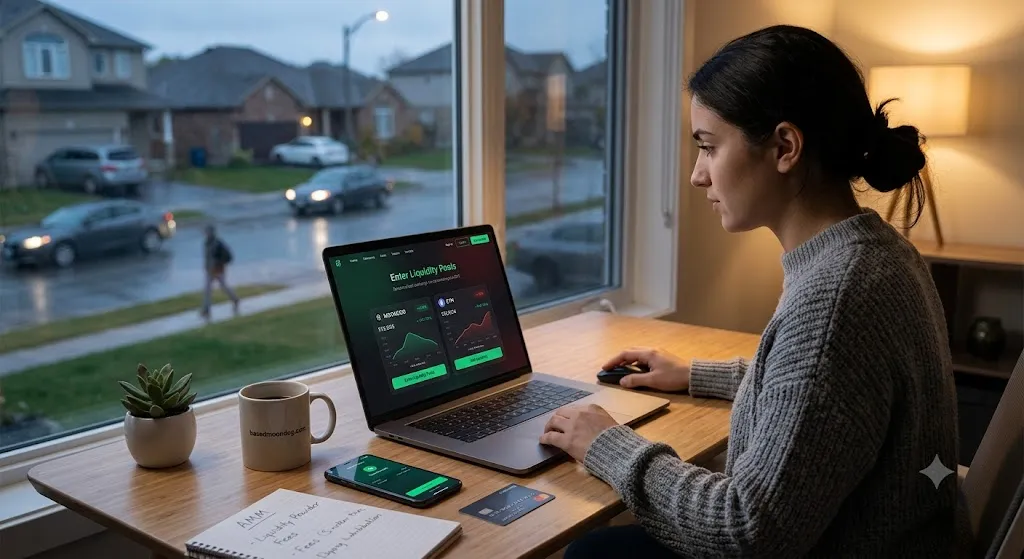
A liquidity pool is essentially a shared pot of two (or sometimes more) tokens, locked into a smart contract, that traders can swap against directly. Instead of waiting for a matching buyer or seller, you trade against the pool itself, and an automated formula adjusts the price based on the ratio of tokens remaining in it after each trade. This system is often called an automated market maker, or AMM.
Anyone can contribute funds to a liquidity pool, becoming what’s called a liquidity provider, in exchange for a cut of the trading fees generated by that pool. It’s a genuinely clever piece of financial engineering, and it’s a big part of what made decentralized finance possible in the first place.
How Much Liquidity Is Enough?
There’s no fixed number that defines “enough” liquidity — it really depends on the size of the trade you’re trying to make and how much price movement you’re willing to tolerate. As a rough guideline, many traders look for daily trading volume that’s at least a small multiple of the amount they intend to trade, so their own order doesn’t make up an outsized share of the day’s activity.
For liquidity pools, the amount of TVL needed depends on the size of the trade and the amount of slippage a trader is willing to accept. Larger pools generally provide more capacity to absorb trades without significant price impact, while smaller pools can experience substantial slippage even on relatively modest transactions.
The safest approach is to test with a small trade first and see how much the price moves — if a modest order shifts the price significantly, liquidity likely isn’t sufficient for what you’re trying to do.
Why Liquidity Pools Come Up So Often in Beginner Discussions
Two issues in particular come up again and again.
The first is slippage — the difference between the price you expect and the price you actually get, caused by your own trade moving the pool’s ratio. In a small, thinly funded pool, even a modest trade can cause noticeable slippage, and newer traders are often surprised the first time they see it happen, especially on lower-cap tokens where pools haven’t attracted much liquidity yet.

The second, and more consequential, is something called impermanent loss. This is a phenomenon that trips up a huge number of people who decide to become liquidity providers without fully understanding the mechanics first. In simple terms, if the price of one token in a pool moves significantly relative to the other, the value of what a liquidity provider can withdraw ends up lower than if they’d simply held the two tokens separately without depositing them at all. It is called “impermanent” because the difference can decrease or disappear if the relative prices of the assets move back toward their original relationship. If you withdraw while the difference remains, the resulting value difference is realized relative to simply holding the assets.
This concept is a recurring source of confusion and frustration in DeFi discussion threads. A pattern that shows up often: someone provides liquidity expecting to simply earn trading fees passively, doesn’t fully grasp impermanent loss going in, and later posts asking why their withdrawal is worth less than expected even though the pool generated fees the whole time. It’s consistently cited as one of the most misunderstood risks in decentralized finance, and one that even fairly experienced crypto users occasionally get caught off guard by.
How Much Liquidity Does a Crypto Token Need?
There isn’t one universal threshold that separates a “liquid enough” token from a risky one, because the right amount of liquidity really depends on a mix of factors specific to that token. Token size matters, since a larger market cap coin generally needs deeper liquidity to support the bigger dollar amounts moving in and out of it.
Typical trade size matters too — a token mostly traded in small amounts can get by with less liquidity than one attracting large institutional-sized orders. Which exchange it’s listed on plays a role as well, since liquidity can vary dramatically between a major centralized exchange and a smaller platform.
Trading volume, pool structure (including how liquidity is distributed across multiple pools or concentrated in one), and the token’s expected volatility all factor in too, since a highly volatile token generally needs deeper liquidity to absorb sharp price swings without collapsing entirely.
Rather than chasing a single benchmark number, it’s more useful to weigh these factors together for the specific token and trade size you’re dealing with.
Liquidity Risk: What Can Actually Go Wrong
Beyond the mechanics of individual trades, “liquidity risk” refers to a broader category of danger that experienced traders and analysts talk about constantly, especially during market downturns.
Difficulty exiting a position. The most direct form of liquidity risk is simply not being able to sell when you want to, at a price you’re willing to accept. This is especially common with smaller altcoins, newly launched tokens, or anything trading primarily on smaller, less established exchanges.
Rug pulls. This is one of the more notorious risks specific to decentralized liquidity pools, and it’s a term you’ll see constantly in crypto discussion communities. A rug pull happens when the creators of a token, who also control a large share of a liquidity pool, suddenly withdraw all the liquidity, crashing the token’s price to near zero and leaving other holders unable to sell at any meaningful price. It’s discussed so frequently in online communities precisely because it’s happened often enough to become a recognized pattern, and a huge portion of beginner-focused advice in these spaces is specifically geared toward spotting the warning signs before it happens — checking whether a pool’s liquidity is locked, for instance, or whether a small number of wallets control an outsized share of a token’s supply.
Market-wide liquidity crunches. During major downturns or periods of panic, liquidity can dry up across the board, not just for individual tokens. This is a topic that resurfaces in trading communities during every significant market crash — traders describing spreads widening suddenly, exchanges struggling under order volume, or prices gapping down sharply because there simply weren’t enough buyers to absorb a wave of selling.
Exchange-specific liquidity problems. Liquidity can also vary significantly between exchanges for the exact same asset. A token might trade with tight spreads and deep liquidity on one major exchange while being nearly untradeable on a smaller one. This is a frequent topic in trading discussions, particularly among people comparing execution quality across platforms, since buying on a shallow exchange can mean paying a noticeably worse price than the same trade would get elsewhere.
How to Check Liquidity Before You Trade
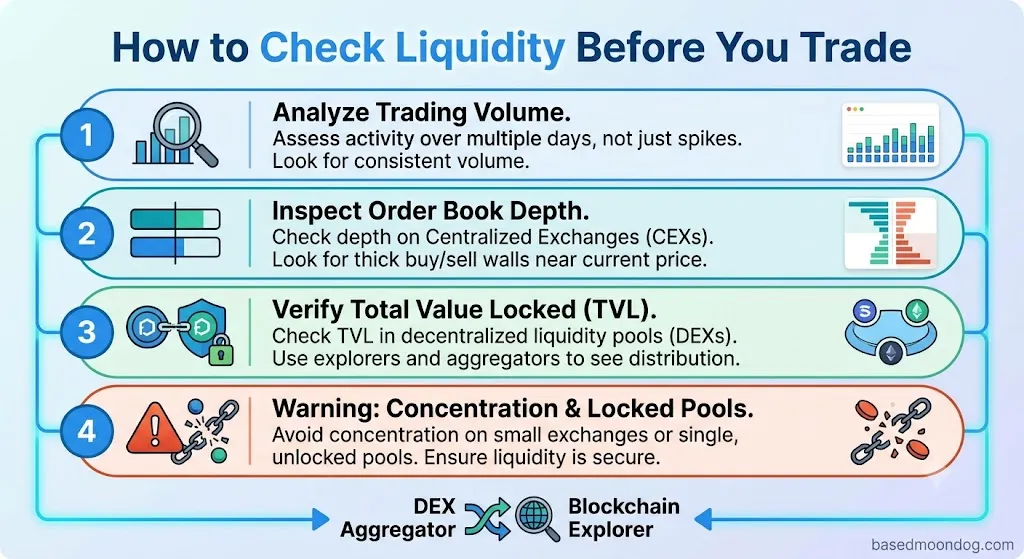
There are a few practical habits worth adopting before buying into any less-established token. Check the trading volume across a realistic time frame, not just a single spiking day. Look at the order book depth on centralized exchanges, or the total value locked in a liquidity pool on decentralized platforms — tools like DEX aggregators and blockchain explorers make this fairly easy to check. Be wary of tokens where liquidity is concentrated on a single small exchange or a single, unlocked pool. And generally, be skeptical of dramatic price spikes on low-liquidity assets, since those same conditions that let a token pump quickly also make it capable of collapsing just as fast.
The Bottom Line
Crypto liquidity is one of the most important factors to understand before trading a digital asset. It determines how easily you can buy or sell without significantly affecting the market price. Understanding the difference between liquidity and trading volume, how liquidity pools work, and the risks of low liquidity can help you make better-informed trading decisions. Before buying a cryptocurrency—especially a smaller or newer token—always consider its liquidity, trading activity, market depth, and potential price impact.
Key Takeaway
Crypto liquidity is how easily a cryptocurrency can be bought or sold without significantly affecting its price. Low liquidity can increase slippage, make positions harder to exit, and expose traders to greater liquidity risk.
FAQ: What Is Crypto Liquidity?
What is crypto liquidity? Crypto liquidity refers to how easily a cryptocurrency can be bought or sold without significantly affecting its price. A liquid asset has plenty of active buyers and sellers, so trades happen quickly and at prices close to the current market rate. An illiquid asset has fewer participants, meaning trades can be slow, difficult, or cause noticeable price swings.
Why is liquidity important in cryptocurrency? Liquidity determines whether you can actually enter or exit a position at a price close to what you expect. Without it, even a modest trade on a low-liquidity token can crash or spike the price, leading to major losses when trying to sell. High liquidity generally means more price stability, tighter spreads between buy and sell prices, and a smoother overall trading experience.
What is a liquidity pool? A liquidity pool is a shared pool of two or more tokens locked into a smart contract, used on decentralized exchanges like Uniswap or PancakeSwap to let people trade directly against the pool instead of matching with another individual trader. People who deposit funds into these pools, known as liquidity providers, earn a share of the trading fees generated whenever someone swaps tokens through that pool.
What is the difference between liquidity and trading volume? Trading volume measures how much of an asset has been bought and sold over a set period, usually 24 hours. Liquidity measures how much buying and selling capacity is available right now to absorb a trade without moving the price much. A token can show high trading volume while still having poor liquidity, especially if that volume is concentrated in just a few large trades or artificially inflated.
What happens when a crypto has low liquidity? Low liquidity typically means wider gaps between buy and sell prices, higher slippage on trades, and difficulty selling a position without significantly dropping the price. It also makes an asset more vulnerable to sudden, dramatic price swings from relatively small trades, and increases the risk of scenarios like rug pulls, where liquidity is suddenly pulled from a pool entirely.
How do you check a crypto’s liquidity? Look at trading volume over a realistic time frame rather than a single spike, check order book depth on centralized exchanges, and review the total value locked in a token’s liquidity pool on decentralized platforms using tools like blockchain explorers or DEX aggregators. It’s also worth checking whether liquidity is spread across multiple exchanges or concentrated in just one, and whether a pool’s liquidity is locked or could be withdrawn at any time.
What is liquidity risk in crypto? Liquidity risk is the danger of not being able to buy or sell an asset at a fair price when you want to. This can show up as difficulty exiting a position, market-wide liquidity crunches during downturns, exchange-specific liquidity gaps, or more severe events like rug pulls, where a token’s liquidity is deliberately withdrawn, leaving other holders unable to sell.
What is impermanent loss? Impermanent loss happens to liquidity providers when the price of one token in a pool changes significantly relative to the other, resulting in the value of their withdrawn funds being lower than if they had simply held the tokens separately. It’s called “impermanent” because the loss only becomes locked in once funds are actually withdrawn; if prices move back toward their original ratio, the loss can shrink or disappear entirely.
Sources
- Uniswap Docs — Introduction to Automated Market Makers (AMMs)
Explains how automated market makers and liquidity pools work on decentralized exchanges. - Uniswap Docs — Liquidity Pools
Provides technical information about liquidity providers, pools, token swaps, and trading fees. - Ethereum.org — Decentralized Finance (DeFi)
Provides background on DeFi and how smart-contract-based financial applications operate. - Ethereum.org — Smart Contracts
Explains how smart contracts work and their role in blockchain-based applications such as decentralized exchanges and liquidity pools. - Coinbase Learn — Crypto Liquidity
Provides beginner-friendly explanations of liquidity, trading activity, and the ability to buy or sell crypto without substantial price impact. - CoinMarketCap Alexandria — Liquidity
Provides educational information about crypto liquidity, trading volume, market depth, and related trading concepts.
About the Author:
Ana Milojevic is a crypto writer and the creator of basedmoondog.com. She writes in-depth guides on Web3, DeFi liquidity, and AI trading technologies, including insights on MoonDog AI. When she isn’t breaking down complex crypto mechanics, she is tracking market trends across decentralized ecosystems.
Disclaimer: The content on basedmoondog.com is provided for informational and educational purposes only and does not constitute financial, investment, or trading advice. Cryptocurrency markets, decentralized finance (DeFi) protocols, and AI trading tools carry inherent risks, including market volatility, smart contract vulnerabilities, and liquidity loss. Always conduct your own research (DYOR) and consult a qualified financial advisor before making any investment decisions.
Leave a Reply