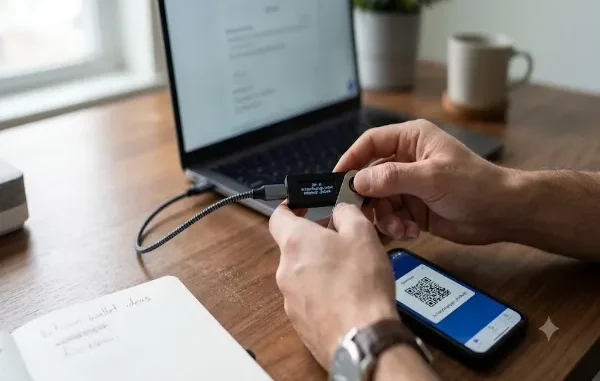
If you’ve ever tried to buy your first bit of Bitcoin or Ethereum, you’ve probably hit a moment of pure panic staring at a long string of random letters and numbers you’re told to “send funds to.” That string is your crypto wallet address, and understanding what it actually is — and isn’t — can save you from one of the most common and painful mistakes in crypto: sending money into the void.
Let’s break it down without the jargon.
Key Takeaways
- A crypto wallet address is used to receive cryptocurrency.
- It is safe to share your wallet address.
- Never share your private key.
- Always verify the blockchain network before sending funds.
- Test large transfers with a small amount first.
The Simple Definition
A crypto wallet address is a unique identifier that functions like an account number for receiving digital currency. It’s a string of letters and numbers, usually somewhere between 26 and 42 characters depending on the blockchain, that tells the network exactly where a transaction should land.
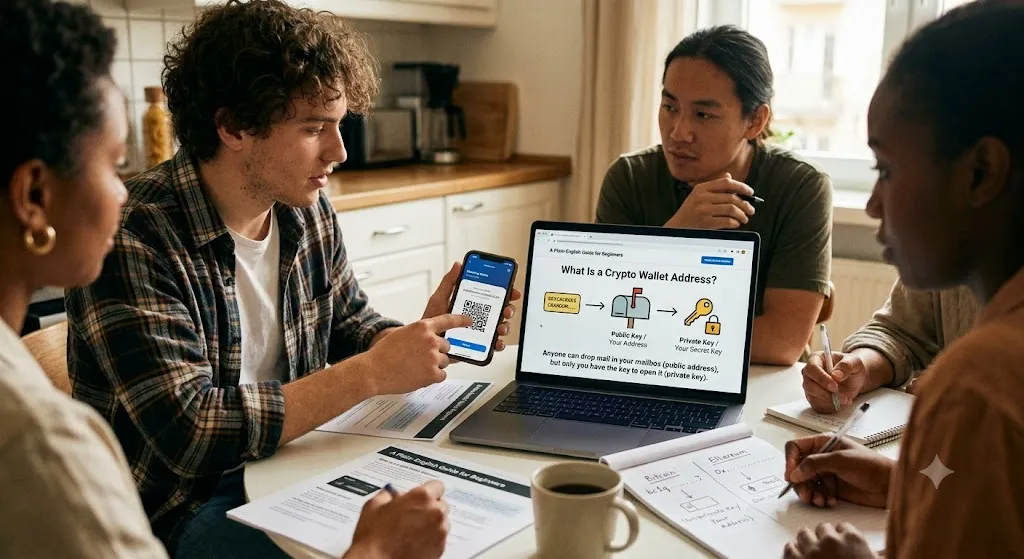
Think of it like a mailbox. Anyone can look up your street address and drop something in your mailbox, but only you have the key to open it and take what’s inside. In crypto terms, the address is public — you can share it freely, post it online, put it on a business card if you’re feeling bold — but the “key” that lets you actually spend or move the funds inside is private, and it should never leave your possession.
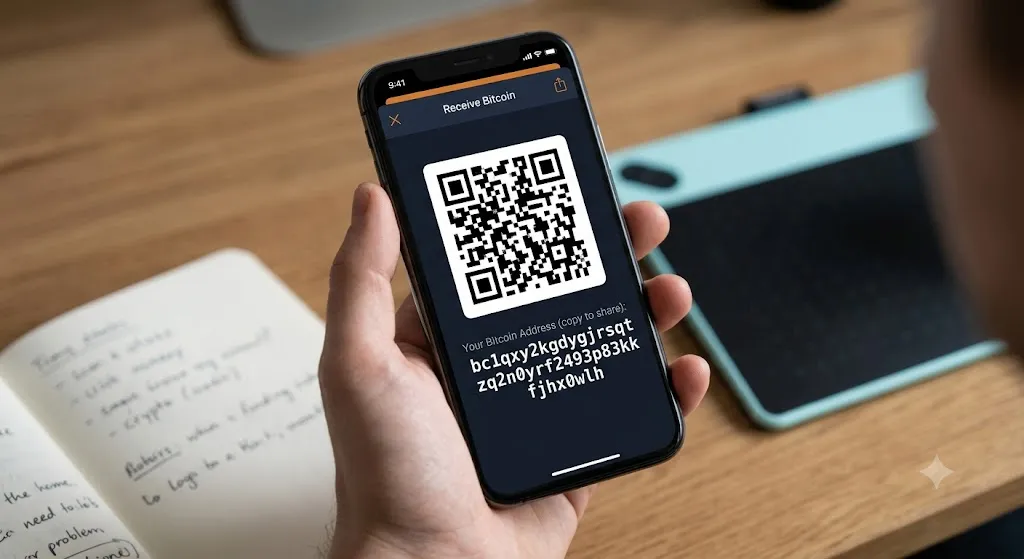
A typical Bitcoin address looks something like this:
bc1qxy2kgdygjrsqtzq2n0yrf2493p83kkfjhx0wlh
An Ethereum address looks quite different:
0x71C7656EC7ab88b098defB751B7401B5f6d8976
Same basic concept, different formats, because different blockchains use different technical standards.
Where Does the Address Actually Come From?
Here’s where a lot of beginner confusion sets in, because a wallet address isn’t something you type in or choose, like a username. It’s mathematically generated.
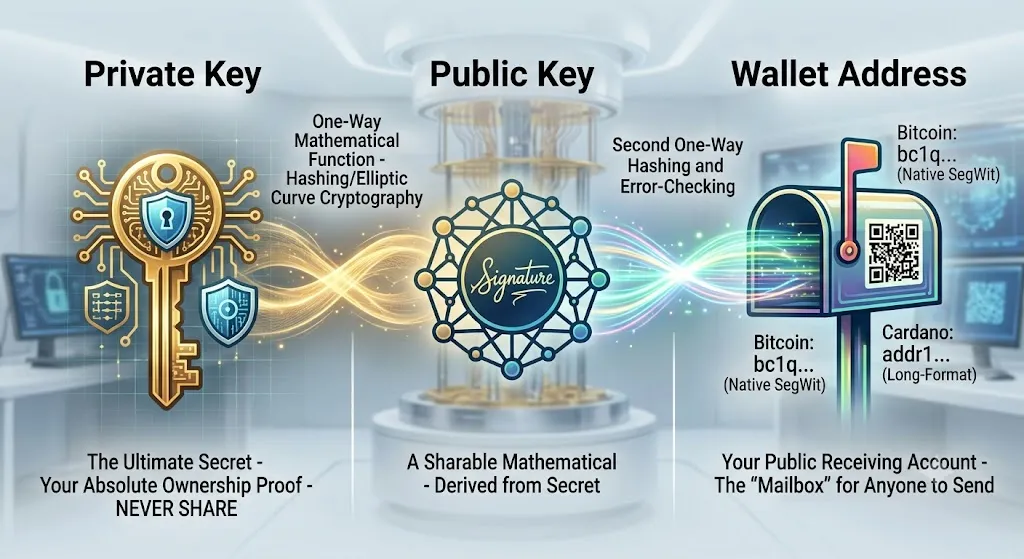
Every crypto wallet is built on a pair of cryptographic keys: a private key and a public key. The private key is a massive random number, generated when you first set up the wallet, and it’s the actual proof of ownership over your funds. From that private key, the wallet software runs a one-way mathematical function to produce a public key. Then, through another round of hashing, that public key gets turned into the address you actually share with people.
The important part is that this process only works in one direction. You can go from private key to public address, but you cannot reverse-engineer someone’s private key just by looking at their public address, even with enormous computing power. That one-way relationship is the entire foundation of blockchain security.
Most wallets today handle this generation automatically. You don’t see the raw math happening behind the scenes; you just get a shiny new address in a few seconds each time you tap “receive” in your app.
| Network / Coin | Typical Prefix | Example Address Format | Key Characteristics |
|---|---|---|---|
| Bitcoin (BTC) | bc1 (or 1, 3) |
bc1qxy2kgdygjrsqtzq2n0yrf... |
Native SegWit standard starts with bc1; cheaper transaction fees. |
| Ethereum (ETH) & EVM Chains | 0x |
0x71C7656EC7ab88b098defB... |
42-character hex format; reused across ERC-20 tokens, NFTs, and Layer 2s. |
| Solana (SOL) | Base58 (No standard prefix) | 7vx9Jk2LpNmQ8xR4vW... |
Shorter alphanumeric string; case-sensitive Base58 encoding. |
| Cardano (ADA) | addr1 |
addr1q9x2kgdygjrsqtzq2... |
Significantly longer string designed for complex staking and script data. |
Public Key vs. Private Key vs. Address: Untangling the Terms
People throw these three terms around like they’re interchangeable, and that’s part of why newcomers get confused. Here’s the actual hierarchy:
Private key: The secret. This is what proves ownership and what you use to authorize a transaction. Anyone who gets hold of this can move your funds. Never share it, never type it into a website, never screenshot it and store it in cloud photos.
Public key: Derived from the private key. It’s used internally to verify signatures on transactions, but you rarely deal with it directly in everyday use.
Wallet address: Derived from the public key, usually shortened and reformatted to be more manageable and to include error-checking. This is the one you actually hand out to receive money.
So the address is really the “public face” of your wallet, sitting a couple of mathematical steps removed from the private key that actually controls things.
Why Different Cryptocurrencies Have Different Address Formats
This trips up a huge number of new users, so it’s worth spelling out clearly: a Bitcoin address and an Ethereum address are not interchangeable, and sending the wrong asset to the wrong network’s address is one of the fastest ways to lose money permanently.
Bitcoin addresses have gone through a few generations. Older ones start with a “1”, a slightly newer format starts with “3”, and the current standard, called a native SegWit address, starts with “bc1”. All three still work, but bc1 addresses are cheaper to transact with.
Ethereum, and most of the tokens built on top of it, use addresses that start with “0x” followed by 40 hexadecimal characters. Because so many tokens ride on the Ethereum network — from stablecoins to NFTs — this same address format is often reused across dozens of different assets, as long as they’re on Ethereum’s underlying infrastructure.
Other blockchains, like Solana, Cardano, or Litecoin, have their own distinct formats entirely. Solana addresses tend to be shorter, encoded in a system called Base58. Cardano addresses are notably long and often start with “addr1”.
The practical takeaway: always double check that the address you’re sending to matches the network of the coin you’re sending. Sending Bitcoin to an Ethereum address, or vice versa, will very often result in funds that are gone for good, with no customer service line to call and no bank to reverse the charge.
How to Find Your Own Wallet Address
If you’re using an exchange app like Coinbase or Kraken, or a self-custody wallet like MetaMask or Trust Wallet, the process is nearly identical across platforms:
Open the app and select the specific cryptocurrency you want to receive. Look for a button labeled “Receive” or “Deposit.” The app will display your address as text, and almost always as a QR code as well. You can copy the text directly or let someone scan the QR code with their own wallet’s camera to auto-fill it, which avoids any typos.
That QR code, by the way, isn’t just a convenience feature. Wallet addresses are long and unforgiving; get even a single character wrong and the transaction can fail or, worse, succeed but send funds to a completely different, unrelated wallet that happens to share that address structure. Scanning a QR code sidesteps that risk entirely.
Do Wallet Addresses Expire, or Can You Reuse Them?
This depends on the wallet and the blockchain. Bitcoin wallets, in particular, are often built to generate a brand-new address every single time you request one, even though they all still draw from the same underlying private keys. This is considered good privacy practice, since it makes it harder for outside observers to track how much you’re holding or spending just by watching one address.
Ethereum wallets, by contrast, typically use the same address indefinitely unless you deliberately create a new account within your wallet software. Neither approach is “wrong” — they’re just different design philosophies, with Bitcoin leaning harder into per-transaction privacy.
Either way, an old address doesn’t stop working. Funds sent to it will still arrive; wallets are built to sweep across all the addresses they’ve ever generated when calculating your total balance.
Common Mistakes Worth Avoiding
A few patterns show up again and again among people new to crypto, and they’re worth naming directly.
Sending the wrong asset to the right-looking address. Just because an address is valid doesn’t mean it’s set up to receive every type of token. Always confirm network compatibility first.
Copying an address from an untrustworthy source. Malware exists specifically designed to detect when you’ve copied a crypto address to your clipboard and silently swap it for the attacker’s own address before you paste it. Always double check the first and last few characters after pasting, and ideally the full string, before confirming a send.
Sending a test amount first. Especially for large transfers, seasoned crypto users will often send a small trial amount first, confirm it arrives, and only then send the rest. It costs a bit in fees but it’s cheap insurance.
Confusing a wallet address with an exchange account. Sending crypto to an exchange requires using the specific deposit address that exchange generates for you, tagged to your account, and sometimes an additional “memo” or “tag” field for certain coins. Skipping that memo field on coins that require it can mean support tickets and long delays to recover funds.
| Term | Purpose | Keep Private? |
|---|---|---|
| Wallet Address | Receive cryptocurrency | No |
| Public Key | Verify transactions | Usually |
| Private Key | Access your funds | Yes |
The Bottom Line
A crypto wallet address is, at its core, just a destination — a public string that tells a blockchain network where to route funds. It’s generated from a private key through one-way cryptographic math, which is what makes the whole system trustworthy without needing a bank in the middle. But because blockchains don’t have a customer service department to undo mistakes, treating that address with a bit of care — checking the network, verifying the characters, and understanding what it actually represents — goes a long way toward keeping your money exactly where you intended it to go.
Disclaimer: This article is for educational and informational purposes only and should not be considered financial, investment, or legal advice. Always verify wallet addresses and conduct your own research before making cryptocurrency transactions.
Frequently Asked Questions (FAQs)
A crypto wallet address is a unique string of letters and numbers used to receive cryptocurrency on a blockchain network.
Yes. Your wallet address is public and can be shared to receive cryptocurrency. However, you should never share your private key or recovery phrase.
No. A wallet address is used to receive funds, while a private key gives you control over your cryptocurrency and must remain confidential.
Many wallets allow you to reuse the same address, while others generate a new one for added privacy. Older addresses generally remain valid.
Most blockchain transactions cannot be reversed. Always double-check the wallet address and network before sending cryptocurrency.
No. Bitcoin and Ethereum use different address formats and networks. Sending funds to an incompatible address may result in permanent loss of your cryptocurrency.
About the Author:
Ana Milojevic is a crypto writer and the creator of basedmoondog.com. She writes in-depth guides on Web3, DeFi liquidity, and AI trading technologies, including insights on MoonDog AI. When she isn’t breaking down complex crypto mechanics, she is tracking market trends across decentralized ecosystems.
Leave a Reply