
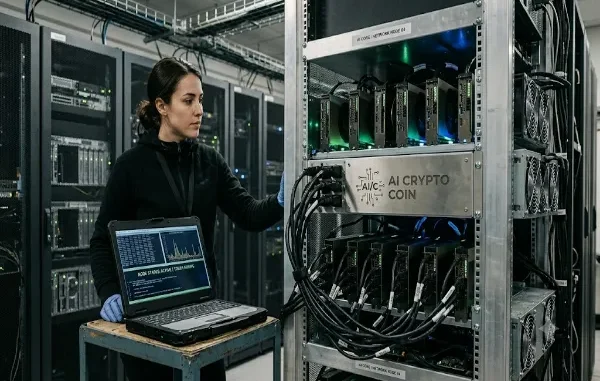
Two of the most transformative technologies of the past decade have collided — and the result is one of the fastest-growing sectors in the entire cryptocurrency market.
AI crypto coins sit at the intersection of artificial intelligence and blockchain technology. They represent a category of digital assets tied to projects that are building, powering, or monetizing AI-related infrastructure, services, or applications on decentralized networks.
If you’ve been paying attention to crypto markets in recent years, you’ve almost certainly come across names like Render, Fetch.ai, The Graph, Bittensor, or Worldcoin. These are all, in different ways, part of the AI crypto ecosystem. But what exactly are these coins? What problem are they solving? And are they a genuine technological development or just the latest narrative being used to sell speculative assets?
This article breaks it all down — plainly, thoroughly, and without the hype.
The Basics: What Is an AI Crypto Coin?
An AI crypto coin is a digital token associated with a blockchain-based project that incorporates, enables, or monetizes artificial intelligence in some form. The token typically serves a functional role within that project’s ecosystem — it might be used to pay for services, reward contributors, govern the protocol, or stake as collateral.
The category is broad by design, because “AI” and “crypto” each cover enormous territory on their own. When you combine them, you get a wide spectrum of projects:
Some are building decentralized computing networks where users can rent out GPU power to train AI models. Others are creating AI agent frameworks that can autonomously execute tasks on the blockchain. Some are building data marketplaces where AI developers can buy and sell training datasets. Others are focused on AI-powered prediction markets, automated trading systems, or decentralized identity verification using biometric AI.
What they share is the ambition to bring AI capabilities into decentralized, permissionless systems — removing the monopoly that a handful of large corporations currently hold over the most powerful AI infrastructure in the world.
Why Do AI and Blockchain Make Sense Together?
To understand why AI crypto coins exist, you need to understand the problem they’re trying to solve.
The AI industry today is dominated by a small number of extremely powerful technology companies. OpenAI, Google DeepMind, Anthropic, Meta AI, and a few others control access to the most capable AI models, the most powerful training infrastructure, and the most valuable datasets. If you want to train a large language model or access frontier AI capabilities, you are, in most cases, dependent on one of these companies or their cloud infrastructure.
This centralization creates several problems:
Access is gatekept. Researchers and developers in countries without strong tech ecosystems often can’t access the same AI tools as their counterparts in Silicon Valley. Prices are set by monopolies. If AWS, Google Cloud, or Microsoft Azure are the only practical options for renting GPU compute at scale, they set the price. Data is controlled by corporations. The training data that powers modern AI models is largely owned and controlled by tech giants, who use it to build competitive moats. There is no transparency. When a centralized AI system makes a decision — about your credit score, your social media feed, or your medical diagnosis — there’s often no way to audit how that decision was made.
Blockchain technology, at its core, is about solving centralization problems. It provides a way to coordinate economic activity and trust between parties without requiring a central authority. When applied to AI, this creates the possibility of:
Open, permissionless access to AI computing power. Transparent, auditable AI systems whose logic is verifiable on a public ledger. Incentive structures that reward individuals for contributing data, compute, or intelligence to a shared AI network. Decentralized ownership of AI infrastructure, where no single company can act as a gatekeeper.
This is the core thesis behind AI crypto coins. Whether the execution lives up to the thesis is a separate question — but the problem being addressed is real and significant.
The Main Categories of AI Crypto Projects
Not all AI crypto coins are doing the same thing. Understanding the different categories helps you evaluate any specific project more clearly.
Decentralized Computing Networks
These projects create marketplaces where individuals and organizations can buy and sell computational resources — primarily GPU power needed to train and run AI models.
The logic is straightforward: there are millions of high-powered GPUs sitting in gaming computers, data centers, and crypto mining rigs around the world that sit idle for large portions of the day. At the same time, AI researchers and startups desperately need GPU compute, and the cost from centralized providers is enormous.
Decentralized computing networks like Render Network and Akash Network allow GPU owners to rent out their idle hardware and earn tokens in return. AI developers can access this compute at lower prices than centralized alternatives. The token powers the marketplace — it’s how payments are made and how contributors are rewarded.
AI Agent Frameworks
This is one of the most exciting and rapidly developing corners of the AI crypto space. AI agents are software programs that can autonomously perceive their environment, make decisions, and take actions to accomplish goals — including actions on the blockchain like executing transactions, managing wallets, or interacting with smart contracts.
Projects in this space are building the infrastructure for AI agents to operate in decentralized environments. Fetch.ai pioneered much of this work, building a network where autonomous agents can negotiate, transact, and collaborate without human intervention. More recently, projects built on frameworks like ElizaOS have enabled a wave of AI agents that operate on social media, in DeFi protocols, and across blockchain networks.
The token in these ecosystems often serves as the medium of exchange between agents, as a staking mechanism to ensure agent behavior, or as a governance token for the protocol itself.
Decentralized AI Model Marketplaces
Training AI models requires not just compute but data and the expertise to build the models in the first place. Decentralized AI marketplaces aim to create open platforms where AI models, datasets, and algorithms can be bought, sold, and accessed without going through a centralized platform.
Ocean Protocol is one of the best-known examples in this category. It allows data providers to publish and monetize datasets while maintaining control over how that data is used, using token-based access mechanisms that enforce usage policies without requiring trust in a central party.
SingularityNET takes a similar approach to AI models themselves, building a decentralized marketplace where AI developers can publish and monetize their algorithms, and where users can access and combine AI services from multiple providers in a single workflow.
AI-Powered Data and Oracle Networks
AI systems need reliable data to function. In blockchain environments, this creates demand for high-quality, verifiable data feeds — known as oracles — that can supply real-world information to smart contracts and AI agents.
Some projects at this intersection are building oracle networks that use AI to validate, curate, and deliver data. Others are building decentralized data labeling systems where humans are incentivized to provide the high-quality labeled training data that supervised AI models depend on.
Bittensor occupies a unique position in this category. It has built a decentralized network of AI models that compete to provide the best responses to queries, with token rewards distributed based on the quality of their outputs as judged by other models on the network. In essence, it creates an economic incentive system for developing better AI — without any central company directing the research.
Decentralized Identity and Verification
One of the most controversial but intellectually interesting corners of the AI crypto space involves using AI to solve the problem of verifying human identity in a world where AI-generated content makes it increasingly difficult to distinguish real people from bots and deepfakes.
Worldcoin — now rebranded as World — represents the most ambitious effort in this direction. It uses a specialized hardware device called the Orb to scan the iris patterns of real humans, creates a privacy-preserving proof of unique human identity, and rewards participants with tokens. The idea is to create a global system for verifying humanness that becomes more valuable as AI makes digital identity harder to trust.
This category raises profound questions about privacy, surveillance, and the ethics of biometric data collection — questions the industry is still working through.
How Do AI Crypto Tokens Actually Work?

The specific mechanics vary by project, but AI crypto tokens generally serve one or more of the following functions:
Payment for services. The token is used to pay for access to computing power, AI models, data, or other services on the network. GPU renters on Render Network, for example, get paid in RENDER tokens. Data buyers on Ocean Protocol pay in OCEAN tokens.
Staking and collateral. Participants who want to provide services on the network often must stake tokens as a form of collateral, ensuring they have economic skin in the game and face a financial penalty if they behave maliciously or provide poor service.
Governance. Token holders can vote on changes to the protocol — adjusting fees, approving upgrades, or allocating treasury funds. This is how decentralized projects make decisions without a CEO or board of directors.
Incentive and reward distribution. In networks where people contribute compute, data, or AI model outputs, tokens are the mechanism for distributing rewards. They function like shares in the network’s output, flowing to those who do useful work.
Speculation and value storage. Like all cryptocurrency tokens, AI crypto coins also trade on open markets and are subject to speculation. Their price is influenced by both the underlying utility of the network and by broader market sentiment.
Notable AI Crypto Coins Worth Knowing About
Without making specific investment recommendations, here are some of the most significant and widely discussed AI crypto projects as of 2025:
Bittensor (TAO) — A decentralized network of AI models where participants earn rewards for providing valuable AI intelligence. One of the most intellectually novel projects in the space and among the largest by market capitalization.
Render Network (RENDER) — A decentralized GPU rendering and computing marketplace connecting artists, developers, and AI researchers with idle GPU capacity around the world.
Fetch.ai (FET) — Now merged into the Artificial Superintelligence Alliance alongside SingularityNET and Ocean Protocol, Fetch.ai builds infrastructure for autonomous AI agents that can transact and collaborate on the blockchain.
The Graph (GRT) — An indexing protocol that organizes blockchain data and makes it queryable, serving as a kind of Google for blockchain data. While not exclusively an AI project, it provides critical data infrastructure that AI applications on blockchain depend on.
Ocean Protocol (OCEAN) — A decentralized data marketplace enabling data monetization and sharing with built-in privacy and access control mechanisms.
SingularityNET (AGIX) — A decentralized marketplace for AI algorithms and models, founded by prominent AI researcher Ben Goertzel, who is one of the most vocal advocates for decentralized AI development.
Worldcoin / World (WLD) — A biometric identity project using iris scanning to create a proof-of-humanity system, backed by Sam Altman of OpenAI.
Akash Network (AKT) — A decentralized cloud computing marketplace offering an open alternative to AWS, Google Cloud, and Azure.
Near Protocol (NEAR) — A Layer 1 blockchain that has made AI integration a central part of its development roadmap, positioning itself as a chain built for the AI era.
The Artificial Superintelligence Alliance: A Significant Development
One of the most notable recent developments in AI crypto has been the merger of Fetch.ai, SingularityNET, and Ocean Protocol into what they call the Artificial Superintelligence Alliance, with a unified token called ASI.
The stated goal of this alliance is to build toward artificial general intelligence — AI that can perform any intellectual task a human can — in a decentralized way, outside the control of large corporations and governments. Whether that goal is achievable is a matter of serious debate. But the merger itself represents a significant consolidation of resources and developer talent in the decentralized AI space, and the combined ecosystem is one of the largest in the AI crypto sector by developer activity and real-world usage.
Real Use Cases vs. Hype: How to Tell the Difference
The AI crypto sector has attracted genuine innovation — but it has also attracted enormous amounts of speculation and outright dishonesty. Plenty of projects have slapped “AI” into their name or whitepaper without building anything of substance.
Here are some questions to ask when evaluating whether an AI crypto project is real:
Does the project have a working product? Many AI crypto projects are still in development, which isn’t automatically disqualifying — but you should be able to find evidence of real technical progress: a mainnet, active users, transaction data, developer commits on GitHub. Whitepapers and roadmaps without demonstrable progress are warning signs.
Is there real demand for what they’re building? The best projects solve problems that people actually have. Decentralized GPU compute is a real need. Open AI data marketplaces address a real problem. If you struggle to articulate who would use this product and why they’d prefer it over existing alternatives, that’s a red flag.
Who is building it? Anonymous teams are common in crypto, but in the AI space specifically, credibility matters. Does the team have verifiable AI research credentials? Have they published academic papers? Do they have a track record in either AI or blockchain? Projects led by people with genuine expertise in both domains are significantly more credible.
Is the AI actually on-chain, or is it just adjacent? Some “AI crypto” projects are really just regular crypto projects with AI-related marketing. The AI might be running entirely off-chain on centralized servers, with the token serving no meaningful function in the AI system at all. Ask specifically how the AI and the blockchain interact — and whether the blockchain interaction is actually necessary.
Does the token have a genuine utility function? If you removed the token from the system entirely, would the system work just as well? If yes, the token is probably unnecessary and exists mainly for fundraising. If the token is genuinely essential to the protocol’s incentive design, that’s a stronger foundation.
Risks Specific to AI Crypto Coins
Beyond the general risks of cryptocurrency investment, AI crypto coins carry some specific risks worth understanding:
Technology complexity creates information asymmetry. Most investors cannot fully evaluate whether an AI crypto project’s technology is sound. This creates opportunities for technically sophisticated teams to mislead less technical investors. It’s why independent research from credible sources matters more in this sector than in most.
Centralized AI may simply outcompete decentralized AI. The honest truth is that centralized AI systems currently produce better results than most decentralized alternatives. The compute available to OpenAI, Google, and Meta is orders of magnitude larger than what decentralized networks can currently aggregate. If that gap doesn’t close, decentralized AI projects may struggle to find real adoption.
Regulatory uncertainty is particularly high. AI regulation and crypto regulation are both rapidly evolving areas of law. Projects at their intersection face potential scrutiny from multiple directions — financial regulators concerned about token securities, data protection regulators concerned about training data practices, and AI safety regulators considering governance of powerful AI systems.
Narrative-driven price cycles. AI crypto coins are particularly susceptible to narrative-driven price spikes disconnected from fundamental progress. When ChatGPT captured public imagination in 2023, AI crypto tokens surged regardless of their individual merits. When hype cycles end, the repricing can be severe.
Centralization risk in “decentralized” AI projects. Many projects that describe themselves as decentralized AI still have significant centralization risks — a small number of validators controlling the network, a foundation controlling the treasury, or core developers who could theoretically make unilateral changes. The degree of actual decentralization varies enormously and should be scrutinized carefully.
The Bigger Picture: Why This Sector Matters Beyond Speculation
Even if you have no interest in investing in AI crypto coins, the questions they raise are important to everyone.
Who should control the most powerful AI systems in history? A handful of American technology companies? Governments? An open, decentralized network owned collectively by its participants? These are not hypothetical questions — they are being answered right now, and the answers will shape how AI affects every aspect of human society.
The decentralized AI movement, whatever its flaws and excesses, is attempting to build an alternative answer. It is arguing that AI infrastructure should be open, accessible, and governed collectively rather than owned and controlled by those who got there first.
That argument deserves to be taken seriously — separate from the question of whether any particular token is a good investment. The projects exploring this space are working on genuinely hard problems. Some will fail. Some will be fraudulent. But some may succeed in ways that meaningfully change the balance of power in the AI industry.
Should You Invest in AI Crypto Coins?
This is the question everyone eventually asks, and it deserves an honest answer.
AI crypto coins have produced extraordinary returns in certain periods — particularly during the broader crypto bull markets of 2020-2021 and again in 2024-2025, when AI narrative momentum combined with rising Bitcoin prices to push the sector to new highs. Some projects in this space have delivered genuine value to genuine users.
They have also produced spectacular losses. Projects with impressive-sounding names and ambitious whitepapers have failed to build anything real, run out of funding, been revealed as fraudulent, or simply failed to find product-market fit.
The right way to approach this sector is with the same rigor you’d apply to any high-risk, early-stage investment. Understand what you’re buying, not just the narrative around it. Evaluate the team, the technology, the tokenomics, and the competitive landscape. Size your position in line with the risk — which is substantial. And never invest capital you cannot afford to lose.
The AI crypto sector is not going away. The problems it’s trying to solve are real and growing more important. But in a space this young and this complex, the difference between the projects that matter and the ones that don’t requires serious analysis to detect.
Final Thoughts
AI crypto coins represent one of the most intellectually interesting and economically significant developments in the blockchain space. They’re attempting to solve one of the defining challenges of our technological moment — who controls AI — using the tools of decentralization.
The sector includes serious, credentialed teams building infrastructure that real users are beginning to rely on. It also includes an enormous amount of noise, speculation, and outright fraud that exploits the combination of two exciting narratives.
Your job as an informed participant in this space is to tell the difference. That means going deeper than headlines, asking hard questions, and being willing to conclude that most projects — however exciting their pitch — don’t meet the bar.
The ones that do meet that bar may be building something that matters not just for crypto portfolios, but for the future of artificial intelligence itself.
Disclaimer: This article is for informational and educational purposes only. Nothing in this article constitutes financial, investment, or legal advice. Cryptocurrency investments carry significant risk of loss, including total loss of capital. Always conduct your own research and consult a qualified financial advisor before making investment decisions.
About the Author:
Ana Milojevic is a crypto writer and the creator of basedmoondog.com. She writes in-depth guides on Web3, DeFi liquidity, and AI trading technologies, including insights on MoonDog AI. When she isn’t breaking down complex crypto mechanics, she is tracking market trends across decentralized ecosystems.
Leave a Reply