Artificial intelligence is transforming nearly every industry, and cryptocurrency trading is no exception. As digital asset markets become larger, faster, and more complex, investors are increasingly turning to AI-powered tools to help analyze market trends, monitor blockchain activity, and identify potential trading opportunities. Among the most exciting innovations are AI trading agents—intelligent software systems designed to process vast amounts of information and assist with decision-making in real time.
Unlike traditional crypto trading bots that simply execute predefined rules, modern AI trading agents can evaluate changing market conditions, interpret sentiment from news and social media, recognize complex patterns, and continuously adapt their analysis. While these systems cannot guarantee profits or accurately predict every market movement, they have the potential to improve research, reduce emotional decision-making, and help traders navigate the highly volatile world of cryptocurrencies more efficiently.
AI Trading Agent at a Glance
An AI trading agent is intelligent software that analyzes cryptocurrency markets using artificial intelligence, machine learning, market data, blockchain activity, and sentiment analysis to help traders identify opportunities and manage risk.
In this guide, we’ll explain what AI trading agents are, how autonomous crypto bots work, how they differ from conventional trading bots, and the key benefits and risks investors should understand. We’ll also explore how AI-powered trading tools are shaping the future of decentralized finance (DeFi) and discuss how projects like MoonDog AI aim to combine artificial intelligence, blockchain technology, and community-driven innovation to make crypto trading more accessible.
What Is an AI Trading Agent?
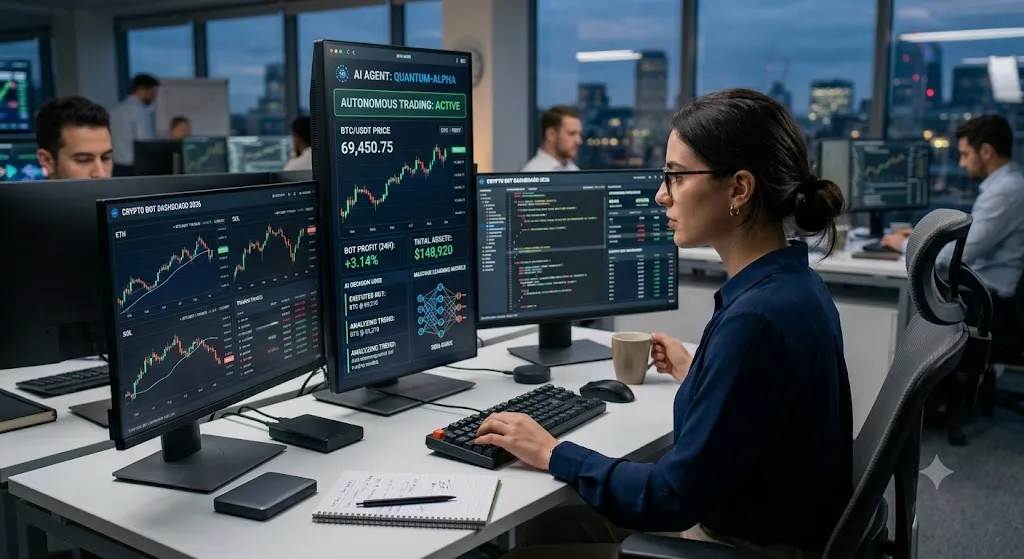
Artificial intelligence is rapidly changing the cryptocurrency industry. While algorithmic trading has existed for years, the newest generation of AI-powered trading agents goes far beyond simple automation. Instead of following a fixed set of instructions, AI trading agents are designed to analyze enormous amounts of market data, recognize patterns, adapt to changing conditions, and help traders make more informed decisions.
As cryptocurrency markets operate 24 hours a day, seven days a week, many investors struggle to monitor prices, news, blockchain activity, and social media around the clock. AI trading agents aim to solve this problem by processing information continuously and providing trading insights much faster than humans can.
In this guide, you’ll learn exactly what AI trading agents are, how autonomous crypto bots work, how they differ from traditional trading bots, their advantages and disadvantages, and why they are becoming one of the fastest-growing sectors of Web3.
Common Misconceptions About AI Trading Agents
- AI cannot predict the future.
- AI is not always fully autonomous.
- AI trading agents still require human oversight.
- More data does not always mean better decisions.
- AI cannot eliminate investment risk.
How Do AI Trading Agents Work?
An AI trading agent is software that uses artificial intelligence to analyze financial markets, identify trading opportunities, and assist with investment decisions.
Unlike traditional software that only follows predefined rules, AI agents attempt to interpret market conditions and improve their performance over time.
Depending on their design, an AI trading agent may analyze:
- Cryptocurrency prices
- Trading volume
- Market volatility
- Technical indicators
- Blockchain transactions
- Wallet activity
- Social media sentiment
- News articles
- Economic events
- Historical trading data
The goal is not to predict the future with certainty but to estimate probabilities and identify situations where market conditions appear favorable.
Some AI trading agents only provide recommendations, while others can automatically execute trades if users authorize them to interact with an exchange or decentralized trading platform.
Modern AI trading agents combine several technologies into a single system.
Data Collection
Everything begins with data.
An AI agent continuously gathers information from multiple sources, including cryptocurrency exchanges, blockchain explorers, decentralized finance protocols, news websites, and social media platforms.
Instead of relying on a single price chart, the agent builds a much broader understanding of market activity.
Market Analysis
After collecting data, artificial intelligence begins searching for meaningful patterns.
The AI may examine:
- Price trends
- Momentum
- Volume changes
- Support and resistance levels
- Liquidity
- Whale transactions
- Token inflows and outflows
- Network activity
Rather than analyzing one indicator alone, AI systems can evaluate hundreds of variables simultaneously.
Sentiment Analysis
One area where AI excels is understanding language.
Large language models and natural language processing systems can analyze thousands of posts from platforms like X, Reddit, Telegram, Discord, and crypto news websites.
The AI looks for changes in investor sentiment, identifying whether communities are becoming increasingly bullish, bearish, or uncertain.
Because meme coins often move based on community excitement rather than fundamentals alone, sentiment analysis has become particularly valuable.
Pattern Recognition
Artificial intelligence is exceptionally good at finding relationships within large datasets.
For example, an AI system may discover that a certain combination of:
- increasing wallet activity,
- growing trading volume,
- positive social sentiment,
- and declining exchange balances
has historically preceded significant price movements.
These relationships would be difficult for most human traders to identify manually.
Decision Support
After completing its analysis, an AI trading agent may:
- suggest a possible trade,
- recommend waiting,
- identify increased market risk,
- generate alerts,
- estimate probabilities,
- summarize current market conditions.
Some systems stop there, leaving the final decision to the investor.
Others are capable of placing trades automatically.
What Is an Autonomous Crypto Bot?
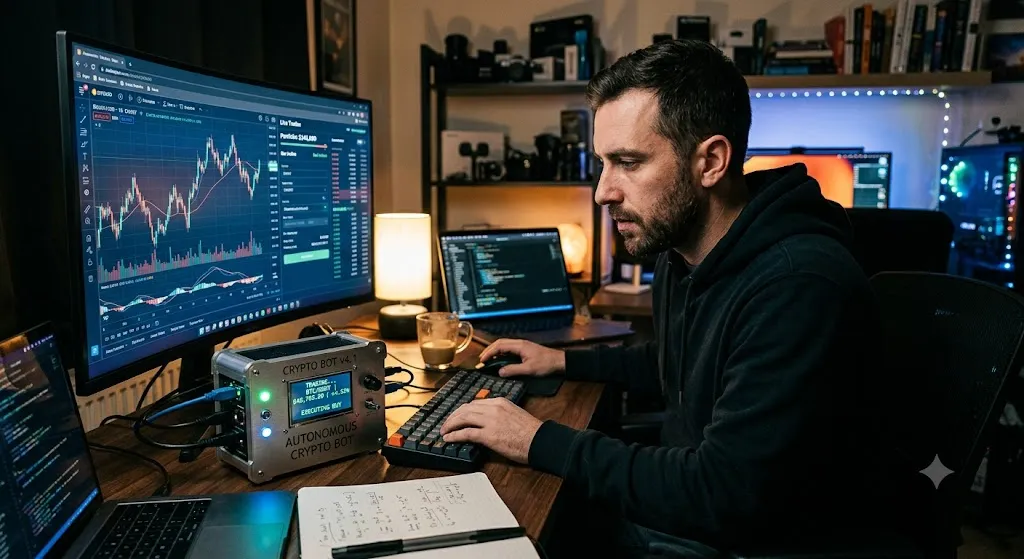
An autonomous crypto bot is software capable of executing cryptocurrency trades with minimal human involvement.
Traditional trading bots simply follow rules.
Autonomous AI agents attempt to evaluate changing market conditions before deciding what action to take.
For example, instead of following:
“If Bitcoin drops 5%, buy.”
An autonomous AI agent might evaluate:
- overall market trend,
- macroeconomic news,
- volatility,
- liquidity,
- whale activity,
- sentiment,
- historical probability,
before deciding whether buying the dip is actually appropriate.
This flexibility makes AI-powered systems significantly more advanced than earlier generations of automated trading software.
AI Trading Agents vs Traditional Trading Bots
Although many people use these terms interchangeably, they are not the same.
Traditional trading bots operate using fixed rules programmed by developers.
For example:
- Buy when RSI drops below 30.
- Sell when RSI exceeds 70.
- Place stop-loss at 5%.
- Never trade during weekends.
The bot never questions these rules.
It simply executes them exactly as programmed.
AI trading agents operate differently.
Instead of rigid instructions, they evaluate changing information before making recommendations.
An AI system may determine that an RSI of 30 means something very different during a strong bull market than during a panic-driven selloff.
Rather than blindly following one indicator, AI attempts to understand context.
This makes AI systems potentially more adaptable but also significantly more complex.
| Feature | Traditional Trading Bot | AI Trading Agent |
|---|---|---|
| Uses fixed rules | ✅ | ❌ |
| Learns from data | ❌ | ✅ |
| Market sentiment analysis | ❌ | ✅ |
| Adapts to market changes | Limited | Yes |
| Human supervision | Recommended | Recommended |
| Machine learning | No | Often |
Benefits of AI Trading Agents
24/7 Market Monitoring
Crypto markets never close.
AI agents continuously analyze prices, blockchain activity, and news while human traders sleep.
Faster Analysis
Artificial intelligence processes information far faster than any individual investor.
Instead of reviewing dozens of charts manually, AI can analyze thousands of data points within seconds.
Emotion-Free Decision Making
Fear and greed often lead to poor investment decisions.
AI systems do not experience emotional reactions.
While they can still make mistakes, they are not influenced by panic or FOMO.
Improved Research
Modern AI agents combine:
- technical analysis,
- on-chain analysis,
- sentiment analysis,
- market news,
- historical data,
into one comprehensive overview.
This saves investors significant research time.
Risk Management
Many AI systems help identify increased market risk before major volatility occurs.
Some monitor:
- wallet concentration,
- liquidity changes,
- exchange inflows,
- unusual transaction activity,
- whale movements,
allowing traders to react more quickly.
Risks of AI Trading Agents
Despite their advantages, AI trading agents are not guaranteed to generate profits.
Investors should understand several important risks.
AI Cannot Predict the Future
Markets remain unpredictable.
Unexpected news, regulations, security breaches, and geopolitical events can rapidly change market direction.
No AI system can forecast every event.
Poor Data Produces Poor Decisions
Artificial intelligence depends entirely on the quality of the information it receives.
Incorrect, outdated, or manipulated data can lead to poor recommendations.
Overfitting
Some AI systems perform exceptionally well during testing but fail in real-world conditions because they learned historical patterns that no longer exist.
Black Box Decisions
Advanced machine learning models sometimes generate recommendations without clearly explaining how they reached those conclusions.
This lack of transparency can make it difficult for users to evaluate risk.
Security Risks
If an AI trading platform connects directly to exchange accounts, users must trust that platform to protect API keys and account permissions.
Using reputable providers and limiting account permissions are important security practices.
AI Trading Agents in Decentralized Finance
AI is becoming increasingly integrated into decentralized finance.
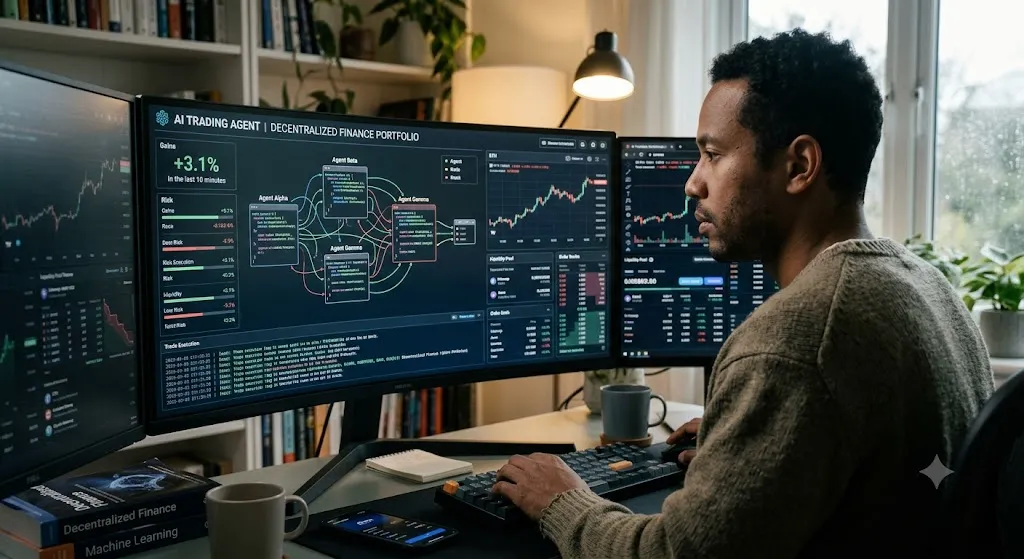
Emerging platforms combine AI with:
- decentralized exchanges
- on-chain analytics
- portfolio management
- risk scoring
- staking optimization
- yield analysis
- wallet monitoring
Instead of replacing investors, these tools aim to help users navigate increasingly complex blockchain ecosystems.
The Future of Autonomous Crypto Trading
Artificial intelligence is expected to become a core component of digital asset investing over the coming years.
Future AI trading agents may include:
- personalized investment assistants,
- voice-controlled portfolio management,
- autonomous DeFi strategies,
- multi-chain portfolio optimization,
- predictive risk monitoring,
- cross-chain arbitrage,
- AI governance participation,
- fully autonomous financial agents.
Rather than replacing human judgment, AI will likely become a sophisticated co-pilot that helps investors make faster, more informed decisions.
As blockchain networks continue to expand, manually monitoring every token, protocol, and market trend becomes increasingly difficult.
AI provides a scalable solution for processing this growing volume of information.
Where MoonDog AI Fits Into This Evolution
One example of this emerging trend is MoonDog AI, an AI-focused cryptocurrency project built on the Base Network.
Rather than positioning itself as a traditional meme coin alone, MoonDog AI aims to combine community-driven engagement with AI-powered trading intelligence. Its broader vision includes using artificial intelligence to simplify crypto market analysis, highlight potential trading setups, and help users interpret complex market data more efficiently.
Projects exploring AI-assisted trading reflect a broader shift within the crypto industry toward tools that enhance decision-making instead of relying solely on speculation. While the capabilities and roadmap of any project should be evaluated carefully, this category illustrates how artificial intelligence is becoming an increasingly important part of decentralized finance.
As with any cryptocurrency investment, prospective users should conduct their own research, review official documentation, understand the project’s risks, and avoid assuming future performance based on AI-related branding alone.
Final Thoughts
AI trading agents represent one of the most exciting developments in cryptocurrency technology. By combining artificial intelligence, machine learning, blockchain analytics, and market data, these systems can help investors monitor markets continuously, recognize patterns, and improve research efficiency.
However, AI should not be viewed as a guaranteed path to profits. Cryptocurrency markets remain highly volatile, and no algorithm can eliminate investment risk. Successful investors continue to rely on sound risk management, diversification, and independent research alongside any AI-powered tools they choose to use.
As AI capabilities continue to evolve, autonomous trading agents are likely to play an increasingly important role in the future of digital asset investing. For traders willing to understand both their strengths and limitations, these intelligent systems may become valuable companions in navigating the fast-moving world of crypto.
AI trading agents represent the next stage in cryptocurrency investing by combining artificial intelligence, blockchain analytics, and automation. While they cannot eliminate risk or guarantee profits, they can help traders process vast amounts of information more efficiently. As AI continues to evolve, these intelligent systems are likely to become an integral part of Web3 and decentralized finance. Investors should view AI as a tool to enhance research and decision-making while continuing to practice sound risk management and independent analysis.
Key Takeaways
- AI trading agents are intelligent software systems that use artificial intelligence to analyze cryptocurrency markets, identify patterns, and assist with trading decisions.
- Unlike traditional crypto trading bots, AI trading agents can evaluate multiple sources of data—including price movements, blockchain activity, technical indicators, market sentiment, and news—to adapt to changing market conditions.
- Autonomous crypto bots may execute trades automatically or provide trading insights, depending on how they are designed and the level of user control.
- AI-powered trading tools can monitor cryptocurrency markets 24/7, helping investors react more quickly to opportunities and changing market trends.
- Potential benefits include faster market analysis, emotion-free decision-making, improved research, and enhanced risk management.
- Despite their capabilities, AI trading agents cannot guarantee profits or accurately predict future price movements, as cryptocurrency markets remain highly volatile and unpredictable.
- Investors should use AI trading tools as decision-support systems rather than replacements for independent research, sound risk management, and personal judgment.
- As artificial intelligence continues to evolve, autonomous trading agents are expected to become an increasingly important part of Web3, decentralized finance (DeFi), and cryptocurrency investing.
- Projects such as MoonDog AI are exploring how AI-powered analytics and blockchain technology can work together to simplify crypto trading and improve access to market intelligence for both beginners and experienced investors.
Frequently Asked Questions (FAQ)
An AI trading agent is software that uses artificial intelligence to analyze cryptocurrency markets, identify patterns, monitor market conditions, and provide trading insights or execute trades automatically. Unlike traditional bots that follow fixed rules, AI trading agents can evaluate multiple sources of information and adapt their analysis as market conditions change.
A traditional crypto trading bot follows predefined rules, such as buying or selling when certain technical indicators reach specific levels. An AI trading agent goes further by analyzing price data, market sentiment, blockchain activity, news, and other variables to make more informed decisions. AI systems are generally more flexible and adaptive than rule-based bots.
No. AI trading agents cannot guarantee profits or accurately predict future market movements. Cryptocurrency markets are highly volatile and influenced by many unpredictable factors, including economic events, regulations, security incidents, and investor sentiment. AI tools should be viewed as decision-support systems rather than profit-generating machines.
AI trading agents can be safe when provided by reputable platforms and used responsibly. However, users should research the provider carefully, secure their exchange accounts with strong authentication, limit API permissions where possible, and never rely entirely on automated systems for investment decisions.
Some AI trading agents only provide market analysis, alerts, and trading suggestions, leaving the final decision to the user. Others can execute trades automatically after receiving permission to connect with a cryptocurrency exchange or decentralized trading platform. The level of automation depends on the specific platform.
AI trading agents may analyze a wide range of information, including cryptocurrency prices, trading volume, technical indicators, blockchain transactions, wallet activity, liquidity, news articles, macroeconomic events, and social media sentiment. Combining multiple data sources allows AI systems to develop a broader understanding of market conditions.
Many AI-powered trading platforms are designed to simplify market analysis for beginners by presenting information in an easy-to-understand format. However, beginners should still learn the fundamentals of cryptocurrency investing, understand the risks involved, and avoid depending entirely on automated tools.
Some of the main risks include inaccurate market predictions, poor-quality data, software bugs, changing market conditions, overreliance on automation, and security concerns when connecting bots to exchange accounts. AI can improve research and efficiency, but it cannot eliminate investment risk.
Artificial intelligence is making cryptocurrency trading more data-driven by helping investors analyze massive amounts of information in real time. AI is increasingly being used for market research, portfolio management, sentiment analysis, risk assessment, fraud detection, and identifying potential trading opportunities across multiple blockchain networks.
MoonDog AI is an AI-focused cryptocurrency project built on the Base Network that combines meme coin culture with AI-powered trading concepts. The project aims to develop an ecosystem where artificial intelligence assists users in analyzing crypto markets, identifying trading opportunities, and simplifying access to blockchain-based financial tools. As with any cryptocurrency project, investors should conduct independent research and understand the risks before participating.
Disclaimer
This article is provided for educational and informational purposes only and should not be considered financial, investment, legal, or tax advice. Cryptocurrency markets are highly volatile, and investing in digital assets involves a significant risk of loss. Past performance is not indicative of future results, and no AI system, trading strategy, or market analysis tool can guarantee profits or accurately predict future market movements.
References to AI trading agents, autonomous crypto bots, MoonDog AI, or any other cryptocurrency projects are intended solely to explain technologies and industry trends. They should not be interpreted as endorsements, recommendations, or solicitations to buy, sell, or hold any digital asset.
Always conduct your own independent research (DYOR), carefully review official project documentation, assess your financial situation and risk tolerance, and consult a qualified financial professional before making any investment decisions. Never invest more than you can afford to lose.
About the Author:
Ana Milojevic is a crypto writer and the creator of basedmoondog.com. She writes in-depth guides on Web3, DeFi liquidity, and AI trading technologies, including insights on MoonDog AI. When she isn’t breaking down complex crypto mechanics, she is tracking market trends across decentralized ecosystems.
Leave a Reply