
Avoid trading a newly launched meme coin when you can’t verify its liquidity, its holder distribution, or the people behind it. One red flag alone isn’t a death sentence. Several at once usually is.
New tokens launch every day on Ethereum, Solana, and Base. A few build real communities. That combination appears repeatedly in failed or manipulated token launches. The problem is timing. A brand-new coin has no track record. No price history. No proof it can survive a wave of selling. That information gap is one reason new meme-coin launches can be especially risky.
Here’s what to check before you trade one.
Quick Answer
Skip the token if you see more than one of these:
- The team can’t be identified
- Liquidity is small, unlocked, or controlled by an unknown wallet
- A few wallets hold most of the supply
- The contract has unusual admin powers
- Trading volume looks bot-driven or coordinated
- The whole pitch is hype, with no real explanation of what it does
None of these alone proves a scam. Stacked together, they’re a pattern.
A Simple Way to Investigate a New Meme Coin
I start with the contract address rather than the price chart. From there, I check liquidity, the largest holders, the deployer wallet and recent transactions. Only after those checks do I look at the chart and social media activity.
Why New Meme Coins Are So Risky
You’re buying blind.
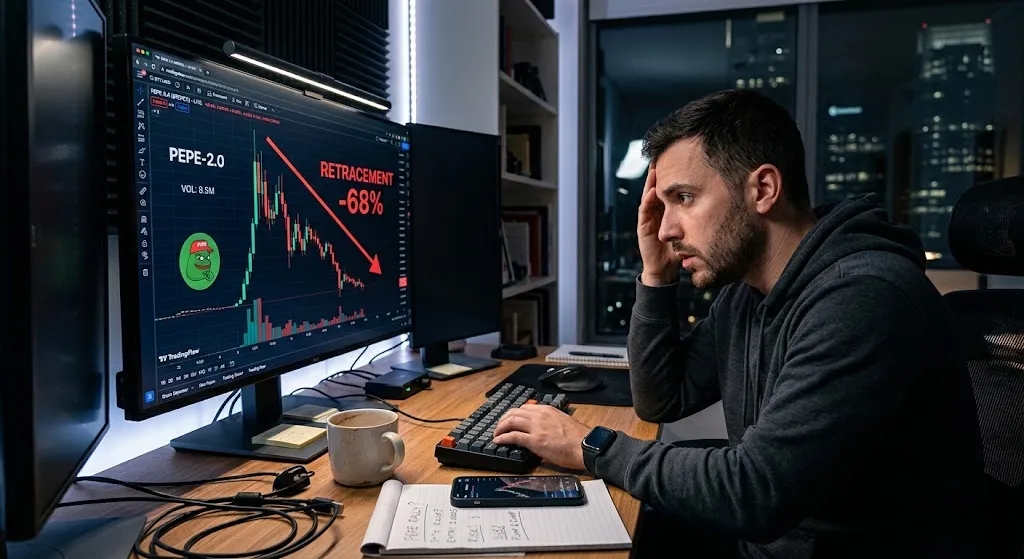
No price history means you don’t know how it behaves under pressure. No holder history means you don’t know who’s really in control. A chart can shoot up in minutes while you still know almost nothing about what you’re holding.
That’s not automatically a scam. It’s just risk you can’t measure yet. Meme coins run almost entirely on attention and speed, which is exactly what makes rushed research so dangerous.
When Should You Avoid a Meme Coin With an Anonymous Team?
Anonymous developers aren’t automatically a red flag. Plenty of legitimate projects started that way.
The problem is when you can’t verify anything at all. No real website. No consistent story. No one you could point to if something went wrong. Just a social media account and a promise of huge returns.
Look for a working website, a roadmap, and some record of the team actually building something. If none of that exists, treat the price action with extra suspicion.
When Is Meme Coin Liquidity Too Risky?
Liquidity is the pool of funds that lets people actually buy and sell the token.
A small pool means a single large sell can crash the price fast. Worse, if the people behind the project control the liquidity and can remove it, they may be able to drain the trading pool and leave holders unable to sell at anything close to the previous price. This is the classic rug pull.
Before trading, check whether liquidity is locked and for how long. Tools like Dexscreener show this in seconds.
One caveat: a locked pool doesn’t make a token safe on its own. It just removes one specific risk. Ownership concentration and contract behavior still matter just as much.
When Is Meme Coin Ownership Too Concentrated?
If a handful of wallets control a large share of the supply, they can have an outsized influence on the price.
Look at the top holders. Look at the deployer wallet. Watch for multiple large wallets that look connected. Crypto whales and connected wallets can have an outsized influence on price, especially when liquidity is thin.
Not every large wallet is an insider — exchanges and liquidity pools hold big balances too. But unexplained concentration is worth digging into before you buy.
Check the Contract
The smart contract decides what a token can actually do.
Some contracts include normal admin functions. Others let the team freeze trading, blacklist wallets, mint unlimited new tokens, or change fees whenever they want. Any of those can trap your money even if the price looks fine on paper.
An audit helps, but it’s not a guarantee — some are rushed or done after launch. No audit doesn’t automatically mean it’s a scam either. Treat it as one data point, not a verdict.
Watch How It Trades
The first few hours after launch tell you a lot.
Watch for a wave of new wallets buying at the exact same time, sharp spikes followed by immediate heavy selling, or repeated trades bouncing between a small set of wallets. That pattern often means bots or insiders are manufacturing demand before cashing out.
Real organic growth is usually messier and slower. Clean, synchronized spikes are the ones to question.
Watch the Hype
Guaranteed returns. Constant “about to explode” posts. Paid influencers pushing hard with zero mention of risk. Pressure to buy right now before it’s “too late.”
That combination appears repeatedly in failed or manipulated token launches. FOMO can become a major part of the marketing strategy. If a project’s entire pitch is the price chart, and nothing about what it does or why it should exist, that’s telling you something.
A Real Example
The $TRUMP token is a clear case study.
Launched on Solana just before Donald Trump’s 2025 inauguration, it spiked past $75 within hours. Early buyers looked like geniuses.
Then it collapsed more than 90% from that peak.
According to reporting on the crash, the drop wasn’t just broader market weakness. It matched a familiar pattern: a small number of wallets holding a large share of supply, a wave of new wallets buying right at launch, and heavy selling into thin liquidity once the hype faded. Retail buyers who came in after the spike were left holding a token worth a fraction of what they paid.
A separate example followed a similar script. In early 2026, a meme coin tied to former NYC mayor Eric Adams surged to a $500 million market cap before liquidity was pulled, triggering an 80% crash. Blockchain analysts flagged the sudden liquidity withdrawal as a rug-pull pattern; Adams and the project team denied wrongdoing.
Neither case needed a complicated scam. Just concentration, hype, and thin liquidity — the same three things this checklist is built to catch.
How to Check a Newly Launched Meme Coin Before Trading
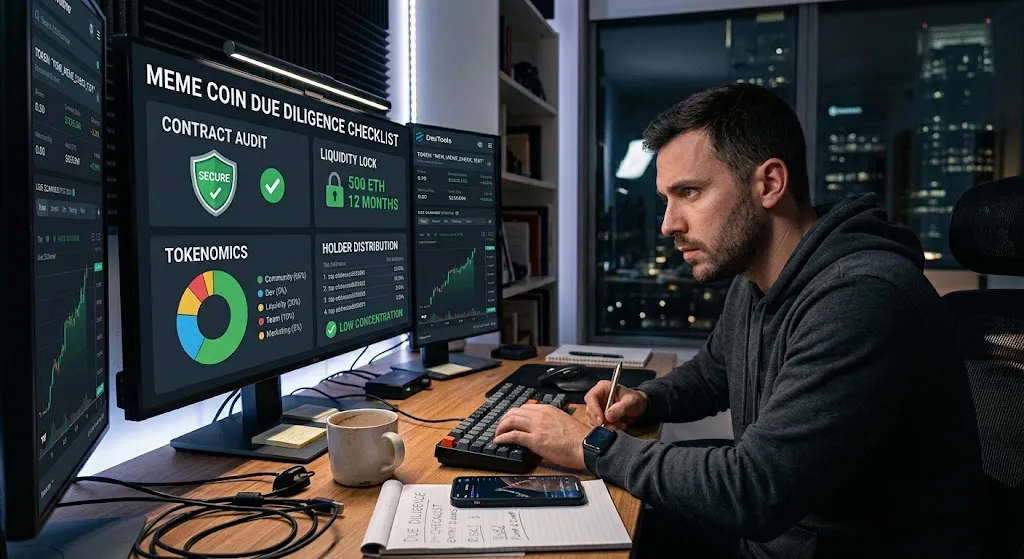
Before buying, verify the token contract, liquidity, top holders, trading activity, and contract permissions. Don’t rely on the project’s website or social media posts alone.
1. Verify the contract address
Make sure you’re looking at the actual token and not a copycat.
2. Check liquidity
Look at the size of the liquidity pool and whether it can be withdrawn.
3. Check top holders
Look for unusual concentration and connected wallets.
4. Check the contract
Look for minting, blacklist, freeze, ownership and fee-changing functions.
5. Check trading activity
Look for unusual buying patterns and wallet coordination.
When to Just Wait
There’s no magic number of hours that makes a new token safe.
Wait if you can’t confirm liquidity is locked. Wait if you can’t tell who’s behind the project. Wait if the only information available is the project’s own marketing. Give it time to prove itself under normal trading conditions instead of buying into the first spike.
A token that rises 500% without you costs you nothing. A token that falls 99% after you buy costs you everything.
Pre-Trade Checklist
Run through this before you commit any money:
- Can I verify the correct contract address?
- Is liquidity locked, and for how long?
- Who holds the largest wallets, and are they connected?
- Does the contract have unusual admin powers?
- Does the trading activity look organic?
- Can I explain what this token actually does in one sentence?
- Am I buying because I did the research, or because I’m afraid of missing out?
If you can’t answer most of these, that’s your answer.
FAQ
When you can’t verify its liquidity, its holder concentration, or the team behind it. Multiple red flags together matter far more than any single one.
Not on its own. It becomes a real concern when paired with unlocked liquidity, concentrated ownership, or unusual trading activity.
No. It removes one specific risk — the team draining the pool — but says nothing about wallet concentration or contract behavior.
Not by itself. Bots and coordinated wallets can inflate volume just as easily as genuine interest can.
There’s no fixed number. Wait until you can actually verify liquidity, ownership, and the team — not just until a clock runs out.
The biggest signs are unlocked liquidity, a handful of wallets holding most of the supply, and an anonymous team with no verifiable information. Unusual trading patterns and hype-heavy marketing with no real explanation of the token’s purpose are also strong red flags. One sign alone isn’t proof of a scam, but several appearing together usually is.
Final Thoughts
Speed is the whole appeal of meme coins. It’s also the trap.
Check liquidity. Check who owns the supply. Check the contract. Watch how it actually trades. Don’t let a rising chart make the decision for you.
You don’t need to catch every pump. You just need to avoid the ones built to take your money.
Disclaimer
This article is for informational purposes only and does not constitute financial advice. Cryptocurrency trading carries significant risk, including total loss of your investment. Always do your own research before making any financial decision.
Sources
- How to Spot a Meme Coin Rug Pull: Five Key Signs — Analytics Insight
- What Is a Rug Pull in Crypto? — CryptoSlate
- Crypto Rug Pulls and Exit Scams: The 5 Red Flags — Blofin Academy
- Trump Meme Coin Rug Pull Explained — Ki Ecke
- Was NYC Token a Rug Pull? Nansen Analysts Identify 4 Red Flags — BeInCrypto
- Identifying Rug Pull Scams: Red Flags to Look Out For — Nominis
- Pump-and-Dump vs Rug Pull — Sumsub
About the Author:
Ana Milojevic is a crypto writer and the creator of basedmoondog.com. She writes in-depth guides on Web3, DeFi liquidity, and AI trading technologies, including insights on MoonDog AI. When she isn’t breaking down complex crypto mechanics, she is tracking market trends across decentralized ecosystems.
Leave a Reply