
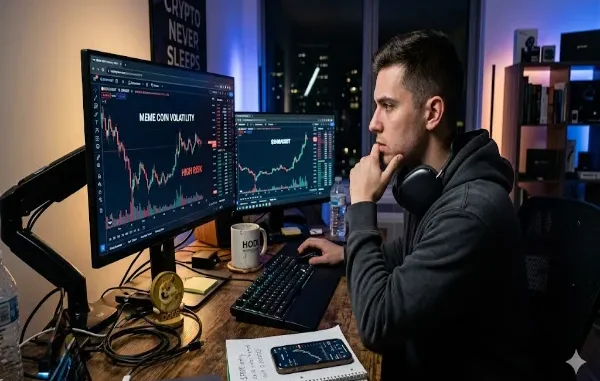
Introduction: The Wild West of Crypto Trading
There is no corner of the financial world quite like meme coin trading. It is loud, fast, unpredictable, and at times completely irrational by conventional standards. Fortunes are built and destroyed in hours. Coins with no technology, no team, and no roadmap outperform established projects with years of development behind them. A single tweet from the right account can send an obscure token up five hundred percent before breakfast.
And yet, despite all of this chaos — or perhaps because of it — meme coin trading has become one of the most active and passionate segments of the entire cryptocurrency market. Millions of traders around the world participate in it every day, ranging from complete beginners making their first crypto purchase to seasoned professionals who have built sophisticated systems for identifying and trading meme coin opportunities.
Meme coin trading is the practice of buying and selling cryptocurrencies inspired by internet memes, viral trends, or online communities with the goal of profiting from price movements. Unlike Bitcoin or Ethereum, meme coin prices are often driven by social sentiment, community activity, and online narratives.
The question is not whether meme coin trading is risky. It obviously is. The question is whether it is possible to approach it intelligently — to understand how these markets work, develop disciplined strategies, manage risk responsibly, and give yourself a genuine edge over the majority of participants who are operating purely on emotion and social media hype.
This guide is the answer to that question. Whether you are completely new to meme coin trading or have some experience and want to sharpen your approach, everything you need to understand this market and operate within it more effectively is covered here.
Meme Coin Trading Definition
Meme coin trading is the buying and selling of cryptocurrencies that derive value primarily from internet culture, community engagement, and social media trends rather than technological fundamentals.
Meme Coin Trading Risks
The main risks of meme coin trading include extreme volatility, rug pulls, low liquidity, pump-and-dump schemes, and emotional decision-making.
Meme Coin Trading at a Glance
If you’re new to meme coin trading, the table below summarizes the key facts, risks, and expectations before you enter the market.
| Feature | Meme Coin Trading |
|---|---|
| Main Goal | Profit from short-term price movements |
| Risk Level | Very High |
| Potential Reward | Very High |
| Typical Holding Period | Minutes to Weeks |
| Key Drivers | Social media, community hype, viral narratives |
| Common Platforms | Jupiter, Raydium, Uniswap |
| Research Tools | Dexscreener, Bubblemaps, Nansen, Solscan |
| Suitable for Beginners? | Yes, but with caution and small position sizes |
| Biggest Risks | Rug pulls, low liquidity, pump-and-dump schemes |
| Most Important Skill | Risk management |
| Capital Required | Can start with $50–$100 |
| Recommended Mindset | Treat it as a high-risk speculative activity |
| Question | Quick Answer |
|---|---|
| What is meme coin trading? | Buying and selling meme-based cryptocurrencies for profit |
| Is it risky? | Yes, extremely risky and highly volatile |
| Can beginners trade meme coins? | Yes, but only with small amounts and proper research |
| What is the best blockchain for meme coins? | Solana currently dominates new meme coin launches |
| What tools are most important? | Dexscreener, Bubblemaps, Solscan, Nansen |
| How much should I start with? | Many traders begin with $50–$100 |
| Biggest mistake? | Buying after a coin has already gone viral |
| Most important skill? | Risk management |
What Makes Meme Coin Trading Different from Other Crypto Trading
Before diving into strategy and execution, it is essential to understand what makes meme coin trading categorically different from trading Bitcoin, Ethereum, or established altcoins. These differences are not superficial — they fundamentally change how you need to think about the market.
The first major difference is the role of narrative and culture. When you trade Bitcoin, price movements are driven by a combination of macroeconomic factors, institutional flows, regulatory news, and long-term adoption metrics. When you trade meme coins, price movements are driven primarily by narrative momentum — the story the community is telling about the coin at any given moment, how widely that story is spreading, and how emotionally engaged the people spreading it are. Understanding narrative is not just helpful in meme coin trading. It is the central skill.
The second difference is the speed at which everything happens. Meme coin trading cycles are dramatically compressed compared to other markets. A meme coin might complete an entire cycle — launch, hype, peak, crash, and death — in two weeks. An established altcoin might take months or years to complete a similar cycle. This speed creates opportunities for rapid gains but also means that the window for making decisions is extremely narrow. Hesitation in meme coin trading has a much higher cost than in slower markets.
The third difference is the information landscape. In traditional finance, price-relevant information tends to flow through established channels: earnings reports, regulatory filings, press releases, analyst reports. In meme coin trading, price-relevant information flows through Twitter, Telegram groups, Discord servers, Reddit threads, and TikTok videos. Knowing where to look, how to filter signal from noise, and how to assess the credibility of information sources is a unique skill set that most people entering meme coin trading have not developed.
The fourth difference is the prevalence of manipulation. Meme coin markets are largely unregulated, thinly traded, and easily influenced by coordinated groups. Pump and dump schemes, coordinated shill campaigns, and influencer-driven price manipulation are common occurrences. Successful meme coin trading requires the ability to identify manipulation attempts and decide whether to avoid them or trade alongside them strategically.
| Factor | Meme Coin Trading | Traditional Crypto Trading |
|---|---|---|
| Volatility | Extremely High | Moderate to High |
| Price Drivers | Community hype and memes | Technology, adoption, fundamentals |
| Trading Speed | Very Fast | Moderate |
| Risk Level | Extremely High | High |
| Market Manipulation | Common | Less Common |
| Liquidity | Often Limited | Usually Strong |
| Research Focus | Narrative and social sentiment | Fundamentals and market analysis |
| Potential Returns | Very High | Moderate to High |
| Failure Rate | Very High | Lower |
| Best For | Speculative traders | Long-term investors and traders |
The Lifecycle of a Meme Coin: Understanding the Pattern
One of the most useful frameworks for meme coin trading is understanding the typical lifecycle that most meme coins follow. Not every coin follows this pattern exactly, and the timing can vary wildly, but recognizing where a coin sits in its lifecycle is one of the most important inputs into any trading decision.
Stage One: Launch and Early Discovery
Every meme coin begins with a launch. In the current environment, this often happens on a token launch platform — Pump.fun on Solana being among the most prominent examples — where a new token can be created and made available for trading within minutes. At this stage, the coin has almost no community, no social media presence, and no narrative beyond whatever description the creator attached to it.
Early discovery is the phase where the first buyers appear — usually people actively scanning new launches looking for the next big thing. These early buyers take the highest risk but also have access to the lowest prices. The vast majority of coins that launch never progress beyond this stage, dying quietly with minimal trading volume.
Stage Two: Narrative Formation
If a coin attracts enough early interest, a narrative begins to form around it. This might be because the coin’s name or mascot connects to a trending meme, because a notable wallet or influencer buys in, because the coin has an unusually compelling backstory, or simply because a small group of early buyers begins actively promoting it across social platforms.
This is one of the most critical stages to understand as a trader. Coins that develop strong, emotionally resonant narratives at this stage have a much higher probability of reaching significant price levels than coins where the narrative is weak or confusing. The question to ask at this stage is: can I explain why someone who has never heard of this coin before would get excited about it?
Stage Three: Viral Spread and Price Discovery
When a narrative catches fire — when it crosses from a small early community into broader crypto Twitter, major Telegram groups, and eventually mainstream crypto media — the coin enters its viral phase. This is the phase of explosive price appreciation, enormous trading volume, and intense FOMO from the broader market.
This is also the most dangerous phase for new entrants. The people buying at the peak of viral spread are typically buying from the people who bought in stages one and two. The early buyers who took the risk when the coin was unknown are now the sellers distributing their holdings to the crowd of FOMO buyers who are seeing the coin for the first time on a price chart that looks almost vertical.
Stage Four: Distribution and Decline
As early buyers take profits and the pace of new buyer inflow slows, the coin enters a distribution phase. Price begins to fall, often sharply. Traders who bought during the viral phase start to panic and sell, accelerating the decline. Communities begin to fracture as financial losses mount. Social media promotion decreases as the promotional incentive (holding bags that are rising in value) disappears.
Stage Five: Death or Revival
Most meme coins die at this point, slowly fading to negligible trading volume and price. A small minority experience a revival — sometimes due to a new catalyst like an exchange listing, a celebrity mention, or an organized community buyback campaign. These revival moments can create secondary trading opportunities, though they are typically smaller in scale than the original move.
Understanding this lifecycle does not mean you can always tell exactly where a coin is in the cycle. But it gives you a mental model for asking the right questions when evaluating any meme coin trading opportunity.
How to Find Meme Coin Opportunities Before the Crowd
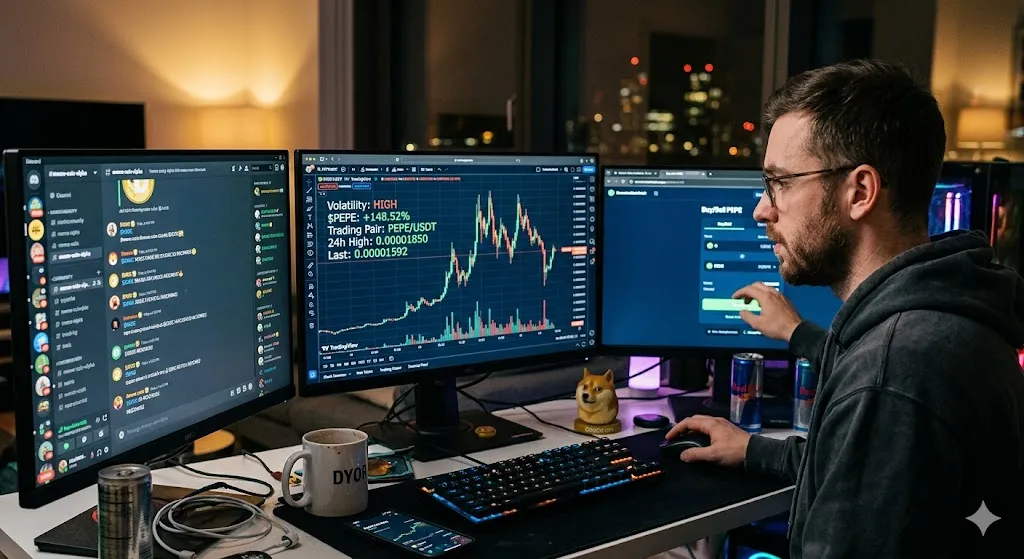
The most consistent meme coin traders are not the ones who react to opportunities after they have already gone viral. They are the ones who find opportunities early, when prices are low and risk-reward ratios are most favorable. Here is how experienced traders approach early opportunity discovery.
Monitor New Token Launches Actively
Platforms like Pump.fun on Solana and comparable launchpads on other chains create dozens or hundreds of new tokens every day. Most are worthless. But among them, on any given day, are one or two coins that have the potential to break out. Active monitoring of new launches — looking for coins with unusual early trading volume, interesting names or concepts, or unusual wallet activity — is one of the primary ways experienced meme coin traders find early opportunities.
This requires developing a feel for what early traction looks like. A coin that attracts a hundred unique buyers in its first hour is behaving differently from one that attracts ten. A coin where the top holders are distributed across many wallets rather than concentrated in one or two is a healthier early distribution profile. These details matter.
Track Whale and Smart Money Wallets
Blockchain technology makes all transactions publicly visible, which means you can see exactly what sophisticated and well-capitalized traders are buying. Tools like Bubblemaps, Nansen, and various Solana-specific analytics platforms allow traders to identify wallets with track records of buying meme coins early and profitably — and to set up alerts when those wallets make new purchases.
Following smart money is not foolproof. Even the best meme coin traders lose on the majority of their bets, compensating with large gains on their winners. But watching what wallets with strong track records are buying provides a meaningful signal about where early momentum might be building.
Scan Social Platforms for Emerging Narratives
Before a meme coin’s price explodes, its narrative almost always starts building on social platforms. Twitter, Telegram, and TikTok are where meme coin narratives form. Learning to monitor these platforms for emerging discussions about new coins — while filtering out the constant promotional noise from paid shillers — is a skill that takes time to develop but pays significant dividends.
Specific things to look for include organic discussions about a coin from accounts that do not appear to be paid promoters, unusual levels of community activity around a new project, and coins whose themes connect to broader cultural moments or trending memes in the general internet space.
Use On-Chain Data to Validate Interest
Before committing capital to any meme coin opportunity, checking the on-chain data is essential. Key metrics include trading volume over the past twenty-four hours and how it is trending, the number of unique wallet addresses holding the token and whether that number is growing, the distribution of holdings across wallets (high concentration in a few wallets is a red flag), and liquidity depth (thin liquidity means large slippage and easier price manipulation).
Risk Management in Meme Coin Trading: The Rules That Keep You in the Game
Meme coin trading without disciplined risk management is not trading — it is gambling. The traders who survive and thrive long-term in this space are not necessarily the ones with the best entry picks. They are the ones who manage their risk so carefully that their wins significantly outpace their losses even when the majority of individual trades do not pan out.
Position Sizing: Never Risk More Than You Can Lose Entirely
The foundational rule of meme coin risk management is simple: never allocate money to any single meme coin position that you are not prepared to lose one hundred percent of. This is not pessimism. It is an accurate assessment of the probability distribution of outcomes in meme coin trading.
For most traders, this means keeping individual meme coin positions small relative to total portfolio size. A common approach among experienced meme coin traders is to allocate no more than one to five percent of their total trading capital to any single meme coin position. This allows them to participate in a wide range of opportunities, survive the inevitable losers, and still benefit meaningfully when a position generates a large multiple return.
Setting Take-Profit Levels Before Entering
One of the most common mistakes in meme coin trading is having no exit plan when entering a position. Traders buy in, watch the price rise, and then freeze — unable to sell because they think the price might go higher, until the price reverses and wipes out their gains. This pattern is almost universal among new meme coin traders and is responsible for an enormous amount of avoidable loss.
Experienced traders set take-profit levels before they enter a position. They decide in advance that they will sell a portion of their holdings at two times their entry, another portion at five times, and hold a small remainder in case the coin continues much higher. This tiered approach locks in profits at multiple levels while maintaining exposure to additional upside.
Setting Stop-Loss Levels and Honoring Them
A stop-loss is a predetermined price level at which you will exit a position regardless of your emotional state. In meme coin trading, stop-losses are essential because price reversals can be sudden and severe. A coin that is up eighty percent can give back all of those gains in thirty minutes.
The discipline required to honor stop-losses is largely psychological. When a position is falling and your stop-loss level is reached, every emotional impulse says to hold on and hope for a recovery. Experienced traders have learned, often through painful experience, that honoring stop-losses is almost always the correct decision. The coins that recover meaningfully after significant drops are the exception, not the rule.
Diversification Across Multiple Positions
Because the outcome of any individual meme coin trade is genuinely unpredictable, spreading capital across multiple positions is a core risk management strategy. If you allocate capital to ten different meme coins, you might lose entirely on six of them, break even on two, and make ten times your money on the remaining two. The overall result can still be significantly profitable even with a majority loss rate, as long as position sizing is consistent and winners are allowed to run.
Reading the Charts: Technical Analysis in Meme Coin Trading
Technical analysis — the practice of using price charts and trading volume data to identify patterns and predict future price movements — is a useful tool in meme coin trading, though it works differently than in more established markets.
Volume Is Your Most Important Indicator
In meme coin trading, trading volume is the single most important technical indicator. Rising volume accompanying rising prices confirms genuine buying interest. Rising prices on declining volume suggests the move may be losing momentum and is more susceptible to reversal. Sudden spikes in volume without corresponding price movement can indicate large-scale distribution — sophisticated traders selling their holdings into market demand.
Before entering any meme coin position based on chart analysis, always check whether the volume pattern supports the price narrative. Price movements without volume are far less reliable than price movements accompanied by strong, consistent volume.
Support and Resistance Levels
Even in the chaotic world of meme coin trading, price charts tend to respect certain levels. Support levels are price points where buying interest has historically been strong enough to prevent further decline. Resistance levels are price points where selling pressure has historically been strong enough to prevent further advance.
Identifying these levels on a meme coin chart — typically by looking at previous highs and lows where price spent significant time or experienced notable reversals — gives traders useful reference points for entry and exit decisions. Buying near established support levels offers better risk-reward ratios than buying when price is far above any support.
The Importance of Timeframe
Meme coin traders need to be careful about which timeframe they are analyzing. A coin can look extremely bullish on a five-minute chart while the one-hour chart tells a very different story. Developing the habit of checking multiple timeframes before making trading decisions — understanding both the short-term and medium-term technical picture — reduces the risk of being fooled by noise in shorter timeframes.
The Psychology of Meme Coin Trading: Managing Your Own Mind
Technical skills and research capabilities matter enormously in meme coin trading. But for most traders, the biggest obstacle is not a lack of knowledge. It is their own psychology.
Fear of Missing Out and How to Handle It
FOMO — the fear of missing out — is the most powerful negative force in meme coin trading. When you see a coin going up five hundred percent and your friends are posting profit screenshots online, the pressure to buy immediately regardless of price or risk is intense. FOMO-driven entries are one of the primary drivers of retail trader losses in this market, because FOMO typically hits hardest near price peaks when risk is highest.
The antidote to FOMO is having a clear process. If you have a defined set of criteria that a meme coin must meet before you allocate capital to it — minimum volume, wallet distribution, narrative quality, technical setup — then you can ask yourself whether a coin meets your criteria rather than simply reacting to its price chart. Opportunities that do not meet your criteria get passed on, no matter how exciting they look.
The Sunk Cost Trap
Another common psychological trap in meme coin trading is holding losing positions far longer than rational analysis would justify, simply because of the psychological pain of realizing a loss. This is the sunk cost fallacy applied to trading: the money already lost influences decisions about future action, even though it should not.
When a meme coin position is not working out and your stop-loss has been triggered, the right move is almost always to exit and redeploy capital into better opportunities. The money you have already lost is gone regardless of whether you hold or sell. The only question is what you do with your remaining capital.
Staying Grounded After Both Wins and Losses
Meme coin trading produces extreme emotional swings. Big wins create overconfidence. Big losses create despair and the temptation to make reckless trades to recover losses quickly. Both states are dangerous and lead to poor decision-making.
Experienced meme coin traders develop the habit of treating each trade independently. A big win does not mean the next trade will also win. A big loss does not mean the strategy is broken. Maintaining emotional equilibrium — celebrating wins appropriately without getting overconfident, processing losses without falling into despair — is one of the hardest and most important skills in this game.
Common Meme Coin Trading Mistakes and How to Avoid Them
Learning from mistakes is essential in any trading discipline. In meme coin trading, certain mistakes are so common and so costly that they deserve specific attention.
Buying After a Large Price Increase
The single most common mistake new meme coin traders make is buying a coin after it has already gone up significantly. The logic feels sound — the coin is clearly going up, so buying makes sense. But in most cases, a large initial price increase represents the distribution phase of early buyers, not the beginning of a sustained move. Buying after a coin is already up three hundred or four hundred percent from its launch price means buying into selling pressure from people who entered at much lower prices.
Ignoring Liquidity
Liquidity refers to how much money can flow in and out of a meme coin position without significantly impacting the price. Low liquidity meme coins — those with small liquidity pools on decentralized exchanges — are dangerous for a specific reason: they are easy to get into and very difficult to get out of without experiencing massive price impact.
A coin might show a very attractive price on screen, but if the liquidity pool supporting that price is tiny, attempting to sell any meaningful amount will crash the price significantly before your sell order is fully executed. Always check liquidity before entering a meme coin position, and be very cautious about any coin where the liquidity seems thin relative to the market cap.
Trusting Anonymous Influencers Promoting Coins
The meme coin space is full of anonymous influencers on Twitter and Telegram who promote coins with apparent enthusiasm. Many of these promotions are paid arrangements where the influencer holds a large position, promotes the coin to their audience, and sells into the buying pressure their promotion generates. This is a direct transfer of wealth from their audience to themselves.
Treating any influencer promotion with heavy skepticism — and independently researching any coin that an influencer is pushing hard — is essential. The question to always ask is: what does this person’s position look like? If they hold a large bag of the coin they are promoting, their incentives are not aligned with yours.
Going All-In on a Single Position
Concentrating your entire meme coin trading capital into a single position might feel exciting when the trade is going well, but it is a path to ruin over any extended period. No matter how confident you are about a specific meme coin opportunity, the inherent unpredictability of these markets means that even the highest-conviction trades fail regularly. Diversification is not just a nice-to-have in meme coin trading. It is survival infrastructure.
Tools Every Meme Coin Trader Should Know
The right tools can make a significant difference in meme coin trading effectiveness. Here is a breakdown of the categories of tools that serious meme coin traders use.

Blockchain Explorers and On-Chain Analytics
Solscan and Solana Explorer for Solana-based meme coins, Etherscan for Ethereum-based tokens, and Basescan for Base network tokens are the foundational tools for reading on-chain data. These platforms let you see transaction history, wallet holdings, token distribution, and liquidity pool details — all information that is essential for evaluating a meme coin before trading it.
For more advanced on-chain analysis, platforms like Bubblemaps visualize the connections between wallets holding a token, making it easy to identify clusters of related wallets that might indicate insider holdings or coordinated manipulation. Nansen provides wallet profiling and smart money tracking capabilities that help identify whether notable or historically successful wallets are involved in a project.
DEX Aggregators and Trading Platforms
Most meme coin trading happens on decentralized exchanges rather than centralized platforms. Jupiter on Solana, Uniswap on Ethereum, and comparable platforms on other chains are where meme coin trades are executed. DEX aggregators find the best prices across multiple liquidity sources automatically, which matters in meme coin markets where price differences between venues can be significant.
Social Monitoring Tools
Keeping track of what is being discussed across crypto Twitter, Telegram, and Reddit simultaneously is challenging without tools designed for it. Social monitoring platforms that aggregate meme coin discussions from multiple sources into a single dashboard can provide significant efficiency advantages in spotting emerging narratives early.
Portfolio Tracking
Because meme coin traders often hold positions in many different tokens simultaneously, portfolio tracking tools that aggregate holdings across multiple wallets and chains into a single view are essential for maintaining a clear picture of overall exposure and performance.
Meme Coin Investing vs. Trading: Understanding the Difference
Many people use the terms trading and meme coin investing interchangeably, but they describe two very different approaches to the market. Trading is short-term — buying and selling based on price momentum, often within hours or days. Investing is longer-term — buying into a project you believe has the community strength, branding, and staying power to grow significantly over weeks or months.
Meme coin investing requires a different mindset than short-term trading. Instead of chasing rapid price movements, investors look for projects with large and genuinely passionate communities, active development even if minimal, strong cultural staying power, and growing social media presence. Dogecoin and Shiba Inu are the clearest examples of meme coins that rewarded long-term investors who believed in the community before the broader market did.
The risk profile is also different. Short-term traders can cut losses quickly when a trade is not working. Long-term meme coin investors need to be prepared to hold through significant drawdowns — sometimes ninety percent or more — without panicking. That requires a level of conviction that only comes from doing genuine research into a project’s community and cultural resonance before committing capital.
How to Trade Meme Coins: A Practical Starting Point
Understanding how to trade meme coins begins with getting the mechanics right before worrying about strategy. The process starts with setting up a self-custody crypto wallet — Phantom for Solana, MetaMask for Ethereum and Base — and funding it by transferring crypto from a centralized exchange. From there, connecting your wallet to a decentralized exchange like Jupiter or Uniswap is what gives you access to the full meme coin market.
Once the infrastructure is in place, the trading process itself involves finding a token you want to buy, checking its contract address on a tool like Dexscreener to verify it is the legitimate version and not an impersonator, reviewing the liquidity and holder distribution, and then executing the swap through your DEX of choice. Setting slippage tolerance — the maximum price difference you will accept between the quoted price and the executed price — is an important step that new traders often overlook, particularly on volatile tokens where prices can move significantly in the seconds between submitting and confirming a transaction.
Exiting a position is just as important as entering one. Knowing in advance at what price levels you will take profit and at what level you will cut your losses removes the emotional decision-making that causes most traders to hold too long in both directions. The mechanics of meme coin trading are learnable within a few days. The discipline to execute those mechanics correctly under pressure is what separates traders who grow their accounts from those who blow them up.
Meme Coin Strategies That Experienced Traders Actually Use
There is no single correct approach to meme coin trading, but there are several distinct meme coin strategies that experienced traders have developed and refined over multiple market cycles. Understanding these strategies gives you a vocabulary for thinking about your own approach and choosing which fits your personality and risk tolerance.
The early launch sniper strategy involves monitoring new token launches constantly — particularly on platforms like Pump.fun — and buying into coins within the first few minutes of launch when prices are at their lowest and potential multiples are at their highest. This strategy carries extreme risk because the vast majority of new launches fail completely. It compensates with the occasional trade that returns ten, fifty, or one hundred times the initial investment. Traders who use this strategy typically make many small bets rather than large concentrated positions.
The narrative momentum strategy involves waiting for a coin to develop a clear, compelling narrative and show early signs of social media traction before buying in. This approach sacrifices the very lowest entry prices in exchange for higher confidence that the coin has genuine community interest behind it. It requires skill in reading social momentum and moving quickly once a signal appears.
The established meme coin rotation strategy focuses on larger, more established meme coins — the ones with real communities, exchange listings, and track records — and trades them based on broader market cycles. When overall crypto market sentiment is bullish, established meme coins tend to outperform. When sentiment turns bearish, rotating out into stablecoins protects capital. This is a lower-risk, lower-reward approach compared to hunting new launches but suits traders who prefer more predictability.
Applying Broader Crypto Trading Strategies to the Meme Coin Market
Many of the crypto trading strategies that work across the broader digital asset market apply to meme coins as well, though they need to be adapted for the higher volatility and faster cycles that meme coins operate on.
Dollar cost averaging — buying a fixed dollar amount of an asset at regular intervals regardless of price — is one of the most reliable crypto trading strategies for reducing the impact of volatility on entry prices. In the meme coin context, this works best for established projects rather than new launches, allowing a trader to build a position gradually rather than committing all capital at once and being fully exposed to an immediate price reversal.
Trend following is another broadly applicable strategy that translates well to meme coins. The core idea is simple: assets that are trending upward with strong volume tend to continue trending upward for longer than most traders expect, and assets in downtrends tend to continue falling. Buying meme coins that are in confirmed uptrends with rising volume — rather than trying to catch falling knives or pick bottoms — is a principle that experienced traders apply consistently across all market conditions.
Momentum trading, which involves buying assets that have shown strong recent performance and selling those that have underperformed, is particularly well-suited to the meme coin market where narrative momentum is the primary price driver. When a meme coin’s momentum is clearly accelerating — growing social media mentions, rising trading volume, new wallet addresses entering — that momentum tends to self-reinforce until a reversal catalyst appears.
Reading the Meme Coin Market: What to Watch Every Day
The meme coin market has its own rhythm and its own set of signals that experienced traders learn to read over time. Developing the habit of monitoring these signals daily gives you a significant advantage over traders who only check in when something is already going viral.
Overall crypto market sentiment sets the backdrop for everything in the meme coin space. When Bitcoin is rising strongly and the broader market is in risk-on mode, capital flows into increasingly speculative assets — and meme coins are the most speculative asset class in crypto. When Bitcoin is declining or consolidating, meme coin markets tend to go quiet or suffer heavy losses. Starting each trading day by assessing where Bitcoin and the broader market sit is essential context for any meme coin decision.
Total meme coin market capitalization, which is tracked by data platforms like CoinGecko and CoinMarketCap, gives a useful macro picture of whether the meme coin sector as a whole is growing or contracting. Rising total meme coin market cap in an environment of rising Bitcoin usually signals a favorable environment for new meme coin trades. Falling meme coin market cap is a warning to reduce exposure.
Social volume — the total amount of discussion happening around meme coins across Twitter, Telegram, and Reddit — is another leading indicator worth monitoring. Spikes in social volume often precede significant price movements, particularly when the volume surge is organic rather than driven by paid promotion campaigns.
Meme Coin Analysis: How to Research a Token Before You Buy
Serious meme coin traders do not buy based on hype alone. They have a consistent meme coin analysis process they apply to every potential trade before committing capital. This process does not need to be complicated, but it does need to be consistent.
The first step is verifying the token’s contract address. Copy the official contract address from the project’s verified social media accounts and check it against what is listed on the exchange. Fake tokens impersonating legitimate projects are extremely common, and buying the wrong contract address means buying a worthless impersonator rather than the genuine coin.
The second step is checking the token’s liquidity pool size and whether the liquidity is locked. A liquidity pool under fifty thousand dollars makes a token extremely difficult to exit without heavy price impact. Unlocked liquidity means the developer can remove it at any time, instantly collapsing the price — a classic rug pull mechanism.
The third step is analyzing the holder distribution using tools like Bubblemaps or the token explorer on Solscan or Etherscan. If a small number of wallets hold a disproportionate share of the total supply — particularly if those wallets appear connected to each other — the risk of a coordinated dump is high. Healthy token distribution shows supply spread across many independent wallets with no single entity holding enough to move the market unilaterally.
The fourth step is evaluating the community quality. Visit the project’s Telegram group or Discord server. Is the conversation organic and engaged, or does it consist almost entirely of price talk and promotional content? Genuine communities discuss the project’s concept, share content, and engage with each other beyond just tracking the price chart. Paid promotional communities show a very different pattern that experienced traders learn to recognize quickly.
Crypto Risk Management: The Skill That Keeps You in the Game
Of all the skills a meme coin trader needs to develop, crypto risk management is the one that matters most over any extended time horizon. Technical analysis, narrative reading, and on-chain research help you find better opportunities. Risk management determines whether you are still in the game long enough to benefit from those opportunities.
The core principle of crypto risk management in meme coin trading is straightforward: never let a single losing trade do catastrophic damage to your overall account. This is achieved primarily through position sizing — keeping each individual trade small enough that even a total loss does not significantly impair your ability to continue trading. Most experienced meme coin traders risk between one and five percent of their total trading capital on any single position.
Stop-losses are the second pillar of effective risk management. Deciding in advance the maximum loss you will accept on a trade — and then actually closing the position when that level is reached — prevents the small losses that are an inevitable part of trading from becoming large losses that take months to recover from. The discipline to close a losing position when your stop is hit, even when every emotion is screaming at you to hold and hope for a recovery, is one of the hardest things to learn in trading and one of the most valuable.
Taking profits systematically is the third pillar that many traders neglect. It is not enough to enter trades well and manage losses — you also need a defined process for locking in gains before the market takes them back. Selling a portion of a winning position at two times your entry, another portion at five times, and holding a small remainder for potential further upside is a simple tiered approach that ensures you capture real profit rather than watching paper gains evaporate in a sudden reversal. Crypto risk management is ultimately about staying in the game long enough for your edge to express itself over many trades. One bad trade should never define your results. Consistent, disciplined risk control across hundreds of trades is what separates the traders who last from the ones who burn out.
Tax Considerations in Meme Coin Trading
Many people trading meme coins do not think about taxes until they are forced to, and by then the situation can be quite complicated. In most jurisdictions, every meme coin trade — including token-to-token swaps on decentralized exchanges — is a taxable event that must be reported.
Given the volume of trades that active meme coin traders can generate — potentially hundreds or thousands of individual transactions — maintaining accurate records from the start is far more efficient than trying to reconstruct trading history later. Crypto tax software platforms can connect to your wallets and automatically categorize transactions, calculating gain and loss figures that can be used for tax reporting.
Working with a tax professional who has specific cryptocurrency experience is advisable for active meme coin traders, particularly those generating significant profits. Tax laws around crypto vary by jurisdiction and change frequently, and the specifics of how different types of meme coin activities — trading, staking, airdrops, yield farming — are treated can differ significantly.
| Factor | Meme Coins | Bitcoin |
|---|---|---|
| Volatility | Very High | Moderate |
| Community Influence | Very High | Moderate |
| Technical Fundamentals | Often Limited | Strong |
| Risk Level | Extremely High | High |
| Potential Returns | Very High | Moderate |
Meme Coin Trading Checklist
✓ Research the token
✓ Check liquidity
✓ Review holder distribution
✓ Monitor social sentiment
✓ Set stop-loss levels
✓ Define profit targets
✓ Never risk more than you can afford to lose
Building a Sustainable Approach to Meme Coin Trading
The traders who last in the meme coin space and build real, sustainable profitability over time share certain characteristics that are worth articulating clearly.
They treat it as a skill, not a lottery. Sustainable meme coin traders invest time in genuinely learning the market — understanding tokenomics, developing research processes, building knowledge of on-chain data interpretation, and studying the psychology of crypto communities. They do not approach each trade as a coin flip.
They protect their capital above all else. Every decision is filtered through the lens of capital preservation first and profit second. Losing less when trades do not work out is ultimately more important than making more when they do.
They stay emotionally detached from individual outcomes. A single trade — whether it wins or loses dramatically — does not define the strategy. The strategy is the sum of many trades executed with consistent discipline over time.
They keep learning and adapting. The meme coin market evolves constantly. The strategies that worked in 2021 are different from the strategies that work today, and the strategies that work today will be different from those that work next year. Successful meme coin traders stay curious and continuously refine their approach.
They know when to step back. Not every market environment is equally favorable for meme coin trading. During extended bear markets or periods of very low community engagement, the best trade is sometimes no trade. Experienced traders recognize these environments and reduce activity accordingly rather than forcing trades that the market conditions do not support.
Famous Meme Coin Success Stories: Lessons from the Biggest Winners
Dogecoin: The Original Meme Coin
Dogecoin remains the most famous meme coin in cryptocurrency history. Created in 2013 as a joke inspired by the popular Shiba Inu “Doge” meme, it was never intended to become a serious financial asset. However, its friendly community, viral internet appeal, and widespread social media attention helped transform it into a multi-billion-dollar cryptocurrency. Dogecoin demonstrated that community strength and cultural relevance can sometimes outweigh traditional fundamentals, making it one of the most important case studies in meme coin trading.
Shiba Inu: Building an Ecosystem Around a Meme
Shiba Inu launched in 2020 and was initially viewed as another Dogecoin copycat. However, the project quickly evolved beyond its meme origins by introducing additional ecosystem features such as decentralized finance tools, token burns, and community-driven initiatives. During the 2021 bull market, Shiba Inu delivered extraordinary returns for early investors and became one of the largest cryptocurrencies by market capitalization. Its success showed that strong branding combined with an active community can help a meme coin achieve long-term relevance.
PEPE: The Power of Internet Culture
PEPE became one of the most successful meme coin launches of the modern crypto era. Inspired by the famous Pepe the Frog internet meme, the token rapidly gained traction across social media platforms and crypto communities. Within a relatively short period, PEPE grew from a small-cap token into a project worth billions of dollars. The rise of PEPE demonstrated how powerful internet culture can be in driving cryptocurrency adoption and highlighted the importance of narrative momentum in meme coin markets.
BONK: Reviving Community Energy on Solana
BONK emerged as one of the most significant meme coins within the Solana ecosystem. Following a difficult period for the Solana network, BONK helped reignite community enthusiasm by distributing tokens widely and encouraging grassroots participation. The project’s rapid growth attracted traders, developers, and new users back into the ecosystem. BONK became an example of how a meme coin can serve as a catalyst for broader blockchain activity rather than existing solely as a speculative asset.
WIF (dogwifhat): Simplicity and Viral Appeal
Dogwifhat, commonly known as WIF, became one of the standout meme coin success stories of the 2024–2025 cycle. Featuring a simple image of a dog wearing a knitted hat, the project demonstrated that meme coins do not require complex narratives to gain popularity. WIF’s growth was fueled by social media engagement, community participation, and strong market momentum. Its success reinforced an important lesson for traders: in meme coin markets, simple concepts that are easy to understand and share often outperform more complicated projects.
Final Thoughts: The Opportunity and the Responsibility
Meme coin trading is one of the most genuinely unique financial activities available to retail participants anywhere in the world. It offers the possibility of asymmetric returns that are simply not accessible in most other markets. A five-hundred-dollar position in the right meme coin at the right time can turn into five thousand dollars, or fifty thousand dollars, or more — outcomes that traditional financial markets rarely offer to ordinary participants.
But this opportunity comes with commensurate responsibility. The same characteristics that make meme coin trading so potentially rewarding — volatility, speed, lack of regulation, community-driven price action — also make it capable of producing devastating losses for unprepared participants.
The traders who ultimately thrive in this space are not those with the most insider information, the most capital, or the most luck. They are the ones who approach the market with genuine curiosity and intellectual rigor, manage their risk with unwavering discipline, keep their emotions from making their decisions, and commit to continuous improvement over time.
Meme coin trading rewards preparation, patience, and process far more than it rewards gambling instinct or blind confidence. Develop those qualities, apply them consistently, and the chaos of this market becomes less of a threat and more of an opportunity.
There has never been a market quite like this one. For those who are willing to do the work to understand it, there has rarely been a more interesting time to be a trader.
Key Takeaways
- Meme coin trading is highly speculative and volatile.
- Most successful traders focus on risk management.
- Narrative and community are often more important than fundamentals.
- Research liquidity, holder distribution, and social activity before buying.
- Never invest more than you can afford to lose.
Frequently Asked Questions About Meme Coin Trading
Meme coin trading is the buying and selling of cryptocurrencies based on internet memes or viral cultural moments to profit from their price movements. Prices are driven almost entirely by community hype, social media momentum, and narrative energy rather than technology or fundamentals. Trading happens mainly on decentralized exchanges where anyone can buy or sell tokens instantly without a centralized intermediary.
It can be, but the majority of traders lose money. Profitability depends on entering early before a coin goes viral, managing risk with strict position sizing and stop-losses, and doing genuine research rather than following hype. Traders who treat it as a skill and stay disciplined can generate strong returns. Those chasing quick profits without preparation rarely do.
You can start with as little as fifty to one hundred dollars. There are no minimum deposit requirements on decentralized exchanges. Solana and Base are the most beginner-friendly networks due to their low transaction fees. The most important rule is simple: only trade money you can afford to lose entirely.
The biggest risks are extreme price volatility, rug pulls where developers abandon the project and disappear with funds, pump and dump manipulation by coordinated trader groups, thin liquidity that makes selling difficult, and smart contract vulnerabilities. The psychological risks of FOMO and panic selling are just as damaging as any of these and are responsible for a large share of retail trader losses.
Most meme coin trading happens on decentralized exchanges such as Jupiter and Raydium on Solana, and Uniswap on Ethereum and Base. New coins are often launched on Pump.fun. For research and chart tracking, traders use Dexscreener, Dextools, Bubblemaps, Solscan, and Etherscan. Larger established meme coins can also be traded on centralized exchanges like Binance, Coinbase, and Kraken.
Yes, beginners can trade meme coins since the technical barrier to entry is very low. However, the market is fast, unforgiving, and full of scams that target inexperienced traders specifically. Beginners should start by learning wallet setup, basic on-chain research, and how decentralized exchanges work before committing real money. Starting with very small amounts and treating early losses as tuition rather than failure is the smartest approach.
Who Should Read This Guide?
This guide is intended for educational purposes and is designed for beginner and intermediate cryptocurrency traders seeking to understand meme coin markets. It should not be considered financial advice, and readers should conduct independent research before making investment decisions.
About the Author:
Ana Milojevic is a crypto writer and the creator of basedmoondog.com. She writes in-depth guides on Web3, DeFi liquidity, and AI trading technologies, including insights on MoonDog AI. When she isn’t breaking down complex crypto mechanics, she is tracking market trends across decentralized ecosystems.
Leave a Reply