
The unexpected pipeline running from virtual companion apps to speculative crypto tokens is more real — and more revealing — than most analysts want to admit.
| Factor | AI Companion Platforms | AI Meme Coins |
|---|---|---|
| Core Function | AI-driven interaction and companionship | Speculative crypto assets |
| Example | Candy AI | MoonDog AI |
| Monetization | Subscriptions, tokens, premium features | Trading, staking, speculation |
| User Intent | Emotional + long-term engagement | Financial + short-term hype |
| Market Driver | Real user adoption & AI usage | Narrative cycles & social hype |
| Risk Level | Medium (privacy, monetization issues) | High (volatility, liquidity risk) |
| Value Source | Utility and user retention | Market sentiment and speculation |
There is a moment that happens to a certain type of internet user. They have spent weeks chatting with an AI companion on a platform like Candy AI, customizing their virtual character’s personality and appearance, paying for premium tokens to unlock features, and slowly becoming fluent in a new digital economy where artificial intelligence is the product and human attention is the currency. Then, almost inevitably, someone in a Discord server or a Reddit thread drops a link to a token — something called MoonDog AI, or one of its dozens of cousins — and the user thinks: I already get this world. Why not put money in it?
That pipeline — from AI consumer product to AI-branded speculative asset — is one of the more underexplored dynamics in crypto right now. And understanding it requires looking seriously at both ends: what Candy AI and platforms like it are actually building, and what something like MoonDog AI actually represents in a market that is equal parts innovation and theater.
| Category | AI Companion Platforms | AI Meme Coins |
|---|---|---|
| Purpose | Emotional interaction & AI experiences | Speculative crypto assets |
| Example | Candy AI | MoonDog AI |
| Revenue Model | Subscriptions, tokens, premium features | Trading, staking, speculation |
| User Behavior | Long-term engagement | Short-term hype cycles |
| Connection to AI | Real AI interaction | Often AI-themed branding |
| Risk Level | Medium (privacy, monetization) | High (volatility, liquidity risk) |
| Market Driver | User retention & AI adoption | Narrative cycles & hype |
What is the Candy AI and MoonDog AI connection?
A speculative narrative where AI companion platforms influence awareness and interest in AI-themed meme coins through shared audiences, culture, and AI adoption trends.
The Scale of the AI Companion Market Is Not a Niche Phenomenon
Most financial and crypto commentators still treat AI companion apps as a curiosity — a slightly embarrassing corner of the internet where lonely people talk to chatbots. That framing is both condescending and analytically wrong.
Candy AI is a web-based AI companion platform built by EverAI Limited, registered in Cyprus. Since its launch in 2023, the platform has grown to over 50 million registered users, with site traffic surging to more than 33 million monthly visits. To put that in context: 33 million monthly visits is comparable to mid-tier mainstream media outlets. This is not a niche. This is a mass-market consumer AI product with the kind of growth metrics that would make a SaaS investor blush.
Candy.ai has sustained an estimated $25 million in annual recurring revenue by monetizing AI companionship through subscriptions, affiliate-driven growth, and token-based add-ons. The revenue model is sophisticated — not just subscriptions, but a layered economy of tokens, image generation credits, and premium persona upgrades that trains users to think in terms of digital micro-economies. That training matters more than most people realize.
The combined emotional support and NSFW AI companion market continues its rapid expansion, maintaining a compound annual growth rate (CAGR) of over 31% year-over-year. Platforms like Candy AI, Dream Companion, and RomanticAI have proven that users are highly willing to spend anywhere between $15 to $99 per month for premium access, persona upgrades, and custom roleplay options.
That last point deserves emphasis: users are already paying real money — sometimes substantial sums — for digital AI experiences. The psychological leap from “I pay for AI companion tokens” to “I buy an AI-branded crypto token” is considerably shorter than it would be for someone with no prior exposure to platform-based AI economies.
What Candy AI Is Actually Teaching Its Users
Platforms like Candy AI are, whether intentionally or not, running a masterclass in digital token economics. Consider what a typical engaged user learns over the course of a few months:
They learn that AI experiences have tiered access. Free content exists but the valuable interactions — better responses, image generation, voice calls, deeper personality customization — require spending. This mirrors exactly how many crypto projects structure their token utility.
They learn that scarcity is manufactured but feels real. Consistent traffic performance, now averaging between 11 million and 33 million monthly visits depending on seasonal spikes, continues to prove massive market demand, but long-term sustainability depends on managing the token drain problem that frustrates heavy users. The “token drain problem” — where users burn through platform tokens faster than they expected for premium image generations and voice clips — is a feature of engagement design, not a bug. It creates urgency, repeat purchase behavior, and a mental model where tokens represent access to AI capabilities.
They learn that the AI brand matters emotionally. Users on Candy AI don’t just use the platform; they form attachments to specific characters, specific personas, specific versions of their AI companion. This emotional investment in AI entities is exactly what AI meme coin projects try to manufacture with mascots and community narratives.
Candy AI anchors massive engagement, consistently drawing in between 11 million and 33 million visits per month depending on seasonal traffic surges. That is not a niche app; that is a mainstream platform with serious staying power. A percentage of those visitors will, through the natural path of internet rabbit holes and community overlap, encounter AI crypto tokens. And they will arrive at that encounter with a baseline understanding — and baseline willingness — to spend money in AI-branded digital ecosystems.
The AI Meme Coin Category: More Differentiated Than It Looks
Not all AI meme coins are the same, and the differences matter for understanding which ones might realistically benefit from consumer AI platform interest.
At one end of the spectrum, you have tokens that are meme coins in the classical sense — they use “AI” as branding decoration, adding the letters to a dog or frog mascot without any meaningful technology underneath. These are speculative vehicles dressed in AI clothing, and their connection to actual artificial intelligence begins and ends with the ticker symbol.
At the other end, you have projects attempting genuine integration between AI functionality and token economics. MoonDog AI sits in interesting territory between these poles.
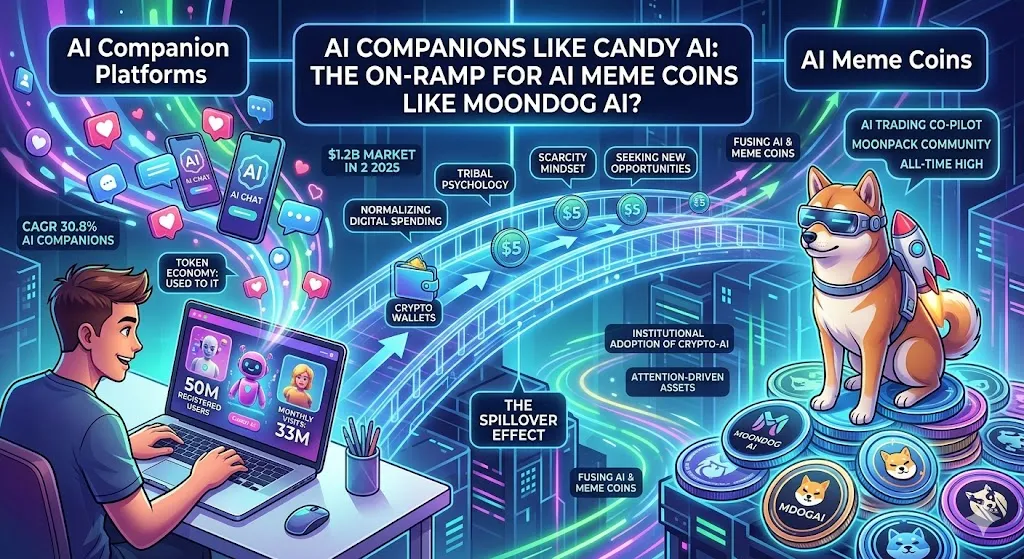
ChadFi functions as an all-in-one cryptocurrency trading hub designed to simplify the market interface. Its core attraction is MoonDog, an AI Trading Co-Pilot that analyzes real-time market data, flags potential trading setups, and provides tailored recommendations. The platform’s objective is to equip market participants with automated tools to help streamline decision-making, optimize profitability, and minimize the time spent manually scanning charts.
This is a meaningful distinction. MoonDog AI’s MDOGAI token isn’t purely a speculative vehicle — it’s connected to a platform where the “AI” component actually does something. The MoonDog trading co-pilot functions as an AI assistant embedded within the ChadFi trading interface, which gives the token at least a plausible utility narrative beyond pure speculation.
The project orchestrates its community engagement under the “MoonPack” banner, emphasizing collective action and shared milestones among its participant base. This community-first branding strategy mirrors what successful consumer AI platforms have learned: people don’t just want a product, they want membership in something. The language of “packs” and shared success deliberately evokes the same tribal psychology that makes AI companion platforms sticky.
The Price History Tells a Story About Attention Cycles
MoonDog AI reached a peak valuation on January 17, 2025, when it was trading at an all-time high of $0.013918. Since then, the token has shed the vast majority of its value, experiencing an intense correction down toward micro-fractional cent levels. That swing — losing nearly all its valuation from its all-time high over a relatively short period — is characteristic of attention-driven assets, and attention-driven assets are especially sensitive to the pipeline we are discussing.
The January 2025 peak coincided with a broader wave of AI enthusiasm in crypto markets, triggered by real-world milestones in AI development and a general narrative shift toward “AI will change everything.” Tokens that could plausibly claim an AI identity surfaced rapidly, caught speculative capital, and then — when the narrative cycle moved on — fell hard.
This pattern reveals the fundamental dynamic at play: AI meme coins like MoonDog AI don’t grow because of product adoption in the traditional sense. They grow when AI as a cultural phenomenon is dominating headlines, and platforms like Candy AI are, paradoxically, part of what keeps AI in headlines. Every time a major outlet runs a piece about AI companion apps — their social implications, their user psychology, their growth numbers — a portion of that media attention rebounds onto the broader AI ecosystem, including AI-branded crypto tokens.
Meme coins are increasingly fusing with AI agents, prediction markets, and PolitiFi volatility. While the sector reached peak euphoria around major political events and high-profile token launches, it subsequently weathered a severe risk-off correction that saw the total meme coin market capitalization bottom out at $35 billion, with daily transaction volumes sliding down to $2.17 billion. However, the asset class remains highly sensitive to shifts in retail sentiment, frequently staging sharp, multi-billion dollar liquidity rebounds that demonstrate how quickly speculative capital can rotate back into viral narratives.
The collapse of 2025’s meme coin cycle is important context. It demonstrates that narrative-driven assets are not immune to macro sentiment — but it also demonstrates that they recover when the narrative returns. And the AI narrative, unlike most crypto-specific narratives, has an external engine keeping it alive: the actual development of AI products that real people use every day.
The Mechanisms of Influence: How Companion Platforms Create Crypto Converts
The influence Candy AI and similar platforms exert on AI crypto markets is not simple or direct. It operates through several distinct channels:
The vocabulary pipeline. Users who spend time in AI companion apps learn to speak fluently about AI capabilities, limitations, and value propositions. They understand what “personalized recommendations,” “real-time analysis,” and “AI-enhanced experiences” actually mean in practice. When an AI meme coin like MoonDog AI deploys that same vocabulary, these users don’t feel like they’re reading marketing copy — they feel like they’re reading about something familiar.
The community overlap. AI companion app users tend to be young, tech-comfortable, and active on the same platforms — Reddit, Discord, X (formerly Twitter) — where crypto communities live. The community Venn diagram between “Candy AI user” and “crypto-curious person” has meaningful overlap, and that overlap creates natural pathways for information about AI tokens to reach receptive audiences.
The trust transfer. When a user has a genuinely good experience with an AI product — when the technology delivers something that feels real, whether it’s a compelling conversation or an impressive image generation — that positive experience creates ambient trust in “AI” as a category. A token that carries the AI brand benefits, however unfairly, from that transferred credibility.
The speculation logic. Perhaps most powerfully: users who have watched Candy AI grow from a niche product to a platform with 50 million registered users have concrete evidence that AI consumer products can scale dramatically. Market data reinforces this perspective, tracking the global AI companion market as it expands from roughly $28 billion to a projected $140.75 billion by 2030, maintaining an aggressive compound annual growth rate of 30.8%. If you believe those growth numbers — and Candy AI’s own trajectory makes them credible — then betting on early-stage AI-branded tokens starts to feel like rational extrapolation, not blind speculation.
| Category | AI Companion Platforms | AI Meme Coins |
|---|---|---|
| Purpose | Emotional interaction & AI experiences | Speculative crypto assets |
| Example | Candy AI | MoonDog AI |
| Revenue Model | Subscriptions, tokens, premium features | Trading, staking, speculation |
| User Behavior | Long-term engagement | Short-term hype cycles |
| Connection to AI | Real AI interaction | Often AI-themed branding |
| Risk Level | Medium (privacy, monetization) | High (volatility, liquidity risk) |
| Market Driver | User retention & AI adoption | Narrative cycles & hype |
The Counter-Argument: AI Products Don’t Guarantee Token Value
This is where intellectual honesty requires pausing on a harder question: does success in the AI consumer product space actually translate to value in AI-branded crypto tokens?
The honest answer is: not necessarily, and often not at all.
The connection between a successful AI platform and the value of an AI meme coin is thematic, not fundamental. Candy AI’s growth doesn’t make MDOGAI tokens more valuable in any direct financial sense. The revenue that Candy AI generates doesn’t flow into MoonDog AI’s ecosystem. These are separate businesses, in separate industries, connected only by a shared adjective.
What consumer AI platform success does do is maintain and amplify the cultural salience of artificial intelligence as a concept. It keeps AI in the conversation. It generates the kind of ambient enthusiasm that, when combined with the volatile, sentiment-driven mechanics of crypto markets, can create significant price movements in AI-branded tokens.
The institutional integration of crypto and AI is accelerating, with close to 300 collaborative web3 and artificial intelligence projects securing venture capital backing. Decentralized finance and AI have decisively shifted from a speculative crossover into a core operational infrastructure. This institutionalization of the crypto-AI category creates a rising tide that even smaller, less-developed tokens can temporarily ride.
The risk, then, is that investors mistake the cultural signal (AI is popular, AI platforms are growing) for a direct value signal (therefore this specific AI token is valuable). These are related but not equivalent. The cultural signal is real. The value connection requires much more scrutiny.
What Makes AI Meme Coins More or Less Viable

Given the framework above, it’s worth asking what actually differentiates AI meme coins that might sustain attention from those that will disappear in the next narrative cycle. Several factors emerge:
Genuine utility versus borrowed vocabulary. Tokens connected to actual AI functionality — even modest functionality — have something to point to when the speculative air goes out of the market. MoonDog AI’s connection to the ChadFi trading platform and its AI co-pilot feature gives it a utility narrative that pure meme tokens lack. The token design promotes near-zero transaction fees alongside staking functionality, which allows participants to secure rewards, unlock trading fee discounts, and engage in platform governance. These mechanics give holders reasons to engage beyond pure price speculation.
Community depth. AI meme coins like Fartcoin and Zerebro pioneer a new meta by utilizing autonomous AI agents that can post content, reply to users, and track viral market reactions in real time. In an environment where market narratives flip within hours, this automated layer helps these projects capture attention and move incredibly fast. The projects that survive brutal narrative cycles are the ones with communities active enough to generate their own cultural content, their own inside jokes, and their own reasons to stay invested far beyond basic price action.
Narrative coherence. The most durable AI meme coins tell a story where the “AI” component and the “meme coin” component reinforce each other, rather than existing in uncomfortable parallel. A token whose AI functionality is genuinely useful to crypto traders, and whose community culture celebrates both the AI and the trading, creates a more stable identity than a dog meme with an AI sticker on it.
Timing relative to narrative cycles. Consumer AI platform milestones — major user growth announcements, new features, media coverage — create windows where the broader AI narrative intensifies. AI meme coins that are well-positioned heading into those windows can capture significant speculative inflows. Timing matters enormously in attention-driven markets.
The Bigger Picture: AI Is Becoming a Consumer Category
Perhaps the most important thing Candy AI and its competitors are demonstrating is that artificial intelligence has successfully crossed from “enterprise technology” to “consumer product.” People are paying for AI experiences the way they pay for streaming services, gaming subscriptions, and social media upgrades.
Candy AI maintains a powerful market hold, capturing over 1.2 million active users—a footprint heavily anchored by specific behavioral trends: 65% of the user base is located in the U.S., while 35% covers international markets. Crucially, 40% of these users fall squarely into the 18-to-24 Gen-Z age bracket. That demographic breakdown — heavily weighted toward a young, tech-native, and digitally connected audience — is essentially a direct description of the core retail crypto investor base. These are not separate populations. They are, to a massive degree, the exact same people.
When you combine a population that is comfortable paying for AI experiences, comfortable with digital token economies, comfortable with speculative risk, and actively engaged with AI tools in their daily lives, you have a natural constituency for AI-branded crypto assets. Candy AI, by building that constituency and keeping it engaged, is indirectly cultivating the market conditions that make tokens like MoonDog AI possible.
This doesn’t mean every user of Candy AI will buy MDOGAI tokens. It doesn’t mean MoonDog AI’s price is correlated with Candy AI’s user growth in any measurable way. What it means is that the cultural infrastructure for AI token interest — the familiarity, the vocabulary, the comfort with digital AI economies — is being built by consumer platforms, and that infrastructure eventually supports speculative markets.
Risk Factors That Neither Side of This Equation Likes to Discuss
Any honest assessment of this pipeline needs to acknowledge the significant risks on both ends.
On the Candy AI side: independent user reviews and security tests highlight ongoing friction points, notably the platform’s heavy monetization system where multimedia features like voice calls and premium generation rapidly drain user tokens, alongside persistent user concerns regarding data handling and conversation privacy in the adult AI space. Privacy concerns and unsustainable monetization models have a history of triggering user backlash that can reverse growth curves rapidly. If a major data privacy incident hits the AI companion space, the ambient trust that flows toward AI-branded tokens could reverse equally fast.
On the MoonDog AI side: recent metrics show the 24-hour trading volume of MoonDog AI (MDOGAI) has trickled down to just $173.00, marking a sharp 83.29% drop in daily activity. A token with this level of trading volume is extremely vulnerable to liquidity problems, price manipulation, and sudden abandonment. The gap between the cultural narrative (“AI is the future”) and the on-chain reality (minimal trading activity, micro market cap) is where retail investors get hurt.
The AI meme coin category as a whole also faces a specific risk that AI consumer platforms don’t: regulatory scrutiny of crypto markets can be sudden and severe, while AI platforms — for now — operate in a relatively permissive regulatory environment. A crypto regulatory event that has nothing to do with AI can crater the prices of AI meme coins while leaving Candy AI’s user growth completely unaffected.
AI Meme Coins Explained: What They Are and Whether They’re Legit
Before diving deeper into the Candy AI crypto connection, it helps to understand what AI meme coins actually are — because the category is more varied than the name suggests, and “are AI meme coins legit” is a question with a genuinely complicated answer. At the most basic level, AI meme coins are cryptocurrency tokens that combine the viral, community-driven energy of meme coins with branding, imagery, or actual functionality tied to artificial intelligence. Some are almost entirely cultural objects — a dog mascot wearing robot glasses, a ticker symbol with “AI” bolted on, and a Telegram group doing the rest of the work. Others make sincere attempts to build AI utility into their ecosystems, using the token to gate access to trading tools, content generation, or autonomous AI agents that interact on-chain.
AI meme coins like Fartcoin and Zerebro add AI agents that can post, reply, and track what people are reacting to in real time — in a market where narratives flip fast, that extra layer helps these projects keep attention and move quickly. The legitimacy question, then, isn’t binary. A token can be speculative and still have real technology behind it. It can have a meme aesthetic and still serve a genuine function. What separates the credible from the cynical is whether the AI component would still make sense if you removed the speculative wrapper — and that test eliminates a large percentage of the category immediately.
What Is MoonDog AI — and Where Does the Candy AI Crypto Connection Come In?

Understanding what MoonDog AI is requires separating the token from the platform it represents. ChadFi is an all-in-one cryptocurrency trading platform designed to simplify and enhance the trading experience, addressing common challenges like information overload, security concerns, and time management by integrating advanced tools and AI-driven insights into a single interface.
Its core feature is MoonDog — an AI Trading Co-Pilot that provides real-time market analysis, identifies high-probability trading setups, and offers personalized trading recommendations. So MDOGAI isn’t simply a mascot with a wallet address; it’s the native token of a platform that uses AI in a context directly relevant to its users — trading decisions. That’s a meaningful distinction in a category full of tokens where the AI branding is purely decorative. The Candy AI crypto connection enters here as a broader cultural argument rather than a direct financial one: both Candy AI and ChadFi are betting that users will pay — in subscription fees, in platform tokens, in trading costs — for AI that makes a specific part of their life feel more manageable, more personalized, and more intelligent.
Candy AI does that for companionship and conversation. ChadFi’s MoonDog does it for market navigation. The audience overlap between people who are comfortable paying for AI-powered consumer experiences and people who are open to holding AI-branded crypto tokens is not coincidental — it reflects a generation that has internalized AI as a utility worth spending on, and that shared psychology is the real thread connecting platforms like Candy AI to tokens like MDOGAI.
Conclusion: The Pipeline Is Real, But It’s Not a Guarantee
Can AI platforms like Candy AI drive interest in AI meme coins like MoonDog AI? The answer is yes — through the indirect mechanisms of cultural familiarity, demographic overlap, vocabulary transfer, and ambient enthusiasm for artificial intelligence as a category. The tens of millions of people building comfort with AI-powered digital economies on consumer platforms like Candy AI represent a real and growing constituency that is more receptive to AI-branded crypto assets than the general population.
But “driving interest” is not the same as “driving value.” Interest in a speculative asset creates price volatility in both directions. The same pipeline that brings new buyers into an AI meme coin in a bull narrative cycle will, when sentiment shifts, produce sellers who feel they were chasing a story rather than an investment.
For investors watching the intersection of AI consumer platforms and crypto markets, the most useful frame is probably this: consumer AI platform success is a leading indicator for AI narrative cycles in crypto, and AI narrative cycles create windows of opportunity in AI-branded tokens — but those windows close. The tokens that survive the window closings are the ones with genuine utility, genuine community, and genuine reasons to exist beyond the moment when “AI” is the hottest word in tech.
MoonDog AI’s AI trading co-pilot represents at least an attempt at genuine utility. Whether that’s enough to make MDOGAI a durable asset rather than a narrative-cycle trade is a question that only time, community development, and the next market cycle will answer.
What Candy AI’s growth makes clear is that the audience for AI-powered digital experiences is enormous, young, and spending real money. Where that audience directs its speculative energy is one of the more interesting questions in consumer finance right now.
Key Takeaways
- AI companion platforms like Candy AI are shaping a new digital economy where users regularly pay for AI-driven experiences and virtual interactions.
- The familiarity users gain from AI apps can make them more open to AI meme coins like MoonDog AI, especially in speculative crypto environments.
- AI meme coins often rely on narrative cycles and community hype, while AI companion apps are driven by real user engagement and subscription models.
- There is no direct financial connection between platforms like Candy AI and tokens like MoonDog AI, but there is a strong cultural and behavioral overlap.
- The “pipeline” from AI apps to crypto investment is driven by shared audiences, vocabulary, and trust in AI-based systems.
- AI narrative trends in tech and media can significantly influence short-term interest in AI-themed crypto assets.
- Despite growing interest, AI meme coins remain high-risk speculative assets with highly volatile performance.
Frequently Asked Questions (FAQ)
Candy AI is a web-based AI companion platform where users interact with customizable AI characters. It operates on a subscription and token-based model that allows users to unlock premium features and enhanced AI interactions.
AI meme coins are cryptocurrency tokens that combine meme-style branding with artificial intelligence themes. Some offer real AI-related tools, while many rely mainly on hype and community-driven speculation.
There is no direct financial or technical connection. However, both exist within the broader AI ecosystem, and user interest in AI companion apps can indirectly increase awareness of AI-themed crypto projects.
Yes, indirectly. AI apps can increase public interest in artificial intelligence, which may boost attention toward AI-branded cryptocurrencies during hype or narrative cycles.
MoonDog AI positions itself as a utility-linked token connected to an AI trading co-pilot system. However, like many AI tokens, it still operates within a highly speculative and narrative-driven market.
This article is for informational and educational purposes only. Nothing here constitutes financial or investment advice. Cryptocurrency investments, including AI meme coins, carry significant risk of loss. Always conduct your own research before making any investment decisions.
About the Author:
Ana Milojevic is a crypto writer and the creator of basedmoondog.com. She writes in-depth guides on Web3, DeFi liquidity, and AI trading technologies, including insights on MoonDog AI. When she isn’t breaking down complex crypto mechanics, she is tracking market trends across decentralized ecosystems.
Leave a Reply