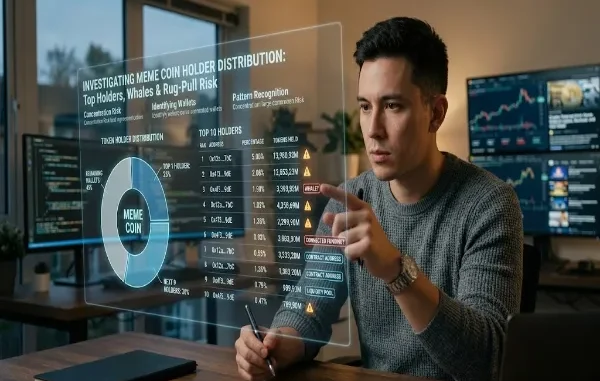
A meme coin can look attractive on a price chart while hiding a very different picture underneath. One of the simplest ways to investigate that picture is to examine the token’s holder distribution.
Holder distribution shows how a token’s supply is divided among wallets. Instead of looking only at price, market capitalization, or trading volume, you can examine how much of the circulating supply is controlled by the largest wallets, whether ownership is concentrated, and whether a small number of addresses could potentially have a significant effect on the market.
A highly concentrated distribution does not automatically mean that a meme coin is a scam. Likewise, a widely distributed token is not automatically safe. Some large addresses may belong to exchanges, liquidity pools, burn addresses, bridges, contracts, or other infrastructure rather than individual investors.
The important point is to understand who holds the tokens, how much they hold, and what those addresses are actually doing.
This guide explains how to read a meme coin’s holder distribution, identify whale concentration, investigate top wallets, understand the limitations of holder rankings, and recognize patterns that may increase rug-pull or market-manipulation risk.
Important: Holder distribution is only one part of crypto due diligence. It should be considered together with the smart contract, liquidity, trading activity, token supply, ownership privileges, and other available information. A holder distribution cannot prove that a token is legitimate or fraudulent by itself.
What Is Meme Coin Holder Distribution?
Holder distribution describes how a token’s supply is distributed across wallets and addresses.
For example, imagine a newly launched meme coin with a total supply of 1 billion tokens.
Suppose the largest addresses hold:
- Wallet 1: 180 million tokens
- Wallet 2: 120 million tokens
- Wallet 3: 80 million tokens
- Wallet 4: 40 million tokens
- Wallet 5: 30 million tokens
- Thousands of smaller wallets: the remaining supply
At first glance, this distribution appears highly concentrated.
The five largest wallets together control:
450 million tokens, or 45% of the total supply.
That does not automatically establish that those wallets are controlled by the project team or that they will sell. But it tells you that a relatively small number of addresses have substantial exposure to the token.
If several of those addresses are controlled by related entities, the effective concentration could be even higher.
This is why looking only at the number of holders can be misleading.
A token might have 20,000 holders, but if the largest few wallets control a large percentage of the supply, ownership may still be highly concentrated.
Why Holder Distribution Matters for Meme Coins
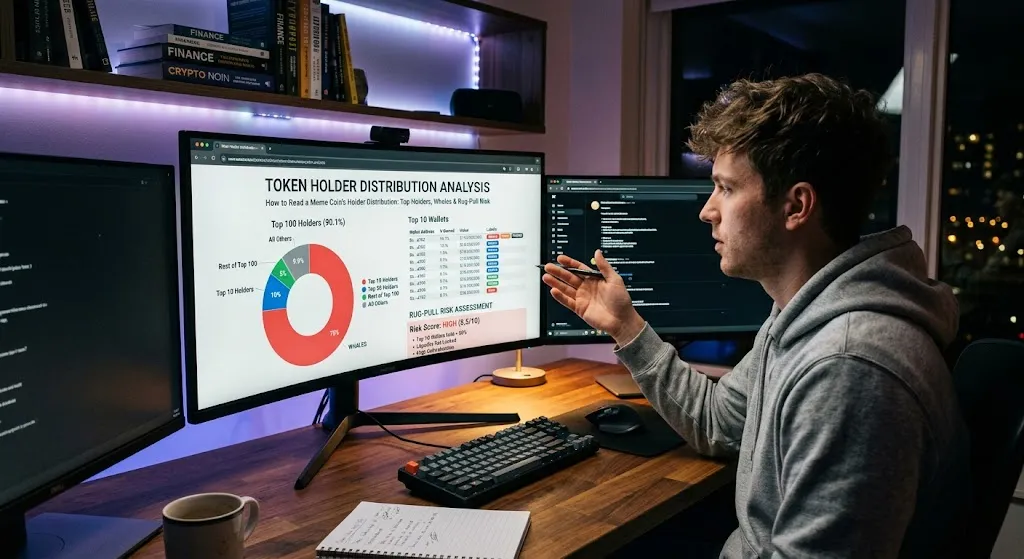
Meme coins can experience large price movements because of relatively small changes in buying and selling activity.
When ownership is heavily concentrated, large holders may have the ability to influence available supply and market liquidity.
For example, if a wallet controls 15% of a token’s supply and suddenly sells a large portion of its holdings, the market may experience significant selling pressure.
The actual effect depends on factors such as:
- available liquidity
- trading volume
- market depth
- the percentage of the wallet’s holdings being sold
- other holders’ behavior
- whether other wallets are controlled by the same entity
- exchange and liquidity-pool activity
Therefore, holder distribution is best viewed as a risk indicator, not a prediction tool.
Holder Count vs. Holder Distribution
These two concepts are different.
Holder count
Holder count tells you approximately how many addresses hold the token.
A project might advertise:
“10,000 holders!”
That sounds impressive, but it does not tell you how the supply is distributed.
Holder distribution
Distribution tells you how much of the supply is held by different addresses.
For example:
10,000 holders
could still mean:
- top wallet: 25%
- second wallet: 15%
- third wallet: 10%
- other large wallets: 20%
- remaining holders: 30%
In that example, the number of holders is large, but ownership remains concentrated.
Therefore, never use holder count alone when researching a meme coin.
What Is a Crypto Whale?
A crypto whale is generally a wallet or entity holding a large amount of a particular cryptocurrency or token.
There is no universal percentage that makes an address a whale.
For one small meme coin, a wallet holding 1% of the supply may be significant.
For another token with a much larger and more liquid market, the same percentage may have a very different practical effect.
The important question is not simply:
“Is this wallet a whale?”
Instead ask:
“How much influence could this wallet have if it moved or sold its holdings?”
That is a much more useful way to interpret holder data.
How to Find the Top Holders
For tokens on Base, Ethereum, and other supported networks, a blockchain explorer can often provide a token-holder list.
For Base tokens, BaseScan can be useful for investigating:
- token holders
- token transfers
- wallet addresses
- contract addresses
- transactions
- contract information
- on-chain activity
Start with the token’s official contract address, rather than searching for the token name alone.
This distinction matters because multiple tokens can have similar or identical names and ticker symbols.
Once you have the correct contract, open the token information and examine the holder distribution.
Step 1: Verify the Correct Token Contract
Before interpreting holder data, confirm that you are looking at the correct token.
A meme coin’s name and ticker are not unique identifiers.
For example, several unrelated tokens could potentially use a similar name such as:
MOON
or
DOGE
or
PEPE
The contract address is what identifies the specific token on the blockchain.
Check the contract address against information provided by the project’s official channels, while remembering that social-media accounts and websites can themselves be compromised or impersonated.
If the address you are analyzing is wrong, everything that follows may also be wrong.
Step 2: Look at the Largest Wallets
Once you have identified the correct token, examine the largest holders.
You might see something like:
| Rank | Address | Percentage |
|---|---|---|
| 1 | Wallet A | 18.4% |
| 2 | Wallet B | 11.2% |
| 3 | Wallet C | 7.8% |
| 4 | Wallet D | 5.1% |
| 5 | Wallet E | 3.7% |
| 6–10 | Various wallets | 9.6% combined |
| Others | Thousands of wallets | 44.2% |
The first question should not be:
“Is this dangerous?”
Instead ask:
“What are these addresses?”
That distinction is extremely important.
Step 3: Identify What the Large Addresses Actually Are
A top holder may not be an individual investor.
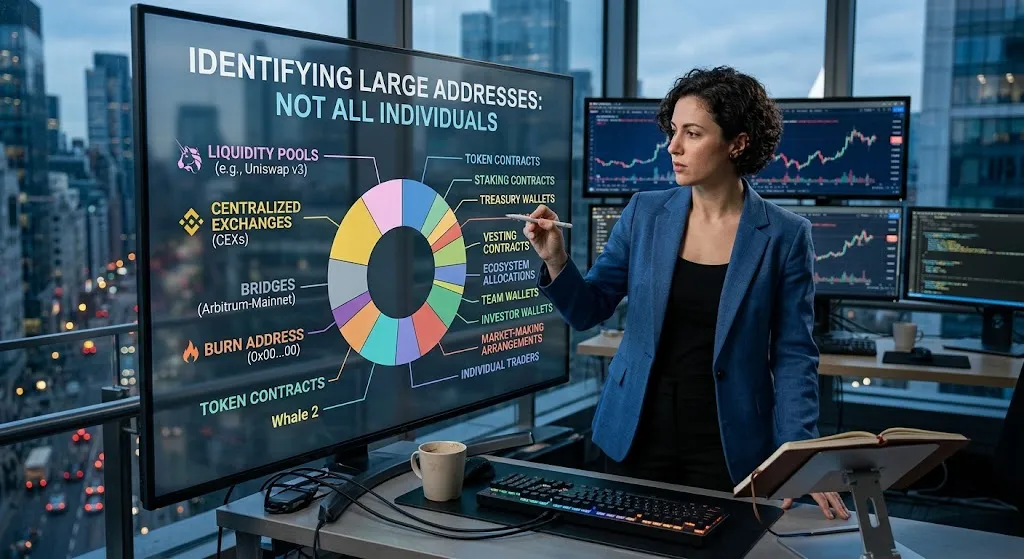
Large addresses can represent:
- liquidity pools
- centralized exchanges
- decentralized exchanges
- bridges
- burn addresses
- token contracts
- staking contracts
- treasury wallets
- vesting contracts
- ecosystem allocations
- team wallets
- investor wallets
- market-making arrangements
- individual traders
Therefore, simply adding the percentages of the top addresses can produce a misleading risk assessment.
For example, suppose a liquidity pool appears as the largest holder with 20% of the token supply.
That does not mean that one person owns 20% of the tokens.
The address may represent tokens deposited into a decentralized exchange liquidity pool.
Similarly, a burn address may contain tokens that are effectively inaccessible.
The identity and function of an address matter.
Step 4: Investigate the Largest Wallets
Click through to the address pages for the largest holders.
Look at:
- transaction history
- token transfers
- funding source
- interactions with exchanges
- interactions with contracts
- transfers to other wallets
- previous buying and selling activity
- whether multiple wallets appear connected
This can reveal information that a simple holder table cannot.
For example, suppose five wallets appear separately in the top 20 holders.
You may discover that all five were funded by the same address shortly before the token launched.
That does not prove that the wallets are controlled by the same person, but it is a reason to investigate the relationship more closely.
What Is Wallet Clustering?
Wallet clustering is the process of examining blockchain activity to determine whether apparently separate addresses may be related.
Suppose a token has:
- Wallet A: 8%
- Wallet B: 7%
- Wallet C: 6%
- Wallet D: 5%
At first glance, those appear to be four separate holders.
But further investigation might show:
Wallet A → Wallet B
Wallet A → Wallet C
Wallet A → Wallet D
or perhaps all four received their initial funding from another common address.
That does not automatically prove common ownership.
Blockchain transactions can have many legitimate explanations.
However, connected funding and coordinated behavior can be important contextual information when evaluating concentration.
Why the Top 10 Holders Can Be More Useful Than the Top Holder
One extremely large wallet deserves attention, but it is often useful to examine the combined concentration of several large addresses.
Imagine two tokens.
Token A
Top holder: 25%
Other top holders: 1–2% each
Token B
Top holder: 8%
Next nine holders: 7%, 7%, 6%, 6%, 5%, 5%, 4%, 4%, 3%
Token A has a very large single holder.
Token B has a much broader concentration among several large wallets.
These situations are structurally different.
For that reason, consider examining:
- top 1 holder
- top 5 holders
- top 10 holders
- top 20 holders
But remember to exclude or separately identify known infrastructure addresses, liquidity pools, burn addresses, bridges, exchanges, and other addresses that may not represent ordinary investor ownership.
Why the Top 10 Holders Can Be More Useful Than the Top Holder
One extremely large wallet deserves attention, but it is often useful to examine the combined concentration of several large addresses.
Imagine two tokens.
Token A
- Top holder: 25%
- Other top holders: 1–2% each
Token B
- Top holder: 8%
- Next nine holders: 7%, 7%, 6%, 6%, 5%, 5%, 4%, 4%, 3%
Token A has a very large single holder.
Token B has a much broader concentration among several large wallets.
These situations are structurally different.
For that reason, consider examining:
- Top 1 holder
- Top 5 holders
- Top 10 holders
- Top 20 holders
But remember to exclude or separately identify known infrastructure addresses, liquidity pools, burn addresses, bridges, exchanges, and other addresses that may not represent ordinary investor ownership.
The purpose is not to find one magic percentage that determines whether a token is safe. Instead, the goal is to understand how ownership is distributed and who controls the largest meaningful positions.
Total Supply vs. Circulating Supply
Another important detail is the difference between total supply and circulating supply.
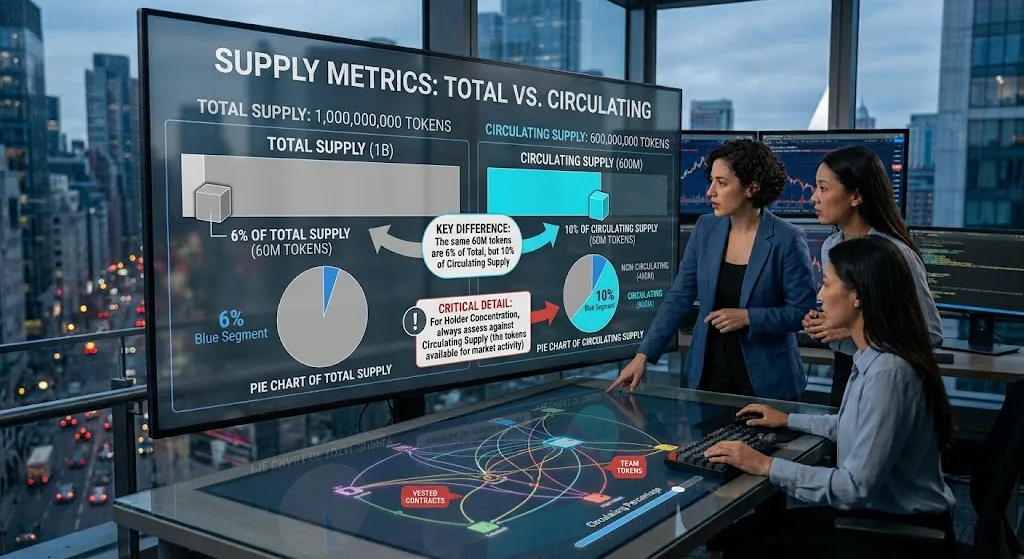
A token may have a total supply of 1 billion tokens, while only 600 million are currently circulating.
If a wallet holds 60 million tokens, that represents:
- 6% of total supply
- 10% of the circulating supply
Those are very different measurements.
When reviewing holder distribution, determine which supply figure the blockchain explorer or project documentation is using.
You should also investigate whether large amounts of tokens are:
- locked
- vested
- held by a treasury
- allocated to a team
- reserved for future development
- held in contracts
- burned
- held in liquidity pools
A percentage by itself does not tell the entire story.
What Is Whale Concentration?
Whale concentration describes how much of a token’s supply is controlled by a relatively small number of large addresses.
There is no universal percentage at which a token suddenly becomes dangerous.
A high concentration can create a potential risk because large holders may have the ability to sell substantial amounts of tokens. However, the significance depends on who owns the wallets, whether the wallets are connected, the liquidity available, and how those wallets behave.
For example, ten unrelated investors holding significant positions can represent a different situation from ten wallets that appear to be controlled by the same entity.
That is why wallet identification and transaction history matter.
Signs of High Concentration Worth Investigating
A high concentration does not automatically mean a token is fraudulent. It means that additional research may be appropriate.
Pay particular attention when:
- one wallet controls a very large percentage of the supply
- several large wallets received tokens from the same source
- multiple wallets were funded by the same address
- several large wallets purchased at approximately the same time
- wallets transfer tokens between one another
- large holders appear to be connected to deployer or team wallets
- significant amounts of tokens can be moved quickly
- liquidity is relatively small compared with large holder balances
- large holders begin transferring tokens to exchanges
- ownership appears concentrated despite a high reported holder count
These observations should be treated as investigation signals, not proof of wrongdoing.
What Is a Rug Pull?
A rug pull is a type of crypto scam or harmful project behavior in which participants lose access to expected value because people controlling important project assets take actions that severely damage or effectively abandon the market.
Different rug-pull structures can involve different mechanisms.
For example, a project may involve:
- removal of liquidity
- large insider token sales
- hidden token privileges
- manipulation of supply
- deceptive project representations
- coordinated selling by connected wallets
Holder distribution can sometimes provide an early clue about where significant token ownership is concentrated, but it cannot establish that a rug pull will occur.
That distinction is important.
How Holder Distribution Can Relate to Rug-Pull Risk
Suppose a newly launched meme coin has 20,000 reported holders.
At first glance, that may appear to indicate broad ownership.
However, imagine that further investigation shows that:
- several wallets hold unusually large positions
- those wallets were funded from the same source
- the wallets received tokens around the same time
- they interact with related addresses
- liquidity is relatively small
- the largest holders can sell significant amounts without warning
The holder count alone would not reveal this structure.
This is why holder count and holder distribution should be analyzed separately.
A large number of holders does not necessarily mean that ownership is widely distributed.
A Simple Holder-Concentration Example
Consider a hypothetical token with 100 million tokens in circulation.
Suppose the largest meaningful wallets hold:
| Wallet | Tokens | Percentage |
|---|---|---|
| Wallet A | 12 million | 12% |
| Wallet B | 8 million | 8% |
| Wallet C | 6 million | 6% |
| Wallet D | 5 million | 5% |
| Wallet E | 4 million | 4% |
The top five wallets collectively hold 35% of the circulating supply.
That number deserves investigation.
But the next question is more important:
Who are these wallets?
If Wallet A is a liquidity pool, Wallet B is a burn address, and Wallet C belongs to a centralized exchange, the economic meaning of the 35% concentration is different.
On the other hand, if all five wallets appear to be controlled by the same project-related entity, the concentration may deserve substantially more attention.
The calculation is only the beginning of the analysis.
Look at Wallet Behavior, Not Just Balances
A wallet balance is a snapshot.
Transaction history provides a much more useful picture of how an address behaves over time.
When investigating a large holder, look at:
- when the wallet received the tokens
- where the tokens came from
- whether the wallet bought or received them
- whether it has transferred tokens to other wallets
- whether it has sold tokens
- whether it repeatedly interacts with the same addresses
- whether it sends assets to exchanges
- whether its balance changes suddenly
A wallet holding 10% of a token today may have a completely different significance from a wallet that has held the same position for months.
Similarly, a wallet that suddenly receives millions of tokens immediately before selling them deserves closer examination than an address with a long and transparent history.
Why Liquidity Matters
Holder distribution should never be analyzed in isolation from liquidity.
Imagine that large wallets collectively hold $500,000 worth of a token, while the available liquidity is only $50,000.
A relatively small portion of those holdings could represent a substantial amount compared with the available liquidity.
This does not mean the holders will sell.
It means that their potential market impact could be significant.
For this reason, when reviewing a meme coin, compare:
Large-holder balances + available liquidity + trading volume
rather than looking at holder percentages alone.
For more background, see What Is Crypto Liquidity? A Beginner’s Guide to Liquidity Pools, Trading Volume, and Liquidity Risk.
Holder Distribution and Market Capitalization
Market capitalization can also create misleading impressions.
A token may appear to have a large market capitalization because its token price is multiplied by a large supply figure.
But market capitalization does not tell you how evenly the tokens are distributed.
Two tokens could have similar market capitalizations while having completely different ownership structures.
One might have thousands of relatively small holders.
Another might have a small group of addresses controlling a substantial percentage of the supply.
Therefore, market capitalization should be considered alongside:
- circulating supply
- total supply
- liquidity
- trading volume
- holder distribution
- wallet concentration
- token unlocks
- contract permissions
Do Not Automatically Treat the Largest Holder as the Team
A common mistake is to look at the first wallet on a holder list and immediately assume:
“This must be the developer.”
That may be completely wrong.
The largest address could be:
- a liquidity pool
- a burn address
- a centralized exchange
- a bridge
- a staking contract
- a treasury
- a vesting contract
- a market-making address
- another protocol-related contract
The blockchain explorer may provide labels that help identify some addresses, but labels should still be interpreted carefully.
Always examine the address itself and its transaction history before assigning ownership.
Do Not Automatically Treat a Large Holder Count as Safety
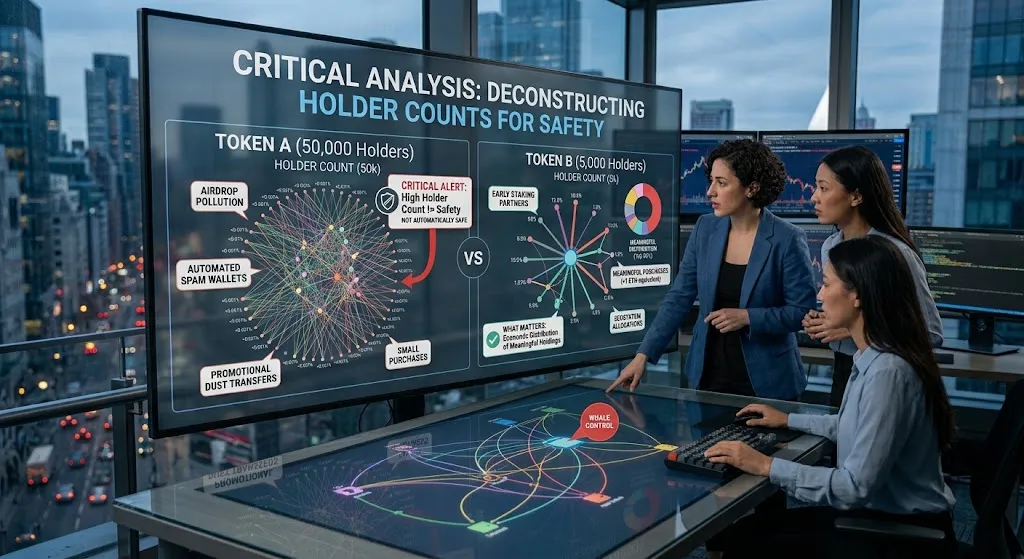
The opposite mistake is also possible.
A token with 50,000 holders is not automatically safer than a token with 5,000 holders.
Holder counts can grow through:
- airdrops
- small purchases
- transfers
- promotional campaigns
- automated activity
- wallet distribution strategies
What matters is the economic distribution of meaningful holdings.
A token with thousands of wallets holding tiny amounts can still have a substantial percentage of its supply concentrated among a relatively small number of addresses.
Check for Possible Sybil-Like Distribution Patterns
Sometimes a project may appear to have many independent holders while the wallets have relationships that deserve investigation.
For example, you may notice:
- many wallets funded by one address
- similar transaction timing
- repeated transfers between the same addresses
- identical funding patterns
- coordinated token movements
- clusters of wallets receiving tokens from a common source
This does not automatically prove that the wallets are controlled by one person.
There can be legitimate explanations for related wallet activity.
However, a strong relationship between supposedly independent large holders is a reason to investigate further.
Airdrop Recipients and Holder Distribution
Airdrops can dramatically increase the number of token holders.
For example, a project might distribute tokens to thousands of wallets.
The holder count can therefore increase rapidly even though most recipients hold only a very small amount.
This is why it can be useful to examine the distribution of balances rather than focusing only on the total number of holders.
Ask:
- How many wallets hold meaningful amounts?
- How much does the median holder own?
- How much do the largest wallets control?
- Did many wallets receive tokens from the same distribution contract?
- Are recipients actively holding or immediately selling?
Again, these observations provide context rather than a definitive judgment about the project.
A Practical Meme Coin Holder-Distribution Checklist
Before trading a meme coin, you can use the following checklist.
1. Confirm the contract
Make sure you are analyzing the correct token contract.
2. Open the holder list
Look at the largest addresses and their percentages.
3. Identify special addresses
Separate:
- liquidity pools
- burn addresses
- exchanges
- bridges
- contracts
- treasury wallets
from ordinary holders where possible.
4. Calculate concentration
Look at:
- top 1
- top 5
- top 10
- top 20
meaningful holders.
5. Investigate connections
Check whether large wallets appear to share funding sources or transaction patterns.
6. Review transaction history
Determine whether large holders are accumulating, distributing, transferring, or selling.
7. Compare holdings with liquidity
A large wallet becomes more important when its potential selling capacity is large relative to available liquidity.
8. Check contract risks
Holder distribution is only one part of due diligence.
Also examine the token contract for potentially dangerous permissions and trading restrictions.
For a step-by-step contract review, see How to Check a Token Contract Before Buying a Meme Coin: A Step-by-Step Guide.
9. Check for honeypot characteristics
A token may have apparently healthy holder distribution while still having restrictions that prevent ordinary holders from selling.
See What Is a Honeypot Token? How to Detect a Crypto Honeypot.
10. Keep the analysis in context
No single metric proves that a token is safe or unsafe.
A Simple Research Table
You can organize your findings in a table like this:
| Metric | What to Check | Why It Matters |
|---|---|---|
| Top holder | Percentage held | Shows largest individual concentration |
| Top 5 | Combined percentage | Shows broader concentration |
| Top 10 | Combined percentage | Shows concentration among major holders |
| Top 20 | Combined percentage | Provides a wider ownership picture |
| Holder count | Number of addresses | Shows the size of the holder base |
| Liquidity | Available trading liquidity | Helps assess potential market impact |
| Trading volume | Recent activity | Shows how actively the token trades |
| Wallet funding | Source of funds | May reveal relationships between addresses |
| Transaction history | Transfers and sales | Shows holder behavior |
| Contract permissions | Administrative controls | Identifies additional technical risks |
The goal is not to produce a single numerical safety score.
The goal is to build a more complete picture.
A Hypothetical Risk Investigation
Imagine you discover a meme coin with:
- 12,000 holders
- one wallet holding 14%
- the next nine wallets holding another 28%
- relatively low liquidity
- several large wallets funded by the same address
That information does not prove that the project is a scam.
But it gives you several questions to investigate.
You could examine:
- Who controls the 14% wallet?
- Are the next nine wallets genuinely independent?
- Where did those wallets receive their funds?
- Is the largest wallet connected to the deployer?
- How much liquidity is available?
- Have any of the large wallets already sold?
- Are tokens locked or subject to vesting?
- Can the token contract change important parameters?
- Are there unusual transfers between major holders?
- Does the apparent holder distribution match the project’s public claims?
This approach is much more informative than simply seeing “12,000 holders” and assuming the token is broadly distributed.
Five Questions to Ask Before Trading
When reviewing a meme coin’s holder distribution, ask:
Question 1: Who owns the largest wallets?
Do not stop at the percentages. Identify what the addresses actually represent.
Question 2: How concentrated are the top holders?
Review top 1, top 5, top 10, and top 20 meaningful addresses.
Question 3: Are the large wallets independent?
Look for shared funding sources and related transaction patterns.
Question 4: How large is liquidity compared with major holdings?
A concentrated token with limited liquidity may have greater potential sensitivity to large transactions.
Question 5: What does the rest of the due diligence show?
Combine holder distribution with contract analysis, liquidity, trading activity, tokenomics, and wallet behavior.
How Holder Distribution Fits Into Complete Meme Coin Due Diligence
Holder distribution is one part of a larger research process.
A more complete analysis can include:
Contract
Check whether the smart contract contains unusual permissions, restrictions, or administrative controls.
Liquidity
Determine how much liquidity is available and whether liquidity arrangements have been disclosed or locked.
Tokenomics
Review the token’s total supply, circulating supply, distribution, allocation, vesting schedules, and any planned future token releases.
A token may appear widely distributed today while a significant amount of the supply remains controlled by the project, treasury, team, or other large wallets.
Also check whether additional tokens can be created or released in the future, as changes in supply can affect the overall ownership structure.
Holder Distribution
Analyze how the circulating supply is distributed among wallets.
Look beyond the largest holder and examine the top 5, top 10, and top 20 meaningful holders.
Try to determine whether large addresses represent independent investors or whether several wallets may be connected.
Wallet Activity
Review the transaction history of major holders.
Look for significant transfers, large deposits, sales, or movements between related addresses.
A wallet’s current balance is only a snapshot. Its transaction history can provide additional context about how that balance was accumulated and how it has changed over time.
Trading Activity
Look at trading volume and transaction activity in relation to the token’s liquidity and market capitalization.
A token with substantial reported trading volume but relatively limited liquidity may require closer examination.
Also consider whether trading activity is consistent over time or concentrated around particular events.
Project Information
Review the project’s website, documentation, stated purpose, development activity, and public information.
Compare what the project says about token distribution with what is actually visible on-chain.
If the public description suggests broad ownership but a small number of connected wallets control a substantial portion of the supply, that difference is worth investigating.
Contract Security
Check whether the smart contract contains functions that could materially affect holders or trading.
Depending on the token, this can include functions related to:
- minting
- burning
- pausing
- blacklisting
- transfer restrictions
- transaction limits
- fees
- ownership
- administrative permissions
The existence of a particular function does not automatically mean that a token is unsafe. The important question is how the function works, who can use it, and whether its permissions are clearly disclosed.
Liquidity and Liquidity Control
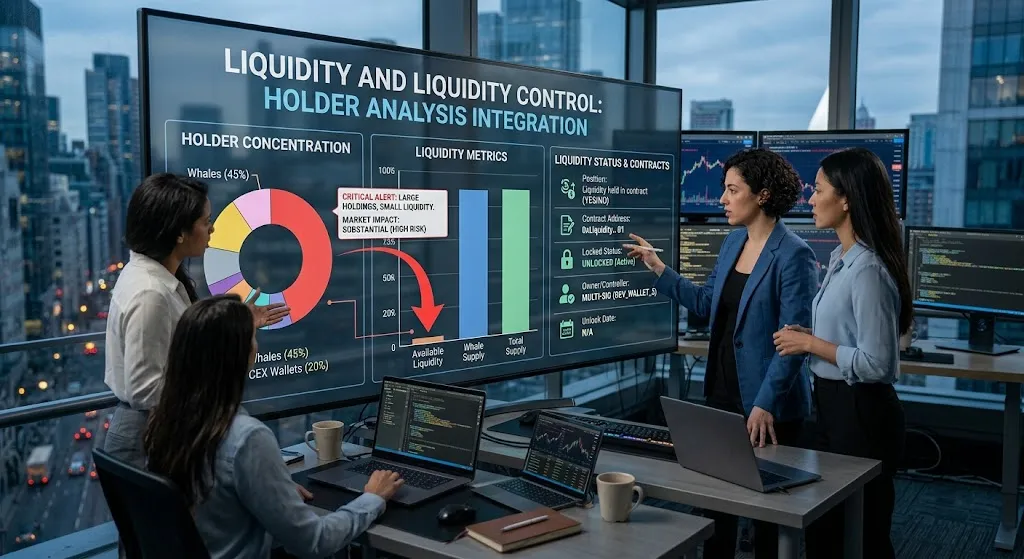
Liquidity deserves particular attention when analyzing holder concentration.
If a few wallets control a large percentage of the supply while available liquidity is relatively small, large transactions could potentially have a substantial effect on the market.
Also determine whether liquidity is held in a contract, whether it is locked, and who controls the relevant liquidity position.
Liquidity information should be considered together with holder distribution rather than separately.
Connections Between Major Addresses
One of the most useful parts of on-chain research is examining relationships between large wallets.
For example, several wallets may appear separate in the holder list but may share:
- the same funding source
- similar transaction timing
- repeated transfers
- common intermediary addresses
- interactions with the same project wallets
These patterns do not automatically prove common ownership.
However, they can provide useful information for further investigation.
A Practical Due-Diligence Sequence
A simple research process can look like this:
Step 1: Verify the token contract.
Step 2: Check the total and circulating supply.
Step 3: Open the holder distribution.
Step 4: Identify the largest meaningful wallets.
Step 5: Separate infrastructure addresses from ordinary holders.
Step 6: Examine the top 5, top 10, and top 20 holders.
Step 7: Investigate connections between major wallets.
Step 8: Review the transaction history of important addresses.
Step 9: Check liquidity and trading activity.
Step 10: Review the contract’s permissions and restrictions.
Step 11: Compare the on-chain information with the project’s public claims.
This process does not guarantee that you will identify every risk.
Blockchain data can be incomplete or difficult to interpret, and wallet ownership is not always publicly known.
However, it can provide a much clearer picture than relying only on price, market capitalization, or the number of token holders.
Final Thoughts
Meme coin holder distribution is one of the useful pieces of information available when researching a token.
The important point is to look beyond the headline holder count.
A token can have thousands of holders while a relatively small number of addresses control a significant percentage of its supply. Conversely, a large holder may represent a liquidity pool, exchange, contract, or another address that should not be treated as an ordinary investor.
That is why the most useful analysis combines holder distribution, wallet behavior, liquidity, tokenomics, and contract information.
Before trading a meme coin, take the time to identify who controls the largest meaningful positions and understand how those wallets acquired and move their tokens.
Holder distribution cannot tell you with certainty what will happen to a token’s price or whether a project will succeed. It is a research tool that can help you understand the structure of token ownership and identify areas that deserve further investigation.
Always verify the token contract and conduct your own research before trading. Meme coins are highly speculative digital assets, and you can lose some or all of the money you invest. This article is for educational purposes only and is not financial or investment advice.
Leave a Reply